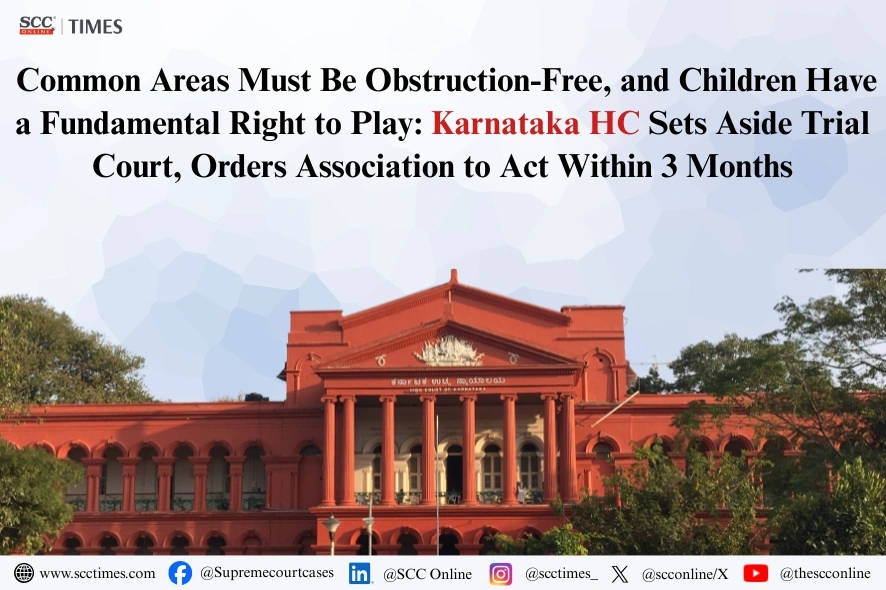
Karnataka High Court: The Single Judge Bench of Hanchate Sanjeevkumar, J., held that common areas of the apartment must remain obstruction-free, affecting safe movement. The Court held that it is a fundamental right of the children to play and prohibiting them takes away their overall health. The restrictions on children’s recreation require reasonable justification. The Court ordered removal of the flower pots and directed the association for a reconsideration of the playground policy.
The Court observed that,
“Playing games is a fundamental right of the children and prohibiting the children from playing, takes away their overall health.”
Background
The plaintiffs, were residents of Esteem Gardenia Apartment in Sahakara Nagar, Bengaluru. They regularly paid maintenance charges and complied with the bye-laws of the Apartment Owners Association (Association). The Association had framed bye-laws governing the conduct of residents. These bye-laws prohibited residents from placing furniture, packages, vehicles, and other articles in common areas such as corridors, stairways, and lobbies. They also required that no obstruction should interfere with the free movement of residents through common passages. Although certain aesthetic objects could be placed in common areas, any dispute regarding such objects was to be decided by the Board of the Association.
Despite these provisions, flower pots were placed on the common stairways. The plaintiffs submitted that watering these pots caused water to spread across the stairs, making them slippery and hazardous. On 29 August 2012, while descending from the terrace to the third floor, Plaintiff 1 slipped on the wet stairway and sustained serious fractures. He underwent multiple surgeries and had to spend a huge amount for medical treatment.
Following the accident, the flower pots were temporarily removed but were subsequently placed back on the stairways. The plaintiffs repeatedly requested the Association to remove the pots permanently, contending that they posed a continuing danger to residents. Legal notices were also issued, but the Association allegedly failed to act.
The Association denied liability. It submitted that after the institution of the suit, the pots had already been removed. The Association asserted that restrictions on football and certain other games had been imposed after receiving complaints from residents. It maintained that only games suitable for the available space were permitted, although it did not specify which games were allowed or prohibited.
The trial court ruled that suit area was common area meant for use and occupation of the suit apartment residents but the plaintiffs failed to prove that defendant has illegally kept pots at stairways of suit apartment and causing inconvenience to them. Hence, dismissed the suit.
Being aggrieved by the judgment and decree passed by the trial court, the appellants-plaintiffs filed an appeal on various grounds and argued that the stairway was a common area for all the users and owners of the flats in the apartment. The pots caused obstruction to the free movement of any of the owners of the flats, which infringes the civil rights of the plaintiffs. The plaintiff has also suffered serious injuries from the slippery stairs caused due to watering the pots. He contended that the trial court has dismissed the suit without considering these grounds.
The appellant further submitted that the defendant-association has prohibited children from playing, without any reasonable grounds, therefore, such a restriction imposed by the defendant-association is a violation of child rights. The action of the defendant-association in this regard was highly illegal and arbitrary, which was not properly considered by the trial court.
Issues
-
Whether the stairways and disputed areas constituted common areas intended for use by all apartment owners.
-
Whether the Association had justified the placement of flower pots under its bye-laws.
-
Whether the Association’s prohibition on children’s physical games in the playground was legally sustainable.
Decision and Analysis
The Court observed that the stairways were the common area and if the act of the defendant causes obstruction and infringes the right of free movement of the plaintiffs, then certainly the pots should be removed. The trial court had not considered this aspect in a practical way.
The Court held that there was no averment in the written statement of the defendant were vague in nature and without giving any clarification as to which games are allowed to be played by the children and which are not. Prohibiting the children from playing games in the play area was without reasonable justification. Playing games is a fundamental right of children and prohibiting them takes away their overall health. The Court directed that the defendant-association to reconsider its decision, specify the games to be played in the play area after taking confidence of the members of the association.
The Court allowed the appeal and set aside the judgment and order by the trial court. It decreed the suit by issuing a mandatory injunction directing the Association to remove all flower pots placed on stairways and other common areas. A perpetual injunction was also granted restraining the Association from placing any pots or other materials in stairways and corridors meant for common use.
Additionally, the Court directed the Association to convene a General Body Meeting within 3 months and reconsider its policy governing children’s games in the playground. The Association was required to specify clearly which games would be permitted and which would not, ensuring that children were not deprived of reasonable opportunities for recreation.
[Sangeetha Agarwal v. Esteem Gardenia Apartment Owners Assn., 2026 SCC OnLine Kar 7971, decided on 16-6-2026]
*Judgment authored by: Justice Hanchate Sanjeevkumar
Advocates who appeared in this case:
For the Appellants: B S Jeevan Kumar., Advocate