Disclaimer: This has been reported after the availability of the order of the Court and not on media reports so as to give an accurate report to our readers.
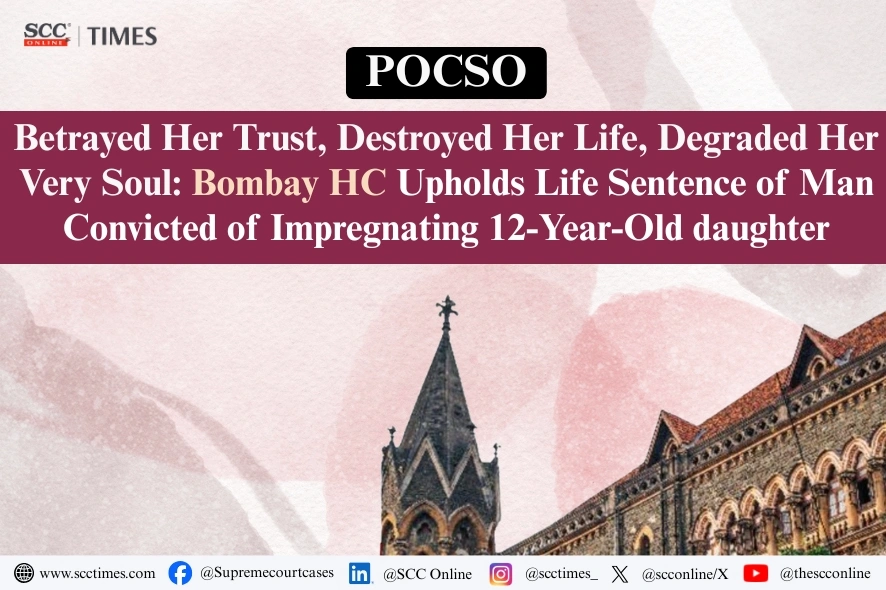
Bombay High Court: In an appeal challenging the sentence for sexually assault of a minor daughter by her father, the Division Bench of Urmila Joshi Phalke* and Nivedita P. Mehta, JJ., held that the victim, who was a minor at the time of the incident, was subjected to forceful sexual assault by her father and the DNA report established the facts; thus, no reason found to interfere with the impugned judgment or the sentence.
The Cour observed that,
“There can never be more shocking heinous crime when a father is charged for committing sexual assault on his own daughter.”
Background
The case arose from a report lodged by an ASHA worker after she noticed that the victim, a 12-year-old girl, appeared to have an unusually enlarged abdomen during a household survey. Suspecting pregnancy, the ASHA worker took the victim for medical examination, where she was found to be approximately 27 weeks pregnant. When questioned about the sexual intercourse, she declined to say anything and disclosed that she does not remember anything. Consequently, an FIR was registered against an unknown person.
During the investigation, the police identified the victim’s father as the accused. Following the victim’s delivery, DNA samples of the victim, the newborn child and the accused were collected for forensic examination. The DNA report established that the accused and the victim were the biological parents of the child born to the victim. Upon completion of the investigation, a charge-sheet was filed against the accused, who pleaded not guilty, and the trial commenced.
After appreciating all the evidence, the trial court held the accused guilty and convicted of the offence punishable under Section 6, Protection of Children from Sexual Offences Act, 2012 and Sections 376, 376-AB, 376(2)(f), (k) and (n), Penal Code, 1860.
Aggrieved and dissatisfied with the same, the convict-appellant preferred the present appeal on the ground that the trial court convicted him merely based on the DNA report. He alleged that there was no evidence as to the proper custody of samples, and there was a possibility of tampering with all the samples during the investigation.
Contentions of the parties
The appellant contended that the victim had falsely implicated him because he used to reprimand her for roaming around the village without informing him. He argued that the Victim did not make any grievance against him, and that the appellant had been arrested merely on suspicion.
The appellant further challenged the reliability of the DNA report, contending that neither his samples were properly obtained nor had the prescribed guidelines for the collection of DNA samples been followed.
It was also submitted that the informant was not examined by the prosecution and that the victim’s sister, a material witness, had not supported the prosecution’s case. Therefore, the appellant sought the benefit of the doubt.
The State submitted that the victim’s pregnancy first came to light when the ASHA worker noticed her enlarged abdomen; however, the Victim had not disclosed anything to her. Subsequently, on lodging of the FIR and during the investigation, the victim disclosed that her father had repeatedly subjected her to forceful sexual assault, resulting in her pregnancy and the birth of a child.
It was further contended that the DNA report conclusively corroborated the prosecution’s case and that the prosecution had established an unbroken chain of collection and forwarding of the DNA samples, ruling out any possibility of tampering. The State further submitted that the evidence of medical witnesses, the carrier and the chemical analyser completes the chain, and thus, the contentions of the appellant are unsustainable.
Analysis and Findings
Age of the victim
The Court noted that to prove the age of the victim, the prosecution relied on the statement of the victim, who disclosed her date of birth. The age of the victim was not challenged by the defence during cross-examination. The prosecution also relied on the birth certificate of the victim provided by the Head of the Birth and Death Department in Chandrapur Municipal Corporation, which reflected the same date of birth as the victim disclosed. Moreover, the accused father’s statement corroborated the disclosed date of birth, and no contrary evidence was brought on record to disprove the same.
Law on the admissibility of birth certificates
The Court reiterated that a birth certificate issued under the Registration of Births and Deaths Act, 1969, is a statutory public document and constitutes reliable evidence of the date of birth. The Court further observed that under Rule 9, Maharashtra Registration of Births and Deaths Rules, 1976, the birth certificate is issued by the Sub-Registrar under the provisions of the Registration of Births and Deaths Act, 1969.
The Court held that the Registrar is statutorily required to maintain records of births and deaths and that a birth certificate issued under Sections 12 and 17 of the Act is an extract of the Birth Register. Referring to Sections 35, 74 and 77, Evidence Act, 1872, the Court held that such a certificate is a public document, constitutes primary evidence and is admissible to prove the date of birth of the victim.
Accordingly, the Court, considering the evidence on record, held that the prosecution succeeded in proving that the victim was below 18 years of age, i.e. 12 years at the time of the incident.
Aspect of sexual assault on the victim
The Court moved to examine the aspect of sexual assault on the victim by her father. The Court noted that the prosecution primarily relied on the evidence of the victim, wherein she described the sexual assault by the accused.
The prosecution further relied upon the evidence of the village Sarpanch, who deposed that the ASHA worker had informed her that the victim, aged about 12—13 years, was approximately 27 weeks pregnant and that the victim’s father was unwilling to lodge a report. She stated that although she personally enquired with the victim, the latter did not disclose anything. She further deposed that during the inquiry conducted by the Child Welfare Committee, it emerged that the accused was the biological father of the child delivered by the victim. The Court noted that nothing material was elicited in her cross-examination to discredit her testimony.
The Court held that the prosecution had established the charge not only through the testimony of the victim but also through the corroborative oral, medical and forensic evidence. The Court observed that although the ASHA worker, who first suspected the victim’s pregnancy, was not examined, the evidence of the Village Sarpanch established that the ASHA worker had informed her about the victim’s condition, and the victim’s father was unwilling to lodge a report. The Court further noted that the medical evidence independently established that the victim, a minor, was pregnant and had subsequently delivered a child.
False implication of the accused
Addressing the defence contention that the victim had falsely implicated the accused to obtain compensation, the Court observed that the victim had initially not disclosed the identity of the perpetrator to the ASHA worker, the police or the Child Welfare Committee. However, during her evidence, she denied the suggestion that she had named her father at the instance of the police or the Child Welfare Committee. She also denied that she had implicated the accused to receive compensation. The Court held that the defence had failed to substantiate its theory of false implication.
Challenge to DNA evidence
The Court further rejected the challenge to the DNA evidence. It held that the prosecution had proved the collection, custody and forwarding of the DNA samples of the victim, the newborn child and the accused through cogent evidence, and that nothing had been elicited in cross-examination to indicate any possibility of tampering. The DNA report conclusively established that the accused and the victim were the biological parents of the child born to the victim. The Court held that the forensic evidence fully corroborated the victim’s testimony and the prosecution’s case.
The Court referred to Kattavellai v. State of T.N., 2025 SCC OnLine SC 1439, wherein the Supreme Court had laid down guidelines governing the collection, documentation, transportation, storage and preservation of DNA samples to ensure an unbroken chain of custody and eliminate the possibility of tampering.
Applying the aforesaid principles, the Court held that the prosecution had established an unbroken chain of custody of the DNA samples. It noted that the acknowledgement receipts and forwarding documents contained the FIR number, date, investigating officer’s details, police station, description of the parcel, carrier’s details and the particulars of the officer receiving the samples. The Court further observed that the forensic laboratory had received the samples in sealed condition and that the medical evidence proved that the samples were duly collected, sealed and handed over to the police for onward transmission.
The Court noted that the DNA samples of the accused were collected and forwarded to the forensic laboratory on the very same day, and the identification forms and related records corroborated the procedure adopted by the investigating agency. The Court held that the prosecution had satisfactorily established the seizure, custody and forwarding of the samples to the forensic laboratory, leaving no scope for tampering.
The Court further observed that the forensic expert had analysed the samples using the prescribed DNA profiling methodology and concluded that the accused and the victim were the biological parents of the child born to the victim. Relying on the DNA report, the Court held that the forensic evidence conclusively corroborated the prosecution case and established the paternity of the child.
Conclusion
The Court summarised the undisputed facts as follows:
-
victim was 12 years of age at the time of the incident;
-
accused is her father, and she had lost her mother before the incident;
-
accused has subjected her to forceful sexual assault; and
-
DNA report establishes the facts.
The Court stated that the evidence revealed that a 12-year-old girl was subjected to sexual assault by the accused, who is her father. The Court held that,
“Undisputedly, the prosecution has established the fact that the Victim has delivered the male child and the DNA report discloses that the Victim and the accused are the biological parents of that child delivered by her.”
The Court, being sensitive to the circumstances, noted that the victim’s admissions had to be appreciated in light of her being only 12 years old, without any support, and thus did not report the incident.
“The evidence shows that, the trust which a child carries about his or her father itself is betrayed by the accused. The accused who was protector has ruined the physic as well as state of mind of the Victim who is his own daughter and destroyed her future life. He had degraded the very soul of helpless girl.”
The Court observed that the prosecution case revolved around the testimony of the victim and the DNA evidence.
“It is well settled law that, man can speak lie but not the circumstances. The circumstances like the Victim has carried the pregnancy and on collection of the samples and analysing the same it revealed that the Victim and the accused are the biological parents of the child delivered by the Victim.”
The Court further observed that DNA testing is now a predominant forensic technique used for identifying offenders where biological tissues are available. The Court noted that DNA testing on samples such as saliva, skin, blood, hair or semen not only helps to convict but also serves to exonerate an accused. The Court observed that DNA testing makes it possible to obtain conclusive results and that the DNA report is capable of both inculpating and exculpating an accused.
The Court held that the prosecution had established an unbroken chain of custody of the DNA samples. The Court stated that the evidence of the medical officers, the forensic expert and the investigating officers established that the samples of the accused, the victim and the child were duly collected, sealed and immediately forwarded for forensic examination. The Court further noted that the defence had failed to bring any material on record suggesting any possibility of tampering with the samples. Relying on the DNA report, the Court held that the accused was the biological father of the child born to the victim.
The Court concluded that the prosecution had proved the involvement of the accused beyond a reasonable doubt. The Court stated that the victim was entitled to live free from fear, threat and violence and that the trial court had rightly convicted the accused and sentenced him to imprisonment for life, having regard to the gravity of the offence. The Court further observed that sentencing must adhere to the doctrine of proportionality by balancing the objectives of deterrence and reformation while ensuring that the victim’s rights and suffering are duly recognised.
Accordingly, the Court found no infirmity in the conviction or the sentence, and declined to interfere with the impugned judgment in the appeal or with the quantum of sentence.
[Bandu Vishwanath Matte v. State of Maharashtra, 2026 SCC OnLine Bom 6366, decided on 15-7-2026]
*Justice Urmila Joshi Phalke authored this judgment.
Advocates who appeared in this case:
For the appellant: K.G. Rathi, Advocate
For the respondent: Shamsi Haider, APP