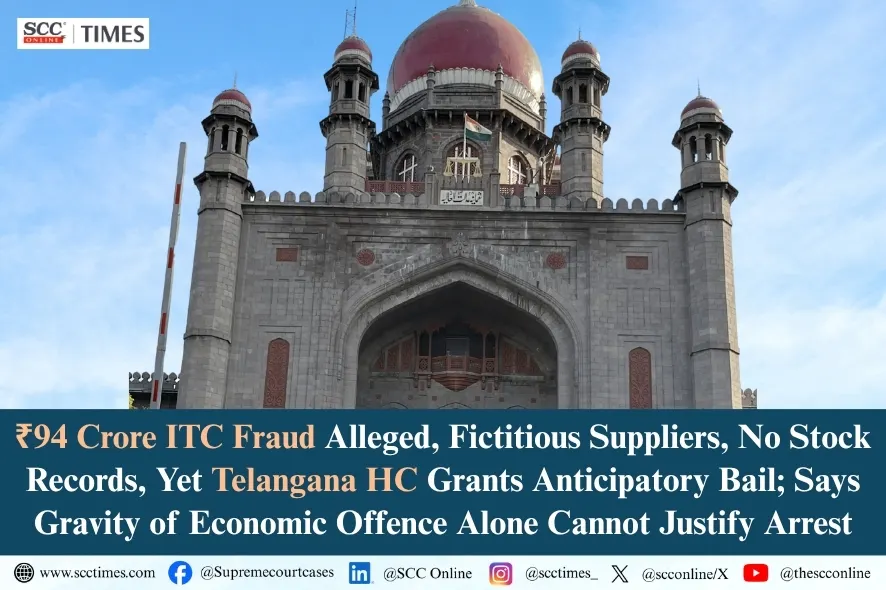
Telangana High Court: While deciding a criminal petition seeking anticipatory bail under Section 482, Nagarik Suraksha Sanhita, 2023 (BNSS), Single Judge Bench of N. Tukaramji, J., held that the power of arrest under the Central Goods and Services Tax Act, 2017 (CGST Act) must be exercised only where statutory and constitutional requirements are satisfied and cannot be invoked merely because the allegations concern serious economic offences. The Court accordingly granted anticipatory bail to the petitioners, subject to stringent conditions.
Facts and Background
The petitioners, partners of Vijay Industrial Needs LLP, were shown as accused in proceedings initiated by the Directorate General of GST Intelligence (DGGI) alleging fraudulent availment and utilisation of input tax credit (ITC) through invoices issued by fictitious suppliers without actual movement of goods. Apprehending arrest pursuant to summons issued under Section 70, CGST Act, the petitioners sought anticipatory bail. The DGGI alleged fraudulent availment of excess ITC amounting to approximately ₹94.96 crores through invoices unsupported by actual movement of goods and issued by fictitious or non-existent suppliers, of which ₹70.93 crores exceeded the ITC reflected in GSTR-2A/2B.
The principal issue before the Court was whether anticipatory bail ought to be granted where prosecution alleged large-scale goods and services tax (GST) fraud but the investigation substantially rested on documentary evidence already secured by the authorities.
Analysis
The Court observed that economic offences involving public revenue are undoubtedly grave and require effective investigation. However, the gravity of allegations alone cannot justify deprivation of personal liberty. Referring to the statutory scheme under Sections 69 and 132, CGST Act, the Court held that the power of arrest is neither automatic nor mechanical and can be exercised only where the Commissioner possesses “reasons to believe” based on objective material that an offence has been committed.
The Court reiterated that arrest is an investigative tool and not a punitive measure. Custodial interrogation must be shown to be genuinely necessary for purposes such as preventing abscondence, tampering with evidence, influencing witnesses or obstructing the investigation.
The Court noted that searches had already been conducted during both the State GST proceedings and the DGGI investigation and that books of account, invoices, banking records, computers, laptops and other documentary and electronic evidence had already been secured by the authorities. The investigation therefore substantially rested on material already available with the Department.
The Court further observed that Petitioner 1 had previously appeared before the authorities pursuant to statutory summons and his statement had been recorded. Although the Department alleged lack of full cooperation thereafter, the petitioners had continued to communicate with the authorities, pursued remedies available under law and unequivocally undertook before the Court to cooperate with the investigation whenever required.
The Court clarified that adjudication of tax liability under Section 74, CGST Act and criminal prosecution under Section 132 operate in distinct spheres. While pendency of adjudicatory or appellate proceedings does not bar criminal prosecution, the question of personal liberty cannot be examined solely from the standpoint of tax recovery.
Relying on Joginder Kumar v. State of U.P., (1994) 4 SCC 260, Arnesh Kumar v. State of Bihar, (2014) 8 SCC 273, Siddharth v. State of U.P., (2022) 1 SCC 676, Satender Kumar Antil v. CBI, (2022) 10 SCC 51, P. Chidambaram v. Enforcement Directorate, (2020) 13 SCC 791, and the Constitution Bench decision in Arvind Kejriwal v. Directorate of Enforcement, (2025) 2 SCC 248, the Court reiterated that arrest must satisfy constitutional requirements of legality, necessity and reasonableness and should remain an exception where investigation can effectively proceed without custodial detention.
The Court also referred to decisions of the Delhi and Karnataka High Courts holding that GST prosecutions are predominantly documentary in nature and that custodial interrogation cannot be justified merely because allegations relate to fraudulent availment of ITC.
While accepting that tracing the money trail, identifying fictitious suppliers and unravelling the alleged conspiracy were legitimate investigative objectives, the Court held that these considerations alone did not establish that custodial interrogation was indispensable, particularly when the investigating agency had already secured substantial evidence and continued to issue summons rather than effect immediate arrest.
Holding that the petitioners were permanent residents, that there was no material indicating likelihood of abscondence or destruction of evidence, and that the investigation could adequately proceed through their continued cooperation, the Court concluded that a fit case had been made out for grant of anticipatory bail.
Decision
Accordingly, the Court allowed the criminal petition and directed that the petitioners be released on anticipatory bail upon surrender or arrest, subject to execution of personal bonds of ₹5 lakhs each with 2 sureties, appearance before the investigating officer whenever required, restriction on leaving India without prior permission, prohibition against influencing witnesses or tampering with evidence, and compliance with Section 482(2) BNSS. The Court clarified that the investigating agency would remain at liberty to exercise its statutory power of arrest in accordance with law if subsequent circumstances justified such action and that the observations in the order were confined to adjudication of the anticipatory bail application.
[Sandeep Kumar Goel v. Union of India, Crl. P. No. 9264 of 2026, decided on 16-7-2026]
Advocates who appeared in this case:
For the Petitioners: B. Chandrasen Reddy, Senior Advocate, B. Vamshidhar Reddy, Advocate.
For the Respondents: Dominic Fernandes, Senior Standing Counsel for CGST Department and DRI.