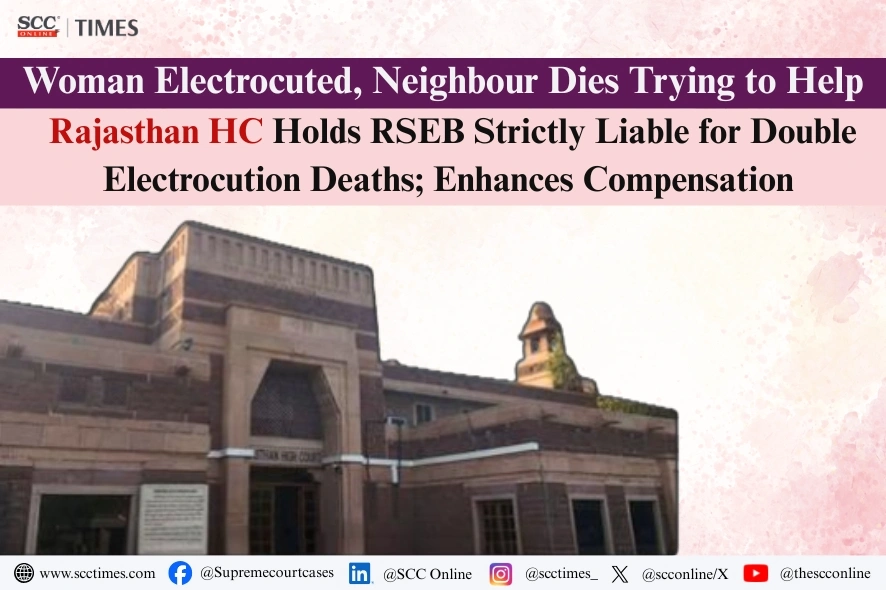
Rajasthan High Court: In a civil first appeal challenging a trial court decree awarding compensation for two deaths caused by electrocution, a Single Judge Bench of Sandeep Taneja, J., dismissed the appeal and partly allowed the cross-objection, holding the Rajasthan State Electricity Board strictly liable and enhancing the total compensation to ₹1,62,272. The Court applied the principle of strict liability and hold the appellants liable stating that liability can arise even without proof of negligence if the escape or transmission of a dangerous substance causes harm, such as electricity, and thus, enhanced the compensation under the heads of loss of dependency, loss of consortium, loss of estate and funeral expenses on the ground that in absence of proof of income, the loss of earning should be determined on the basis of minimum wages prevalent at the relevant point of time.
Background
The respondents had filed a civil suit for compensation under the Fatal Accidents Act, 1855, which was partly decreed by the trial court. Assailing the same, the present civil first appeal was filed under Section 96 read with Order 41 Rule 1 CPC.
As per the respondents, the electrical line situated in their village was in a bad condition and appellants were being negligent, which resulted in the electrocution of both the deceased. It was contended that the accident occurred due to negligence, carelessness and inaction of the appellants as when the wire fell down due to rusting, they neither cut off the power supply nor warned the public, which claimed the lives of 2. The respondents claimed a compensation of ₹88,200 under various heads, on account of death of the deceased.
The appellants refuted stating that the maintenance of the electric line was required to be done before Diwali and rainy season and on the date of the accident the electric wire broke and fell on the ground on account of heavy storm due to which several trees also broke and fell. And since they were not informed of this, neither the broken live electricity wire was removed nor the power supply was immediately cut off. The appellants also claimed that the accident happened due to the act of God and negligence of the deceased.
The trial court partly decreed the civil suit holding that the appellants were negligent and responsible for the accident and awarded a compensation of ₹40,330 along with interest at the rate 6 per cent from the date of filing of the civil suit till recovery.
Hence, this appeal was preferred by the appellants for setting aside the impugned judgment and for dismissal of the civil suit.
The respondents filed the cross-objection seeking enhancement of the compensation amount.
Analysis
The appellants reiterated that the electric line broke due to severe storm and the accident did not happen due to their negligence, but an act of God and negligence of the deceased, as the electric line was properly maintained by them as per the rules of the department.
Opposing the appellants, respondents supported the findings of the trial court and submitted, with respect to the cross-objection, that the compensation awarded by the trial court of ₹33,330 towards loss of dependency, holding that the income of the deceased could not be proved, was not correct as even in the absence of any proof, the income of the deceased ought to have been assessed on the basis of minimum wage notified at the relevant point of time which was ₹22 per day. Moreover, addition of 10 per cent shall be made in the income of deceased towards future prospects with 9 as multiplier, considering the age of the deceased, i.e. 60, loss of consortium shall be ₹40,000 per respondent instead of ₹5000 to 1 respondent, ₹15,000 as funeral expenses instead of ₹2000 and ₹15,000 under the head of loss of estate.
Upon analysing evidence available on record and witness testimonies, the Court observed that the electricity line had not been repaired for a long time and there was negligence on the part of line-man. The evidence nowhere reflected any storm on the night preceding the morning of accident, resulting into electric wire being broken down. Therefore, the contention of proper maintenance and accident being an act of God, lacked merit.
The Court discussed the applicability of the principle of strict liability and stated that liability can arise even without proof of negligence if the escape or transmission of a dangerous substance, such as electricity, causes harm.
The Court referred to Supreme Court judgments where death was caused by electrocution due to live electric wire lying on the ground, being Parvati Devi v. Commr. of Police, (2000) 3 SCC 754 and M.P. Electricity Board v. Shail Kumari, (2002) 2 SCC 162.
The Court opined that the observations in those cases, specially on the point of principle of strict liability, were squarely applicable to the case. Applying the principle, the Court held that the appellants were responsible for the accident, causing death of the deceased and Ganpat, who went to help the deceased and died in the process. Consequently, the appellants were held to be liable to pay just and fair compensation to the respondents.
The Court assessed the income of the deceased for calculating compensation and referred to Govind Yadav v. New India Insurance Co. Ltd., (2011) 10 SCC 683 stating that in absence of any evidence, the loss of earning should be determined on the basis of minimum wages prevalent at the relevant point of time.
The Court held that the monthly income of the deceased would be calculated as per the minimum wages notified by the State Government at the relevant point of time, which was found to be ₹22 per day. Hence, the monthly income of the deceased would amount to ₹660 and the compensation for loss of dependency shall be calculated on the basis of the said amount.
Decision
The Court opined that the compensation awarded by the trial court deserves to be enhanced in the light of the judgment in National Insurance Co. Ltd. v. Pranay Sethi, (2017) 16 SCC 680 and Magma General Insurance Co. Ltd. v. Nanu Ram, (2018) 18 SCC 130.
The Court made an addition of 10 per cent to the income of the deceased towards future prospects while calculating the compensation towards loss of dependency. Multiplier of 9 was applied. The Court deducted â…“rd of the deceased’s income towards her personal expenses as there were 2 dependents upon her. Each of the respondent was awarded ₹40,000 under the head of loss of consortium, ₹15,000 towards funeral expenses and ₹15,000 under the head of loss of estate.
Therefore, the total compensation awarded by the Court was ₹1,62,272 at the same interest rate, i.e. 6 per cent.
[Rajasthan SEB v. Varda, 2026 SCC OnLine Raj 4392, decided on 30-6-2026]
Judgment Authored By: Justice Sandeep Taneja
Advocates who appeared in this case:
Appellants: Vikram Choudhary
Respondents: Kailash Trivedi