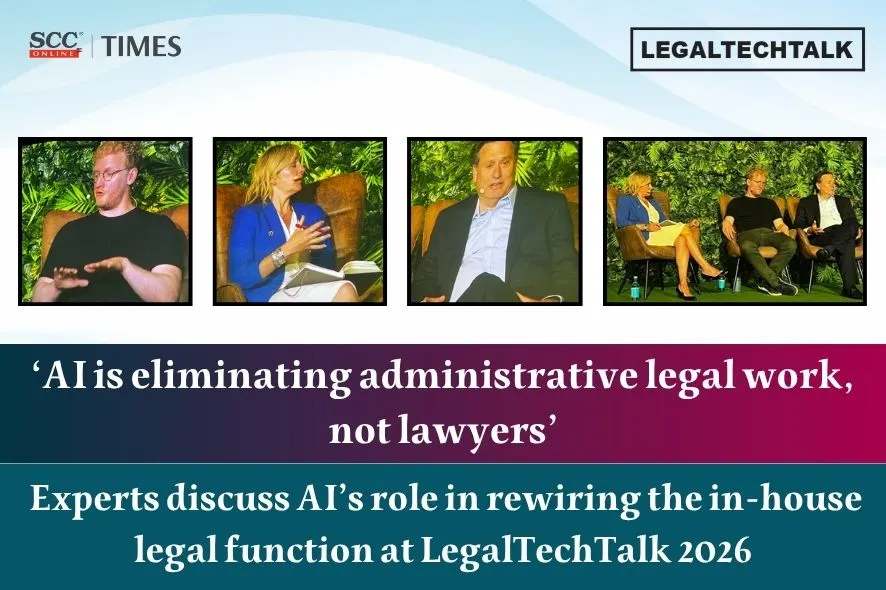
At LegalTechTalk 2026, a session titled “The New Legal Stack: How AI is Rewiring the In-House Legal Function” brought together Mr. Ron Klain, Chief Legal Officer at Airbnb, and Mr. Ross McNairn, Chief Executive Officer of Wordsmith, in conversation with moderator Ms. Genevieve Landricombe, former Head of Transformation at KPMG and RBS.

The discussion explored how artificial intelligence is changing the day-to-day functioning of corporate legal teams, the risks associated with foundation models, the economics of AI adoption, the future of legal work, and the growing responsibilities of legal departments operating in increasingly technology-driven environments.
Why Legal and Why Now?
Introducing the discussion, Ms. Genevieve Landricombe highlighted the diverse backgrounds represented on stage, noting that both speakers had worked at the intersection of law, business and technology during a period of unprecedented transformation.
Responding to the question, “Why legal and why now?”, Mr. Ron Klain began by describing Airbnb’s global operations.
According to Mr. Klain, Airbnb enables approximately five million hosts to accommodate nearly two million guests every night across jurisdictions around the world. While the platform itself is relatively new, Mr. Klain observed that the underlying concept of hospitality is ancient.
Drawing from religious and historical traditions, he noted that welcoming guests into one’s home has long been recognised across cultures and civilisations. Referring to the Greek concept of xenia, he explained that hospitality was considered a social obligation and an essential feature of community life.
As he remarked:
“The platform is relatively new, but the form of hospitality that we provide is ancient.”
Against this backdrop, Mr. Klain explained that Airbnb’s legal department operates at significant scale, with approximately 240 lawyers working across North America, Europe, Asia and Latin America.
Managing such a global legal function, he suggested, would be difficult to imagine today without the assistance of AI-powered tools.
AI Is Replacing Administrative Work, Not Legal Judgment
Mr. Klain explained that AI has already become indispensable within modern legal departments.
According to him, tools supporting legal research, contract lifecycle management and workflow automation are now critical to the efficient functioning of global legal teams. However, he rejected the notion that artificial intelligence is poised to replace experienced lawyers engaged in sophisticated legal work.
As he stated:
“Legal AI at this point in time and for the foreseeable future is not going to replace lawyers who do creative, thoughtful, nuanced, sophisticated legal work.”
Instead, Mr. Klain argued that AI is most effective when deployed against repetitive and administrative tasks that lawyers have traditionally performed despite those tasks requiring little substantive legal judgment.
Using contract review as an example, he noted that AI systems can efficiently identify standard clauses across large volumes of agreements far more quickly than human reviewers. By contrast, strategic legal negotiations involving commercial objectives, policy considerations, public relations concerns and business strategy remain well beyond the capabilities of existing AI systems.
Illustrating the point, Mr. Klain referred to a hypothetical sponsorship negotiation with Federation Internationale de Football Association (FIFA), noting that no AI model could presently balance competing commercial and reputational objectives in the way an experienced lawyer can.
Accordingly, he suggested that lawyers should view AI as a powerful tool for enhancing productivity rather than as a threat to their profession. At the same time, he acknowledged that AI may significantly disrupt entry-level and repetitive legal work.
Legal Teams Must Be Deliberate About AI Risk and Compliance
The discussion then turned to the governance and compliance challenges associated with rapidly evolving AI technologies.
Mr. Ross McNairn explained how Wordsmith evaluates foundation models before deploying them within enterprise environments. He revealed that the company had assessed Anthropic’s Fable model but ultimately decided not to deploy it due to concerns regarding data retention policies.
According to Mr. McNairn, legal teams cannot afford to treat privacy and compliance as afterthoughts.
As he explained:
“Having a rock-solid privacy-first approach isn’t really a debate. It is a foundation because if you get it wrong, it’s existential to your business.”
McNairn observed that legal departments frequently process some of the most sensitive information within an organisation, making robust compliance frameworks essential. He also highlighted the growing role of governments in regulating AI technologies.
Referring to recent export controls and restrictions imposed on AI systems, Mr. McNairn suggested that legal and technology teams should expect increasing regulatory intervention in the years ahead. In response, Wordsmith has deliberately avoided dependence on any single foundation model, retaining the flexibility to switch providers depending upon performance, cost, compliance and regulatory requirements.
AI Creates New Responsibilities for Corporate Legal Departments
Mr. Klain explained that AI intersects with Airbnb’s legal department in two distinct ways.
First, lawyers use AI tools to improve their own productivity and efficiency. Second, they must advise the company regarding its deployment of AI-powered products and services. According to Mr. Klain, Airbnb increasingly uses AI to support customer service operations across multiple languages and to improve search functionality for guests seeking accommodation.
These deployments raise a range of legal and regulatory questions involving privacy, platform governance and consumer protection.
As he observed:
“We are both AI-powered lawyers and AI lawyers every day.”
He noted that legal teams must continuously evaluate AI deployments against regulatory frameworks such as the General Data Protection Regulation (GDPR) and other jurisdiction-specific requirements.
The challenge, he suggested, lies in embracing innovation while ensuring compliance with a growing body of laws governing data usage and consumer protection.
Privacy, Privilege and Trust Remain Fundamental
Both speakers emphasised that legal departments must remain vigilant regarding confidentiality and privilege concerns.
Mr. Klain noted that legal teams are particularly cautious about what information lawyers input into AI systems and how those systems handle sensitive communications. According to him, preserving attorney-client privilege remains a critical consideration, particularly in jurisdictions such as the United States where privilege protections play a central role in legal practice.
He stressed that AI can be a powerful tool, but only when deployed within a framework that protects confidential information and complies with applicable laws.
Similarly, Mr. McNairn argued that privacy and compliance controls must be embedded into legal technology from the outset.
He explained that Wordsmith’s platform was built around the assumption that legal teams require enterprise-grade protections capable of satisfying the compliance expectations of some of the world’s largest organisations.
The Economics of AI Are Reshaping Legal Operations
A significant portion of the discussion focused on the economics of AI adoption.
Mr. McNairn explained that Wordsmith works exclusively with in-house legal teams rather than law firms. As a result, many conversations centre on reducing external legal spend and redirecting resources toward internal capabilities powered by technology.
According to Mr. McNairn, while organisations often worry about increasing AI costs, the broader trend points in the opposite direction.
As he observed:
“The cost per unit of intelligence is cratering every year.”
Although users are consuming far more tokens than they did only months ago, advances in computing power and model development continue to reduce the underlying cost of AI capabilities. He suggested that legal teams should focus less on current pricing fluctuations and more on the long-term trajectory of declining intelligence costs.
Mr. Klain offered a practical example from Airbnb.
He explained that members of his legal team have developed internal AI-powered product review tools that streamline interactions between privacy lawyers, payments lawyers, consumer protection lawyers and regional legal teams.
Rather than eliminating legal review, these systems remove administrative delays that often slow product development.
As he explained:
“We’re trying to do more work more quickly with the same people.”
According to Mr. Klain, the objective is not workforce reduction but increased efficiency, allowing legal teams to support business growth without proportionately increasing headcount.
The Environmental Cost of AI Cannot Be Ignored
The session concluded with a discussion on the environmental implications of AI adoption.
Mr. Klain noted that the rapid expansion of data centre infrastructure has become an increasingly contentious issue in the United States. According to him, concerns regarding energy consumption, water usage and local environmental impacts are now influencing public policy debates across the country.
While recognising the benefits of AI, he argued that future development must be undertaken responsibly. As he explained, environmental considerations must become part of both governmental and industry decision-making.
Mr. McNairn similarly suggested that policymakers may eventually introduce AI-related taxes or tariffs linked to token consumption. He proposed that revenues generated through such mechanisms could potentially be used to offset the environmental costs associated with large-scale AI deployment.
Concluding Reflections
The discussion highlighted a growing consensus that AI is becoming an indispensable component of modern legal operations. Rather than replacing lawyers, the technology is increasingly automating repetitive administrative work, enabling legal professionals to focus on strategic decision-making, negotiation and complex legal analysis.
At the same time, the session underscored that successful AI adoption requires far more than technological capability. Privacy, privilege, regulatory compliance, cost management and environmental responsibility are emerging as central considerations for legal departments deploying AI at scale.
For in-house legal teams, the question is no longer whether AI will become part of legal practice. The challenge now lies in integrating these technologies responsibly while preserving the professional judgment, accountability and trust that remain at the heart of the legal profession.