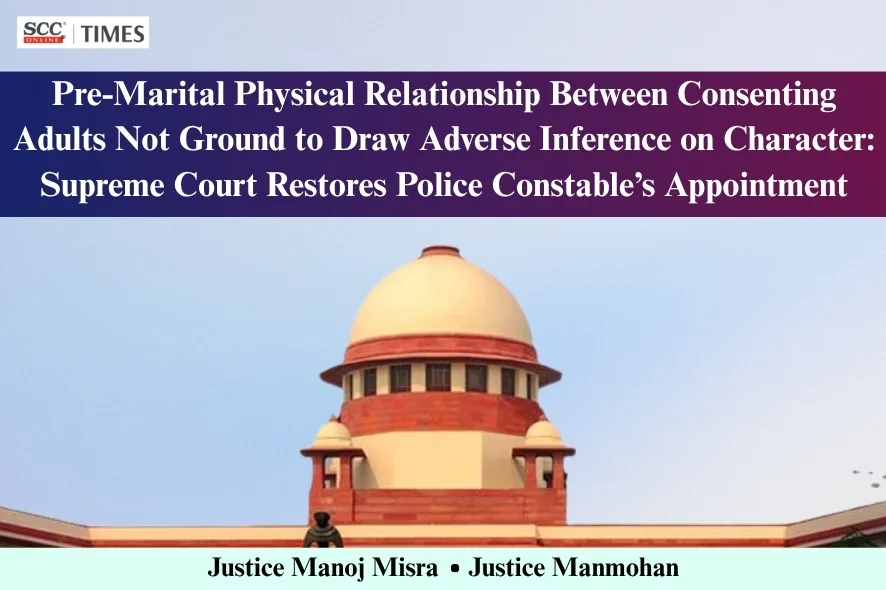
Supreme Court: While considering this case wherein the appellant challenged the cancellation of his provisional selection for the post of Stipendiary Cadet Trainee Police Constable (SCTPC) by the respondent on grounds of moral turpitude, the Division Bench of Manoj Misra* and Manmohan, JJ., allowed the appeal and held the respondent’s action to be arbitrary. The Court stated that merely because the appellant’s pre-marital relationship with his neighbour did not culminate in marriage, the same is not a ground to believe that the appellant had cheated and draw an adverse inference. The Court stated that pre-marital relationships are common today and physical relationship between 2 consenting unmarried adults cannot and should not by itself be a ground to draw an adverse impression about the character of the person in that relationship.
Background and Legal Trajectory
The appellant was provisionally selected for appointment on the post of SCTPC subject to verification of his antecedents and testimonials. In the form, the appellant had made disclosure about registration of a past criminal case against him under Sections 417, 420 and 506 read with Section 34, Penal Code, 1860 (IPC).
Thereafter, a show-cause notice was issued to the appellant seeking his explanation as to why his provisional selection should not be cancelled for his past involvement in an offence involving moral turpitude. The appellant responded that vide order of the Lok Adalat dated 31 August 2015 the case against him was compounded; therefore, the appellant would be deemed to have been honourably acquitted by virtue of Section 320(8), Criminal Procedure Code, 1973 (CrPC). However, the appellant’s explanation was not accepted, and after consideration and re-consideration, his provisional selection was cancelled. The respondent reasoned that, “The victim may be prepared to settle the matter for any consideration other than innocence of the accused, but it did not wash off the criminal antecedents of the accused … . Even if he is acquitted or discharged in the criminal case, that acquittal or discharge order will have to be examined to see whether he has been completely exonerated in the case because even a possibility of taking to the life of crimes poses a threat to the discipline of the police forces.”
Aggrieved with the aforesaid cancellation, the appellant approached the Single Judge Bench of the High Court contending that he had made a full and complete disclosure in his application about his antecedents and had not suppressed any information. The criminal case was compounded in the Lok Adalat and there existed no material to assume that the appellant was given the benefit of doubt or of some technical latch. The Single Judge allowed the petition and directed the respondents to reconsider the appellant’s case.
Aggrieved with the aforesaid order, the respondent preferred an appeal before the Division Bench of the High Court. The Division Bench allowed the respondent’s appeal holding that the employer is the best judge about the suitability of a candidate for its organisation, and therefore, if, in the opinion of the employer, the appellant was not considered suitable for employment in a disciplined force, the Single Judge Bench ought not to interfere with its decision.
Aggrieved with the Division Bench’s verdict, the appellant then approached the Supreme Court.
Court’s Assessment
Perusing the matter the Court firstly clarified that despite a truthful disclosure by an aspiring candidate about a criminal case ending in acquittal, the employer is free to take its own decision that such a candidate would not be suitable for appointment and, therefore, not entitled to appointment. However, it is equally settled that the State and its officers cannot act arbitrarily. The Court explained that in case the State’s decision in its capacity as an employer, is subjected to judicial review on ground of arbitrariness, then there should be certain demonstrable factors such as:
-
there exists material on record to indicate that an offence involving moral turpitude was indeed committed;
-
there exists material against the candidate even though he may have succeeded in earning an acquittal or a discharge for reasons such as the benefit of: (a) a technical latch, (b) a reasonable doubt, and (c) the witnesses turning hostile, either because they are won over or because they are threatened or lured into a compromise.
If after consideration of the aforesaid factors an informed decision has been taken, the courts should be slow to interfere with such a decision of the employer/recruiter because ultimately the employer is the best judge to assess whether a person is suitable for appointment in its organisation.
Thereafter examining the facts of the case and cancellation order issued by the respondent, the Court observed the existence of 2 key statements against the appellant:
-
It was not a case of full trial and then a clean acquittal but of compromise with the victim, which amounts to admission of guilt.
-
If the appellant was innocent and was falsely implicated, he would not have compromised the case with the victim. Since he was guilty, he compromised the case.
The Court explained that the statement that it was not a case of clean acquittal is based on fact but nothing much turns on it. However, the statement that the compromise amounts to admission of guilt is without any basis. Further, the statement that the appellant compromised because he was guilty is completely perverse and defies logic. “While making such statements the respondent lost sight of the nature of the offence alleged.”
The Court then pointed out that the appellant was accused of cheating and his parents were accused of extension of threats. Insofar as the offence of cheating was concerned, the allegation was in respect of making a false promise to marry. Whether a person was deceived into a relationship can ordinarily be determined based on the statement of the person so deceived. Unless the person so deceived wishes to step into the witness box, it cannot be said that that person was deceived or cheated. “Therefore, if that victim is not willing to bring home the charge, how can the accused be blamed for not contesting the proceeding on merit.”
The Court further stated that authorities need to be sensitive to the changing times in the context of pre-marital relationships, which are common nowadays. The Court pointed out that in the present case, the appellant and the victim were neighbours and were in a relationship for about 4 years, which did not culminate in marriage, which should not have become a ground to believe that the appellant had cheated. The Court explained that had it been a case of use of force or extension of threat to force a compromise, the respondent would have been justified in taking a call on the suitability of the appellant for appointment in a disciplined force. However, in the present case, there was no material to conclude that the compromise was foisted upon the victim.
The Court then considered if indictment alone in a police report, based on allegations which have been withdrawn or not pressed, can form the basis to form an adverse opinion about the character of the person indicted. The Court explained that unless the charge is proved in a court of law there shall be a presumption of innocence. The Court noted that in the present case, the appellant was accused of cheating. One of the ingredients of the offence of cheating is false representation/deception. “Whether prosecutrix was deceived into entering a relationship, the prosecutrix alone could have disclosed. The public at large cannot tell whether she was deceived by the appellant.” In such circumstances, when the victim chose not to pursue and had led no evidence, rather had expressed her consent to compound the case, there was no occasion for the respondents to read in between lines and draw an adverse inference regarding the character of the appellant. The Court further pointed out that notwithstanding the police report, which itself was based on statements recorded during investigation, there is a serious doubt whether the offence of cheating was committed at all. Deposition of the victim in court alone could have proved its commission, if at all. Therefore, when the victim herself chose to withdraw the allegations and compound the offence, there was no occasion to suspect the character of the appellant more so when both parties were adult and neighbours, knowing each other for several years.
Decision
With the aforesaid assessment, the Court set aside the Division Bench’s order and restored the Single Judge’s decision.
[Gajula Thirupathi v. State of Telangana, 2026 SCC OnLine SC 1104, decided on 21-5-2026]
*Judgment by Justice Manoj Misra
Advocates who appeared in this case:
For Appellant(s): Mr. Ankolekar Gurudatta, AOR
For Respondent(s): Mr. K. Radhakrishnan, Sr. Adv. Ms. Devina Sehgal, AOR Mr. Srikanth Varma Mudunuru, Adv.
Buy Penal Code, 1860 HERE

Buy Code of Criminal Procedure, 1973 HERE