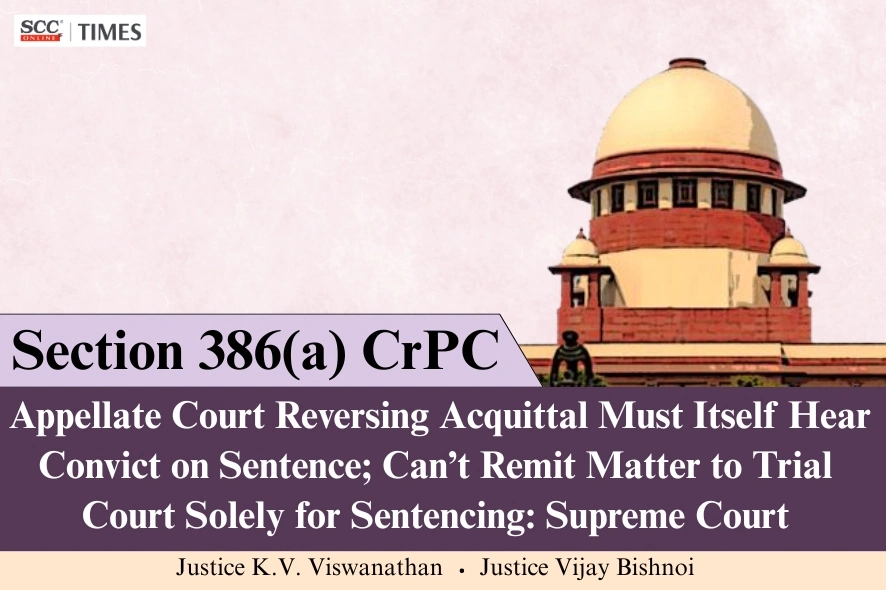
Supreme Court: In the appeals arising from a Calcutta High Court’s judgment dated 23 April 2026, reversing Sessions Court’s judgment of acquittal dated 24 April 2024, convicting the appellant, for offences under Sections 376 and 312, Penal Code, 1860 (IPC) and directing the trial court to hear the accused on sentence and impose punishment, the Division Bench of K.V. Viswanathan* and Vijay Bishnoi, JJ., set aside the part of para 108 of the impugned judgment by which the appellant was directed to surrender before the trial court and the trial court was directed to hear him on sentence and impose punishment, holding that where an appellate court reverses an acquittal and records a conviction for the first time, the appellate court is duty-bound to itself hear the convict on the question of sentence and impose punishment. The appellate court cannot remit the matter to the trial court solely for sentencing. Such a course is inconsistent with Section 386(a), Criminal Procedure Code, 1973 (CrPC) and established judicial precedents.
Factual Matrix
The prosecution case was that he had entered into a sexual relationship with the victim on the false promise of marriage and had subsequently induced her to terminate a pregnancy resulting from that relationship.
Upon appreciation of evidence, the trial court acquitted the appellant of all charges by judgment dated 24 April 2024. Both the State and the victim challenged the acquittal before the High Court through separate appeals.
After re-appreciating the evidence, the High Court held that the victim had been sexually exploited on the pretext of marriage and that the appellant had no genuine intention of marrying her from the inception of the relationship. It further found evidence showing that the appellant persuaded the victim to consume pills to terminate her pregnancy while being fully aware that his promise of marriage was false. It further held that the alleged consent of the victim stood vitiated by misconception of fact and accordingly convicted the appellant under Sections 376 and 312 IPC.
However, instead of itself hearing the accused on sentence and imposing punishment, the High Court directed the appellant to surrender before the trial court and instructed the trial court to hear him on sentence and pronounce appropriate punishment under Sections 376 and 312 IPC.
Issue for Consideration
Whether an appellate court, after reversing an acquittal and recording conviction for the first time, can direct the trial court to hear the accused on sentence and impose punishment, or whether the appellate court itself must hear the convict and pass sentence according to law?
Statutory Framework
The Court examined Chapter 18 CrPC, particularly Section 235. Under Section 235(1), a Sessions Judge delivers judgment after hearing arguments and points of law. Under Section 235(2), if the accused is convicted, the Judge must hear the accused on the question of sentence and thereafter pass sentence according to law, unless the case falls under the probation provisions. The corresponding provision under the Nagarik Suraksha Sanhita, 2023 (BNSS) is Section 258.
The Court then referred to Section 386(a) CrPC (or Section 427 BNSS), which governs appeals against acquittal. The provision empowers the appellate court to reverse an order of acquittal, find the accused guilty and “pass sentence on him according to law”. It noted that the language of Section 386(a) makes it clear that once an appellate court records a finding of guilt after reversing an acquittal, the duty to impose sentence rests upon that very appellate court.
Discussion on Precedents
The Court relied on Allauddin Mian v. State of Bihar, (1989) 3 SCC 5, wherein the Supreme Court explained the rationale behind Section 235(2) and held that the requirement of hearing on sentence was to satisfy the rule of natural justice. An accused who had previously focused on contesting guilt must be afforded a meaningful opportunity to place before the Court all relevant circumstances bearing on punishment. The provision serves a dual purpose: ensuring fairness and assisting the court in selecting an appropriate sentence from a wide range of sentencing discretion. It asserted that “the provision is salutary and must be strictly followed”.
The Court examined Dagdu v. State of Maharashtra, (1977) 3 SCC 68, wherein a convicting Court had omitted to hear the accused on sentence. The Supreme Court held that “higher court can on confirming the conviction, remedy the breach by giving a hearing to the accused on the question of sentence”. The higher court may grant a real and effective opportunity to the accused to place material relevant to sentencing and, if necessary, adjourn the matter for that purpose. Such a course may become necessary where conviction is recorded for the first time by a higher court.
The judgment in Kumar Exports v. Sharma Carpets, (2009) 2 SCC 513, directly addressed the issue involved in the present case, wherein after reversing an acquittal, the High Court had remitted the matter to the Magistrate merely for sentencing. The Supreme Court condemned the procedure as “unknown to law” and held that Section 386(a) CrPC does not contemplate remanding the matter to the trial court after conviction for the purpose of sentence. The appellate court itself must exercise the judicial function of imposing appropriate punishment.
Analysis
The Court held that the law is settled that whichever court records the conviction for the first time must hear the accused on the question of sentence. When conviction is recorded by a Sessions Court, Section 235(2) directly applies. When conviction is recorded for the first time by an appellate court after reversing an acquittal, the same principle applies through the appellate court’s obligation under Section 386(a) CrPC.
“If it is the appellate court which is convicting the accused for the first time after reversing the acquittal, the appellate court has to hear the convict on sentence. The appellate court cannot relegate the matter to the court below only for the purpose of imposing a sentence after the appellate court had recorded a conviction.”
The Court emphasised that the appellate court cannot delegate or transfer the sentencing function to the court below after recording conviction. Such a course would run contrary to the express mandate of Section 386(a) and the law declared in precedents.
“Not only should the appellate court not remand the matter to the trial court only for the purpose of imposing a sentence, after it finds accused guilty, it has a bounden duty to hear and impose an appropriate sentence.”
Referring to Suryamoorthi v. Govindaswamy, (1989) 3 SCC 24 and Kamalakar Nandram Bhavsar v. State of Maharashtra, (2004) 10 SCC 192, the Court asserted that the proper course for the appellate court is to adjourn the matter to a suitable date, hear the convict on the question of sentence, consider aggravating and mitigating circumstances and thereafter impose punishment itself.
Also Read: Whether Art. 32 of the Constitution empowers reconsideration of death sentence that has attained finality? Supreme Court answers
Decision
The Court held that the High Court had committed an error in directing the trial Judge to pronounce and impose a proper sentence. The Court
-
Partly allowed the appeal.
-
Set aside the portion of para 108 of the impugned judgment directing surrender before the trial court and directing the trial court to hear and impose sentence was set aside.
-
Did not examine the conviction recorded by the High Court on merits at this stage.
-
Restored the criminal appeals before the High Court with direction to hear the convict on sentence and thereafter impose an appropriate sentence itself.
-
Granted liberty to the appellant to challenge the conviction and sentence after the High Court completes the sentencing exercise.
[Mukesh Kumar Yadav v. State (UT of Andaman & Nicobar Islands), 2026 SCC OnLine SC 938, decided on 26-5-2026]
*Judgment by Justice K.V. Viswanathan
Advocates who appeared in this case:
Mr. Rauf Rahim, Sr. Adv., Mr. Mohammed Tabraiz, Adv., Mr. Ali Asghar Rahim, Adv., Mr. Mohsin Rahim, Adv., Mrs. Tania Tamanna, Adv., Mr. Shekhar Kumar, AOR, Counsel for the Appellant
Mr. Kunal Chatterji, AOR, Ms. Maitrayee Banerjee, Adv., Mr. Ajith Prasad, Adv., Mr. Rohit Bansal, Adv., Mr. Varij Nayan Mishra, Adv., Mr. Shreekant Neelappa Terdal, AOR, Counsel for the Respondents