


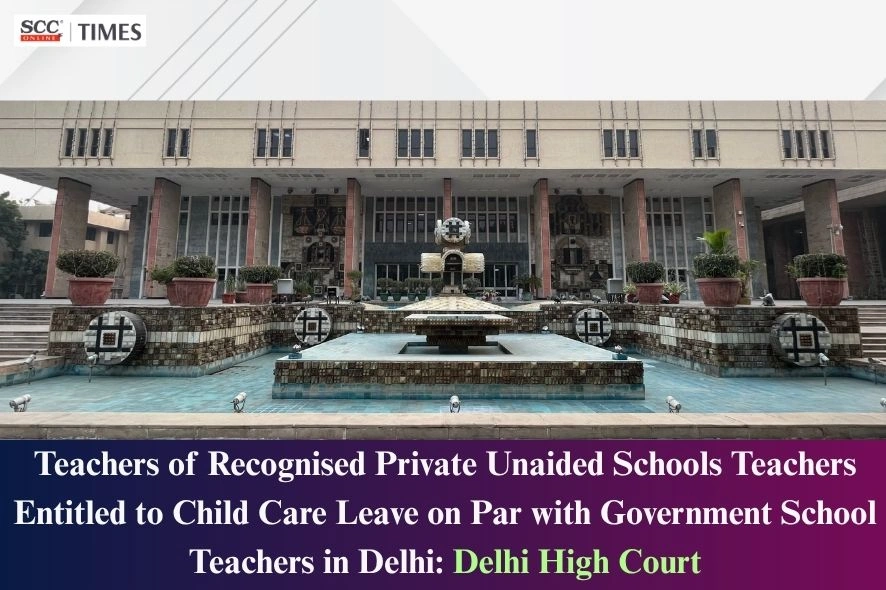
Delhi High Court: In an appeal, raising an important question whether a teacher working in a recognised, privately managed and unaided school is entitled to the benefit of child care leave (CCL) in the same manner as teachers employed in government schools, wherein the Single Judge had dismissed the writ petition challenging denial of such leave by the respondent school, the Division Bench of Devendra Kumar Upadhyaya*, CJ., Tejas Karia, J., set aside the impugned order and directed the respondent school to reconsider the appellant’s request for CCL afresh, holding that:
Rule 111, Delhi School Education Rules, 1973 (DSE Rules) grants the benefit of leave of absence to an employee of a recognised private school, whether aided or unaided, at par with such employees working in a corresponding status in a government school, which included benefit of CCL.
CCL is a recognised category of leave available to government school teachers under Rule 43-C, Central Civil Services (Leave) Rules, 1972 (CCS Rules).
The expression “other prescribed benefits” under Section 10, Delhi School Education Act, 1973 (DSE Act) must be interpreted in light of the Rules framed under the Act, particularly Rule 111.
CCL cannot be denied merely because it does not possess a monetary character.
Teachers employed in recognised private unaided schools are entitled to claim CCL on the same footing as teachers employed in government schools.
Brief Facts
In the instant matter, the appellant was employed as a teacher in Bharti Public School, a recognised but unaided private school. She sought CCL for the period from 1 May 2025 to 30 September 2025 on the ground that her son, who was studying in Class XII, was undergoing considerable academic pressure and required her care and attention. The school did not grant the leave sought.
Aggrieved by the refusal, the appellant approached the High Court seeking a direction for grant of CCL. However, relying on Beena Arora v. Directorate of Education, 2017 SCC OnLine Del 7600, which itself was founded upon the Division Bench judgment in M.I. Hussain v. Director of Education, 2014 SCC OnLine Del 1226, the Single Judge dismissed the writ petition. The appellant preferred the present intra-court appeal challenging that dismissal of writ petition.
Issue for Determination
Whether, the petitioner who is a teacher working with the respondent school, which is a recognised but unaided and privately managed, entitled to the benefit of CCL?
Statutory Framework under
Delhi School Education Act and Rules
At the outset, the Court examined the statutory scheme governing recognised private schools under the DSE Act and noted that Section 2(h) defines the expression “employee” to include teachers as well as every other employee working in a recognised school. Consequently, teachers serving in recognised private schools fall squarely within the ambit of the DSE Act.
Analysing Section 10, DSE Act, the Court noted that Section 10 guarantees parity between employees of recognised private schools and employees of corresponding status in government-run schools. The provision stipulates that scales of pay, allowances, medical facilities, pension, gratuity, provident fund and “other prescribed benefits” available to employees of recognised private schools shall not be inferior to those available to employees holding corresponding positions in government schools. It observed that the expression “other prescribed benefits” assumes considerable significance because the entitlement claimed by the appellant was not directly covered under pay or allowances but under the broader category of service benefits.
The Court referred to Section 2(q), DSE Act, which defines the term “prescribed” as meaning prescribed by rules framed under the Act and noted that any benefit specifically provided under the DSE Rules would qualify as a “prescribed benefit” within the meaning of Section 10.
The Court noted that Rule 111, DSE Rules provides that every employee of a recognised private school, whether aided or unaided, is entitled to such leave as is admissible to employees of corresponding status in government schools.
Therefore, the Court asserted that if a particular category of leave is available to government school employees, employees of recognised private schools are equally entitled to such leave by virtue of Rule 111.
Central Civil Services (Leave) Rules, 1972
The Court then examined Rule 43-C, CCS Rules and noted that under this provision, a female government servant and a single male government servant may be granted CCL for a maximum of 730 days during service for taking care of their 2 eldest surviving children. The Rule specifically contemplates leave for purposes such as education, sickness, upbringing and other child-related needs. The Court observed that government school teachers in Delhi are entitled to this benefit under the applicable leave rules.
“Thus, so far as, teachers working in government schools in Delhi are concerned, in terms of the provisions of Rule 43-C, CCS Rules, CCL is a benefit which has been made available to them.”
Analysis
After considering the statutory provisions, the Court held that Rule 111 grants every employee of a recognised private school, whether aided or unaided, entitlement to the same leave that is admissible to employees of corresponding status in government schools. Since CCL is undeniably available to government school teachers under Rule 43-C, CCS Rules, denial of the same benefit to the appellant would be inconsistent with Rule 111.
The Court noted that apart from pay scales, allowances, medical facilities, pension, provident fund and gratuity, Section 10 also protects “other prescribed benefits”. The Court emphasised that the expression “prescribed” has a specific statutory meaning under Section 2(q), namely, benefits prescribed by rules framed under the Act.
Since Rule 111 forms part of the DSE Rules framed under Section 28, DSE Act, the benefit of leave contemplated therein necessarily constitutes a “prescribed benefit” within the meaning of Section 10. Consequently, leave benefits available under Rule 111 are protected by Section 10 and must be accorded to employees of recognised private schools.
The Court noted that Beena Arora had followed the earlier Division Bench judgment in M.I. Hussain. It found that M.I. Hussain involved an entirely different controversy. The claimant in that case was a librarian employed in Delhi Public School, Mathura Road. He sought parity with teachers regarding the age of superannuation and claimed retirement at 60 years instead of 58 years. The Division Bench in that case had held that extension of retirement age was not covered by Section 10, DSE Act.
The Court observed that M.I. Hussain dealt with a completely different issue, namely, retirement age, and not with the grant of CCL. The ratio of that decision had to be understood in the factual context in which it was rendered.
The Court analysed the reasoning adopted in M.I. Hussain. There, the Division Bench had invoked the principle of ejusdem generis and held that the words “other prescribed benefits” in Section 10(1) must take colour from the preceding expressions such as pay scales, allowances, medical facilities, pension, provident fund and gratuity.
However, the Court observed that while interpreting Section 10, the earlier Division Bench had not considered the statutory definition of the word “prescribed”. Since Section 2(q) expressly provides that “prescribed” means prescribed by rules made under the Act, the contents of the Rules cannot be ignored while construing the expression “other prescribed benefits”. Rule 111, being one such rule, necessarily had to be read with full force.
“It is not in doubt that leave of absence is a benefit available to an employee and since such benefit of leave of absence has been made available to the employees of unaided recognised private schools at par with the employees of government schools, in our opinion Rule 111 will have to be read with full force for considering the issue as to whether, the appellant is entitled to CCL or not.”
The Court further elaborated upon different categories of leave in service jurisprudence, “which have the character of money but some of which do not”. It observed that Rule 111 does not distinguish between leave carrying a monetary character and leave lacking such character. It simply grants parity in respect of leave. Therefore, there was no legal basis for excluding CCL merely because it does not result in encashment.
The Court also relied on Amandeep Kaur v. Union of India, 2015 SCC OnLine Del 13044, wherein CCL was recognised as a special category of leave intended primarily for the benefit of children and observed that “such leave serves a larger societal goal in public interest in furthering every individual right to hold some family life, securing the interest and health of infants which are all facets of Article 21 of the Constitution of India”.
Also Read: Utt HC | State contractual employees entitled to claim Child Care Leave
Decision
The Court allowed the appeal, set aside impugned order and directed the respondent school to reconsider the appellant’s request for CCL afresh and take an expeditious decision in accordance with law.
[Sangeeta Negi v. Bharti Public School, 2026 SCC OnLine Del 4580, decided on 4-6-2026]
*Judgment authored by Chief Justice Devendra Kumar Upadhyaya
Advocates who appeared in this case:
Mr. Sermon Rawat and Ms. Aastha Vishwakarma, Advs., Counsel for the Appellant
Mr. B.C. Pandey, Mr. S.P. Kamrah, Mr. Puneet Batra and Mr. Aryavansh Kamrah, Advs., Counsel for the Respondent 1 and 2
Mr. Yeeshu Jain, ASC with Ms. Jyoti Tyagi, Ms. Vishruti Pandey, Mr. Sachin Garg, Advs., Counsel for the Respondent 3, 4 and 5
Not even provided with maternity leave, forget about child care leave.