Disclaimer: This has been reported after the availability of the order of the Court and not on media reports so as to give an accurate report to our readers.
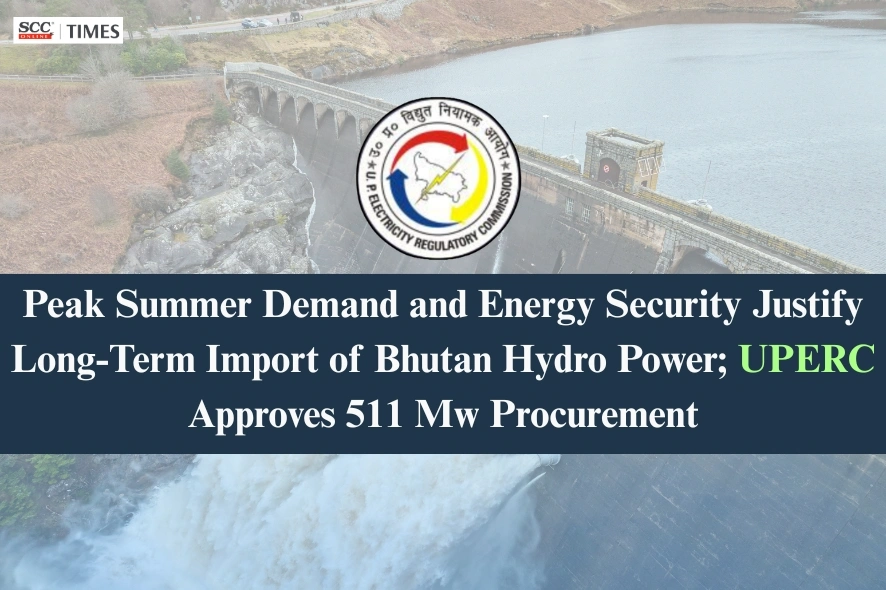
Uttar Pradesh Electricity Regulatory Commission (UPERC): In a petition filed by Uttar Pradesh Power Corporation Ltd. (UPPCL) under Section 86(1)(b), Electricity Act, 2003, seeking approval for long-term procurement of 511 MW hydro power from the 600 MW Khorlochhu Hydro Power Project, Bhutan, through Tata Power Trading Company Ltd. (TPTCL), the Division Bench of Arvind Kumar, Chairman and Sanjay Kumar Singh, Member, approved the proposed procurement and permitted execution of the power sale agreement (PSA). The Uttar Pradesh Electricity Regulatory Commission (UPERC) held that the proposed arrangement, including procurement of 511 MW power with 10 per cent overload capability, would help meet Uttar Pradesh’s peak summer demand, strengthen energy security, and provide long-term tariff certainty through a fixed tariff structure, while directing compliance with the applicable cross-border electricity regulations and statutory approvals.
Also Read: Jan Vishwas (Amendment of Provisions) Act, 2026: Amendments to Electricity Act, 2003 notified
Background
TPTCL, by communication dated 8 August 2024, offered power from the Khorlochhu Hydro Power Project in Bhutan to UPPCL. Thereafter, discussions were made between the parties regarding long-term procurement of power from the project. UPPCL considered the proposal in view of the State’s increasing electricity demand, the need for reliable peak-hour supply during summer months, and compliance with Renewable Purchase Obligations (RPOs).
The proposal envisaged procurement of 511 MW of cross-border hydro power with 10 per cent overload capability from the Khorlochhu Hydro Power Limited (KHPL) project for a period of 30 years, with supply during the months of May to October every year at a levelised tariff of ₹6.75 per unit at the Indo-Bhutan Periphery, through TPTCL as inter-State trading licensee.
Consequently, UPPCL approached the Commission seeking approval of the proposed procurement and the draft PSA.
Issues Considered
The UPERC examined the regulatory framework governing cross-border procurement of electricity, including the applicability of the Guidelines for Import/Export (Cross Border) of Electricity, 2018 and the CERC (Cross Border Trade of Electricity) Regulations, 2019.
The UPERC also considered the requirement of approval by the Designated Authority under the applicable cross-border regime, the tariff structure proposed for procurement, and whether the procurement served the interests of consumers and the State power sector.
Analysis
Recapitulating the entire scope of the petition, the UPERC noted that the proposed procurement stemmed from TPTCL’s offer dated 8 August 2024 to UPPCL, wherein TPTCL informed that its parent company along with Druk Green Power Corporation (DGPC), Bhutan, was developing the 600 MW KHPL hydro project in Bhutan, for supply of 511 MW power from the 600 MW Khorlochhu Hydro Power Project, Bhutan, for 30 years at a firm tariff of ₹6.75/unit at the Indo-Bhutan periphery, which was accepted in principle by UPPCL on 30 December 2024. The Commission further examined the bilateral India-Bhutan hydropower cooperation framework and took note of UPPCL’s stand that the project formed part of the established inter-governmental architecture governing development of hydropower projects in Bhutan for export of electricity to India.
The Commission analysed the scope of its powers under Section 86(1)(b), Electricity Act, 2003 and noted that the provision empowers it to regulate electricity procurement by distribution licensees, including approval of the source and price of power procurement. The Commission also considered the regulatory regime governing cross-border electricity transactions and took note of the “Guidelines for Import/Export (Cross Border) of Electricity- 2018”, which mandate approval of the Designated Authority for import or export of electricity. Accordingly, the Commission examined the proposed transaction in the context of the applicable cross-border regulatory framework and noted that, cross-border import of electricity including scheduling, metering, accounting and deviation settlement is governed by the Central Government and CERC and that the participating entities from and outside India, engaged in cross-border trade with India, is regulated by CERC (Cross Border Trade of Electricity) Regulations, 2019.
The UPERC noted that in response to the Commission’s query for approval of Designated Authority, TPTCL submitted that approval from the Designated Authority, i.e., the Central Electricity Authority (CEA), would be obtained after approval of the PSA by the Commission and execution of the agreement. The Commission examining the tariff framework under the CERC (Cross Border Trade of Electricity) Regulations, 2019, noted that tariff for cross-border power should be allowed through bilateral agreement between the countries or competitive bidding, or mutual agreement between the parties.
The UPERC noted the following, after considering the submissions:
-
1. Supply Arrangement: The Commission noted that 511 MW power with 10 per cent overload capability, would be procured from the Khorlochhu Hydro Power Project, Bhutan, under a 30-year PSA commencing from the project’s commercial operation date (COD).
-
2.Peak Demand Alignment: Power would be supplied during May—October, coinciding with UPPCL’s peak demand period, and that the project’s 4-hour storage capacity would help meet peak-hour requirements.
-
3. Contracted Energy: The annual contracted energy at the delivery point during the 6-month supply period was stipulated at 1748 MUs, with supply scheduled to commence from 1 May 2030.
-
4. Tariff Determination and components: The Commission noted that the levelized tariff of ₹6.75/kWh at the Indo-Bhutan periphery had been worked out in accordance with the CERC Tariff Regulations, 2024 and the recorded that the busbar levelised tariff of ₹6.47/kWh, after adding estimated transmission charges of ₹0.28/kWh up to the Indo-Bhutan border, resulted in a tariff of ₹6.75/kWh.
-
5. Tariff Certainty: Tariff of ₹6.75/unit would remain fixed for 30 years without any annual escalation.
-
6. Transmission Charges and Losses: The transmission charges, losses and operational charges up to the Indo-Bhutan periphery would be borne by TPTCL, while charges and losses beyond the delivery point would be borne by UPPCL.
-
7. Trading Margin: The Commission noted that the agreed trading margin of 5 paise/unit was already included in the tariff of ₹6.75/unit, and no additional amount would be payable on that account.
-
8. The Settlement Nodal Agency (SNA) Charges: This charge was already factored into the tariff and no tariff adjustment would be sought on account of any variation in such charges.
Decision
Allowing the petition, the Commission approved UPPCL’s long-term procurement of 511 MW hydro power (with 10 per cent overload capability) from the Khorlochhu Hydro Power Project, Bhutan, through TPTCL, and approved the execution of the PSA, subject to compliance with the applicable cross-border electricity regulations, guidelines and approval of the Designated Authority.
[UPPCL v. TPTCL, Petition No. 2294 of 2025, decided on 27-5-2026]
Advocates who appeared in this case:
For the petitioner: Abhishek Kumar, Nived Veerapaneni, Anil Prakash, Sanjay Kumar Chaurasia, Advocate
For the respondent: Ketan Nagpal, Shantanu Singh, Shri Venkatesh, Ashwin Singh, Aniket K., Staya Jha, Adya Jha, Advocate