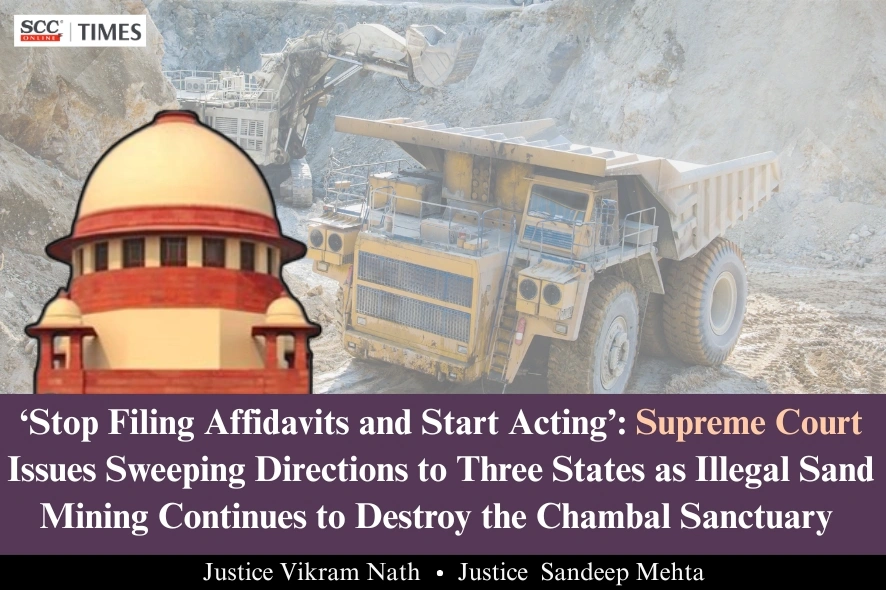
Supreme Court: In a suo motu writ petition concerning the illegal sand mining in the National Chambal Sanctuary and threat to endangered aquatic wildlife, the Division Bench of Vikram Nath and Sandeep Mehta*, JJ., said that the protection of ecologically sensitive regions and wildlife habitats constitutes a continuing constitutional obligation of the State under Articles 21, 48-A and 51-A(g) of the Constitution of India, requiring proactive governance, effective enforcement, and timely implementation of environmental safeguards.
The Court observed that illegal sand mining, enabled by inadequate surveillance, weak enforcement mechanisms, and the operation of unregistered and unidentified vehicles, cannot be effectively curbed through nominal penalties or isolated regulatory actions, and accordingly emphasised the need for a coordinated and deterrent enforcement framework involving robust surveillance systems, adequate field-level personnel, seizure and confiscation of offending vehicles, and prosecution of all persons involved in organised illegal mining networks.
It further said that statutory authorities responsible for public infrastructure, including the National Highways Authority of India (NHAI), are duty-bound to adopt preventive and protective measures against activities that pose a threat to the safety and structural integrity of such infrastructure.
Accordingly, in exercise of its powers under Article 142 of the Constitution of India, the Court issued necessary directions to ensure complete justice and effective implementation of environmental and statutory safeguards in and around the National Chambal Gharial Sanctuary spanning Rajasthan, Madhya Pradesh, and Uttar Pradesh.
Background
The present proceedings arise out of the Court’s continuing monitoring of illegal sand mining activities in and around the National Chambal region, particularly within ecologically sensitive forest and wildlife conservation areas spread across Rajasthan, Madhya Pradesh, and Uttar Pradesh.
In the earlier proceedings, the Court had examined compliance affidavits filed by the States concerned, reports of the Central Empowered Committee, and submissions made by the Amicus Curiae. The Court had observed that although certain preliminary measures had been initiated by the State Governments to address illegal mining activities, compliance with its earlier directions remained inadequate and several critical measures had not been effectively implemented on the ground.
The Court had expressed particular concern over the State of Rajasthan’s failure to comply with earlier directions relating to surveillance, monitoring, inter-departmental coordination, and enforcement against illegal mining. It had also noted the continued operation of unregistered and unidentified vehicles and earth-moving machinery allegedly involved in illegal mining and transportation activities, observing that the inability of authorities to identify and track such vehicles facilitated organised illegal mining operations and undermined effective enforcement.
The Court had further taken note of illegal excavation activities being carried out near a bridge on National Highway-44 at the Morena—Dholpur border. It had observed that mining operations in close proximity to the bridge foundations posed a potential threat to the bridge’s structural integrity and raised serious concerns regarding public safety and protection of critical infrastructure.
In view of these concerns, the Court had directed senior officials of the departments concerned of Rajasthan and Madhya Pradesh to personally appear before it and file detailed compliance affidavits. The NHAI had also been impleaded as a party respondent and was directed to place on record the measures undertaken to protect the bridge and strengthen surveillance and monitoring in the affected area. Pursuant to these directions, fresh compliance affidavits and reports were filed by the States concerned, NHAI, and other stakeholders, which formed the basis for consideration in the present judgment.
Analysis
The Court reviewed the compliance affidavits filed by the States of Rajasthan, Madhya Pradesh, and Uttar Pradesh regarding steps taken to curb illegal sand mining in and around the National Chambal Gharial Sanctuary. While the Court acknowledged that Rajasthan had recently initiated several measures, including installation of CCTV surveillance systems, creation of district-level task forces, establishment of check-posts, and allocation of funds for monitoring infrastructure, it expressed concern over the long timelines proposed for implementation, ranging from 18 to 36 months. The Court observed that such delays were unacceptable given the continuing environmental degradation and illegal mining activities.
The Court noted that most of these actions appeared to have been taken only after senior State officials were directed to appear personally before the Court, reflecting a lack of proactive governance. It emphasised that environmental protection is a constitutional obligation and cannot depend solely on judicial intervention.
“Environmental governance cannot be reduced to a reactive exercise undertaken only after repeated judicial intervention or upon threat of personal accountability before constitutional courts.”
The Court said that under Articles 21, 48-A and 51-A(g) of the Constitution, the State has a continuing duty to prevent environmental harm and protect fragile ecosystems through proactive governance and effective enforcement. It observed that environmental protection cannot be treated as a reactive exercise limited to filing affidavits or temporary compliance reports in court proceedings. Instead, the measures initiated by the States must be implemented in a real and effective manner on the ground through continuous monitoring, institutional accountability, and sustained enforcement. The Court emphasised that only such time-bound and concrete action can curb the ongoing illegal sand mining activities in and around the National Chambal Gharial Sanctuary.
A major concern highlighted by the Court was the continued operation of unregistered and unidentified vehicles allegedly involved in illegal mining and transportation activities. The Court found that the States had failed to develop an effective mechanism for identifying, seizing, confiscating, and prosecuting such vehicles and their owners. It observed that merely imposing small fines was insufficient to deter organised illegal mining networks and stressed the need for stricter enforcement measures.
The Court also expressed concern over large vacancies in Forest Departments, particularly among frontline personnel such as Forest Guards. It observed that shortages in enforcement staff significantly weakened surveillance and anti-mining operations and directed the States to undertake urgent recruitment and strengthen field-level enforcement.
“Effective environmental governance and protection of ecologically sensitive regions cannot be ensured merely through issuance of administrative directions or installation of technological infrastructure in the absence of an adequately staffed and functional field enforcement mechanism. Frontline personnel such as Forest Guards constitute the first and most critical layer of protection against illegal mining, encroachments and destruction of wildlife habitats.”
“Persistent vacancies in such posts inevitably weaken institutional capacity on the ground and
substantially impede timely detection, prevention and enforcement action against illegal activities being carried out within protected areas.”
With regard to illegal excavation near the bridge on National Highway-44 at the Morena—Dholpur border, the Court considered the affidavit filed by the NHAI. While noting that inspections had found the bridge structurally safe at present, the Court held that NHAI could not avoid responsibility for protecting highway infrastructure from threats posed by illegal mining. It directed NHAI and the concessionaire to strengthen surveillance and monitoring systems around the bridge to prevent activities that could endanger its structural integrity and public safety.
The Court further took note of concerns raised by the Central Empowered Committee regarding waste being dumped into the Chambal River from the bridge, adversely affecting the river ecosystem and wildlife. It also examined issues relating to the maintenance of environmental flows (E-flows) in the Chambal River, noting scientific findings that reduced lean-season water flows were threatening aquatic biodiversity and habitat connectivity. The Court considered recommendations for a basin-level assessment to ensure adequate environmental flows in the river and its tributaries.
Lastly, the Court addressed the proposed de-notification of approximately 732 hectares of land from the National Chambal Gharial Sanctuary by the State of Rajasthan. Referring to the Ministry of Environment, Forest and Climate Change’s submissions, the Court noted that de-notification of sanctuary land requires approval from the Supreme Court after following the prescribed statutory procedure. Since the notification had already been stayed by an earlier order, the Court decided to examine the issue further after receiving additional submissions from the parties concerned.
The Court observed that the affidavits filed by the States did not satisfactorily address the continuing problem of illegal sand mining in ecologically sensitive areas. The Court noted that although certain measures had been proposed, they largely remained at the level of planning and documentation and had not translated into effective action on the ground. It further observed that the continued operation of unregistered and unidentified vehicles, along with weak enforcement mechanisms, reflected a serious regulatory failure that enabled organised illegal mining activities to continue with impunity. The Court therefore emphasised that the States must move beyond mere paper compliance and undertake concrete, time-bound, and effectively enforceable measures through strengthened surveillance, monitoring, and coordinated institutional action to protect the ecological integrity of the National Chambal Gharial Sanctuary and surrounding regions.
After reviewing the compliance reports and noting the continuing problem of illegal sand mining in the National Chambal region, the Court issued a series of directions to strengthen enforcement, protect the sanctuary ecosystem, and ensure accountability.
1. Recruitment and Strengthening of Forest Staff
The Court directed the States of Rajasthan, Madhya Pradesh, and Uttar Pradesh to urgently fill vacancies in Forest Departments, especially posts such as Forest Guards and other frontline personnel responsible for surveillance and protection. The recruitment process should be completed, as far as possible, within 1 year, and the Chief Secretaries must submit affidavits detailing measures taken to prevent such vacancies in the future.
2. Faster Installation of Surveillance Infrastructure
The States were directed to establish and operationalise CCTV cameras, monitoring systems, control centres, and other technological infrastructure on a war footing. These surveillance measures should be substantially implemented within 6 months.
3. Strict Action Against Illegal Mining Vehicles
The Court ordered immediate seizure and initiation of confiscation proceedings against vehicles and machinery involved in illegal mining, particularly those operating without valid registration, using fake number plates, or violating motor vehicle laws. Authorities were also directed to prosecute not only drivers but also owners, financiers, contractors, and others connected with illegal mining networks.
4. Digital Tracking and Investigation
The States must maintain digital records of seized vehicles, ownership details, prior violations, criminal cases, and enforcement actions to facilitate coordinated investigations and prosecution of organised illegal mining operations.
5. Protection of Enforcement Personnel
Recognising increasing attacks on forest and enforcement officials, the Court directed the States to consider granting legal protection to Forest Guards and other frontline personnel for bona fide actions performed in the discharge of their official duties.
6. Protection of the NH-44 Bridge
The Court directed the NHAI, in consultation with the Central Empowered Committee, to install high-resolution night-vision CCTV cameras around the bridge on National Highway-44 near the Morena—Dholpur border. The surveillance system must cover the bridge, nearby riverbed, and vulnerable areas to detect and prevent illegal mining activities.
7. Sharing of Surveillance Data
NHAI must provide live CCTV access to police, forest, and other enforcement authorities of Rajasthan and Madhya Pradesh and ensure continuous operation, storage, backup, and sharing of surveillance footage.
8. Preventing Pollution of the Chambal River
The Court directed NHAI and State authorities to prevent dumping of waste into the Chambal River by installing protective fencing, sealing gaps in bridge structures, displaying warning signs, and taking strict action against violators.
9. Alternative Livelihood Opportunities
The States were asked to explore employment schemes, skill-development programmes, and livelihood initiatives for local communities to reduce dependence on illegal mining. They were also encouraged to involve local residents in conservation, afforestation, eco-tourism, and ecological restoration activities.
10. Environmental Flows (E-Flows)
The Court directed the State Departments concerned, the Ministry of Jal Shakti, and the Central Water Commission to file affidavits detailing existing and proposed measures for maintaining environmental flows in the Chambal River and its tributaries. They must also respond to the recommendations of the Central Empowered Committee regarding river flow management and ecological protection.
11. Periodic Monitoring
The Chief Secretaries of Rajasthan, Madhya Pradesh, and Uttar Pradesh were directed to review compliance every 2 months and submit status reports to the Court on surveillance, enforcement, recruitment, and environmental protection measures.
The Court ordered the impleadment of the Ministry of Jal Shakti and the Central Water Commission as parties to the proceedings. All authorities concerned, including the NHAI, were directed to submit fresh progress reports before the next hearing.
The matter will next be taken up on 22 July 2026.
[Illegal Sand Mining in the National Chambal Sanctuary and Threat to Endangered Aquatic Wildlife, In re, 2026 SCC OnLine SC 947, decided on 26-5-2026]
*Judgment Authored by: Justice Sandeep Mehta
Advocates who appeared in this case:
Amicus Curiae: Mr. Nikhjil Goel, Sr. Adv. Ms. Rupali Samuel, Adv.
For Petitioner(s): By Courts Motion Mr. Umesh Kumar Shukla, Adv. Mr. Pritam Singh, Adv. Mr. Ankit Bhatnagar, Adv. Mr. Rohit Kumar-I, AOR Ms. Akanksha Singh, Adv.
For Respondent(s): Ms. Aishwarya Bhati, A.S.G. Mr. Shiv Mangal Sharma, A.A.G. Mr. Saurabh Rajpal, Adv. Ms. Arushi Rathore, Adv. Ms. Nidhi Jaswal, AOR Mr. Rohit K. Singh, AOR Mr. Pritam Bishwas, Adv. Mr. Yashveer Singh, Adv. Mr. Kartikey Bansal, Adv. 1 Mr. Sharan Dev Singh Thakur, Sr. A.A.G. Ms. Ruchira Goel, AOR Ms. Rishika Rishabh, Adv. Mr. Sharanya, Adv. Ms. Ritika Rao, Adv. Mr. S.v. Raju, A.S.G.(V.C.) Ms. Manisha T. Karia, A.A.G. Mr. Nilesh Yadav, A.A.G. Mr. D.S. Parmar, A.A.G. Mr. Harmeet Singh Ruprah, AOR Mr. Sarthak Raizada Ga, Adv. Mr. Kanishk Sharma, Adv. Mr. Karan Singh, Adv. Mr. Shiv Mangal Sharma, A.A.G. Ms. Arushi Rathore, Adv. Mr. Saurabh Rajpal, AOR Mr. Sharan Dev Singh Thakur, Sr. A.A.G. Mr. Sudeep Kumar, AOR Mr. Abhishek Saket, Adv. Ms. Manisha, Adv. Ms. Rupali, Adv. Mr. Anil Kaushik, A.S.G. Mr. Gurmeet Singh Makker, AOR Mr. Gaurav Arya, Adv. Mr. Pranjal Singh, Adv. Mr. Digvijay Dam, Adv. Mr. Eklawya Dwivedi, Adv. Mr. Shiv Mangal Sharma, A.A.G. Ms. Arushi Rathore, Adv. Mr. Saurabh Rajpal, AOR Mr. Rohit Kumar-i, AOR Ms. Akansha Singh, Adv. Ms. Srishti Agnihotri, AOR Mr. D.p.singh, Adv. Ms. Anchal Kanthed, Adv. Mr. Pawan Kumar Saxena, Adv. Mr. Jasveer Rana, Adv. Mr. Charan Dass, Adv. Mr. Pradeep Misra, AOR Mr. Daleep Dhyani, Adv. Mr. Anupam Misra, Adv. Mr. Suraj Singh, Adv.
Buy Constitution of India HERE