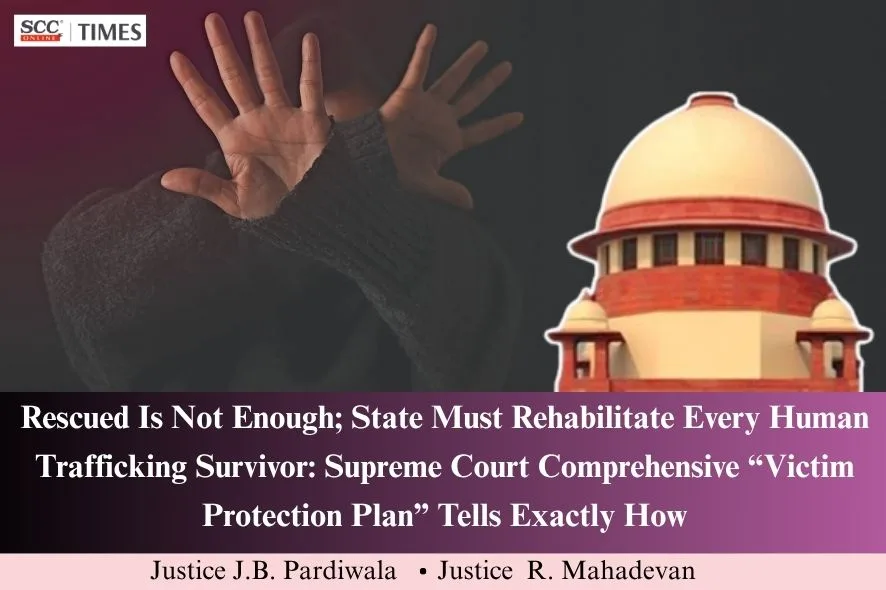
Supreme Court: In a comprehensive pronouncement on human trafficking and the protection of victims of commercial sexual exploitation (CSE) in India, originating from a public interest litigation (PIL) filed by petitioner, an anti-trafficking organisation, seeking enforcement of the assurances and undertakings given by the Union Government regarding the establishment of an Organised Crime Investigation Agency (OCIA) and the formulation of a comprehensive anti-trafficking law as recorded by the Supreme Court while disposing of the original writ petition in Prajwala v. Union of India, (2015) 17 SCC 29, the Division Bench of J.B. Pardiwala* and R. Mahadevan, JJ., while recognising trafficking as a grave assault on human dignity, bodily autonomy and personal liberty, adopted a victim-centric approach and affirmed that rehabilitation is not merely a matter of governmental policy but an integral component of the constitutional guarantee of a life with dignity under Article 21 of the Constitution. The Court issued a comprehensive “Victim Protection Plan” governing the pre-rescue, rescue, post-rescue, rehabilitation, reintegration and prosecution stages, while simultaneously recommending several legislative and policy reforms aimed at strengthening India’s anti-trafficking framework.
Background
The original writ petition was instituted by petitioner in 2004 highlighting deficiencies in the rescue, protection, rehabilitation, and reintegration mechanisms available to victims of trafficking and prostitution. The petitioner contended that victims were frequently treated as offenders rather than survivors of a grave crime.
The central demand was the creation of a comprehensive Victim Protection Plan governing every stage of intervention, namely, pre-rescue, rescue, post-rescue care, rehabilitation, reintegration, and prosecution.
In 2015, the Union Government informed the Court that an Organised Crime Investigation Agency would be established, and an Inter-Ministerial Committee would prepare a comprehensive anti-trafficking legislation. Relying on these assurances, the Court disposed of the writ petition on 9 December 2015.
The Inter-Ministerial Committee prepared draft trafficking legislations in 2016, 2017, 2018 and 2021. Although the 2018 Bill was passed by the Lok Sabha, it lapsed upon dissolution of the House. The proposed OCIA was never established. Instead, offences under Sections 370 and 370-A, Penal Code, 1860 (IPC) were incorporated into the schedule of the National Investigation Agency Act, 2008 (NIA Act) through the 2019 Amendment, empowering the NIA to investigate trafficking offences.
Contending that neither commitment made before the Court had been fulfilled, the petitioner filed the present miscellaneous application seeking implementation of the 2015 directions.
Issues for Determination
-
Whether, on a combined reading of Articles 21 and 23 of the Constitution, respectively, the victims of trafficking for CSE could be said to be entitled to the right to rehabilitation?
-
Whether it could be said that there is a gap or lacuna in the present legislative and institutional framework insofar as the rescue, protection, rehabilitation and repatriation of the victims of trafficking for CSE is concerned?
-
Whether it is necessary for this Court to direct the creation of the OCIA for the investigation of offences pertaining to human trafficking?
Analysis
At the outset, the Court examined the phenomenon of human trafficking through the lens of the Palermo Protocol, 2000, emphasising that trafficking consists of 3 essential components — action, means, and purpose of exploitation. It highlighted that trafficking is not confined to physical movement of victims and extends to harbouring, receipt, and continued exploitation. The Court confined the present matter to trafficking of women and children for CSE and not to other forms of trafficking such as forced labour or organ removal.
The Court recorded the grim realities of trafficking for CSE in India and stated that trafficking networks exploit vulnerabilities arising from poverty, social exclusion, lack of education, gender discrimination, family distress, and economic insecurity. Victims are often lured through false promises of employment, marriage, companionship, or better opportunities and are subsequently subjected to exploitation, violence, debt bondage, physical abuse, psychological trauma, substance dependency, and repeated victimisation.
The Court also recognised the increasing use of digital platforms for recruitment, grooming, and exploitation, leading to the emergence of Cyber-Enabled Human Trafficking (CEHT). It observed that trafficking has evolved beyond traditional brothel systems and now operates through decentralised and technologically sophisticated networks.
Understanding Human Trafficking
The Court described trafficking as the commodification of human beings for profit. It emphasised that trafficking is sustained by structural vulnerabilities and should not be viewed as a problem attributable to a single cause. It acknowledged difficulties in obtaining accurate data because trafficking is largely hidden and underreported.
The Court warned against approaches that seek a singular explanation because such approaches frequently produce ineffective interventions and observed that trafficking cannot be attributed to a single cause. Poverty alone does not explain trafficking. Nor can trafficking be understood solely through gender, migration, caste or any other isolated factor. Rather, trafficking emerges from the interaction of multiple vulnerabilities operating simultaneously. The Court repeatedly emphasised that trafficking must be approached as a “complex social phenomenon”.
“No single framework is sufficient to address the complexity of the phenomenon, and effective anti-trafficking work requires, at its core, a multidisciplinary approach.”
Legal Framework Governing Human Trafficking
The Court undertook an exhaustive analysis of the Palermo Protocol, discussing, the action element, means element, exploitation element, irrelevance of consent where prohibited means are used and distinct treatment of child trafficking. Under the Palermo Protocol, consent becomes irrelevant where prohibited means have been employed. An in case where the victim is a child, proof of the means element is unnecessary. Recruitment, transportation, transfer, harbouring or receipt of a child for the purpose of exploitation is sufficient. The Court observed that the Protocol forms the foundation of modern anti-trafficking law worldwide.
The Court observed that modern international law no longer views trafficking merely as a criminal offence. It is increasingly recognised as a profound violation of human rights affecting dignity, liberty, bodily integrity and equality. Modern anti-trafficking frameworks generally rest upon three pillars — prevention, protection and prosecution.
The Court discussed Article 23 and relevant provisions from Immoral Traffic (Prevention) Act, 1956 (ITPA), Nyaya Sanhita, 2023 (BNS), the Juvenile Justice (Care and Protection of Children) Act, 2015 (JJ Act) and Protection of Children from Sexual Offences Act, 2012 (POCSO Act), i.e., statutory instruments which are most relevant when dealing with instances of trafficking for CSE.
Reading Article 23 (prohibition of trafficking in human beings) together with Article 21 (right to life with dignity), the Court held that the State’s obligation does not end with the rescue of a trafficked person. Relying upon People’s Union for Democratic Rights v. Union of India, (1982) 3 SCC 235 and Bandhua Mukti Morcha v. Union of India, (1984) 3 SCC 161, the Court held that rehabilitation forms an integral component of the constitutional guarantee of dignity. The State is under a positive obligation to ensure the physical, psychological, social and economic rehabilitation of trafficking survivors.
While acknowledging anti-trafficking provisions under the BNS, protections available under statutes such as the POCSO Act and the JJ Act and NALSA (Victims of Trafficking and Commercial Sexual Exploitation) Scheme, 2015, the Court found continuing institutional and policy deficiencies. The Court expressed particular concern regarding rehabilitation infrastructure and noted that the merger of the Ujjawala and Swadhar schemes into the Shakti Sadan framework under Mission Shakti raised questions regarding the ability of rehabilitation facilities to adequately address the specialised needs of trafficking survivors.
Right to Rehabilitation
The Court observed that trafficking for CSE does not end with the victim’s rescue from exploitation. The protection owed to victims is “qualitatively different and places a far heavier obligation on the State”. Recognising that trafficking networks often continue to pose threats even after rescue, the Court observed that “the risk to a victim’s safety can intensify after rescue”.
“On multiple occasions, this Court has held that the right to life guaranteed under Article 21 cannot be restricted to mere animal existence. The right to life encompasses more than mere physical survival. It includes the right to live with dignity, for without dignity, human life is substantially diminished. The right to life, thus understood, incorporates the right to dignity.”
While discussing the content of rehabilitation, the Court held that the most readily recognised dimension includes “the provision of goods, shelter, medical care, psychological support, compensation, and vocational training, i.e., all that is necessary to enable the victim to sustain herself independently”. The Court cautioned that “without this, rehabilitation is an empty promise”.
The Court further explained that rehabilitation cannot be confined to material assistance alone. It must also include measures that “actively work to reduce the stigma, isolation, and marginalisation that victims of trafficking for CSE face”. Measures facilitating “genuine reintegration into the community” and addressing social conditions that perpetuate exclusion or humiliation were held to be equally important components of rehabilitation.
The Court held that “the right to rehabilitation imposes positive obligations on the State”. Although the precise measures may vary depending upon circumstances and available resources, the State is required to take reasonable measures towards the progressive realisation of the minimum core of this right and ensure that such measures are implemented in both letter and spirit.
While examining whether the State is taking reasonable measures towards the progressive realisation of the minimum core of this right, and whether those measures are being implemented in both letter and spirit, the Court noted that there was no complete absence of rehabilitative measures. Various statutes, schemes and institutions collectively demonstrated that the State had undertaken efforts towards securing rehabilitation for victims of trafficking. At the same time, the Court noted several concerns highlighted before it regarding implementation including deficiencies in standards of care, uneven availability of facilities across States, inadequate monitoring, limited rehabilitation opportunities, and difficulties in ensuring meaningful reintegration. The Court acknowledged that these concerns could not be lightly brushed aside and required serious attention from the authorities.
The Court ultimately held that the existing framework could not be described as wholly ineffective or non-existent. Nevertheless, the presence of statutory provisions and welfare schemes did not mean that every aspect of rehabilitation was being satisfactorily addressed. The Court therefore found it necessary to strengthen the existing framework through judicial directions. It was in this backdrop that the Court proceeded to formulate a comprehensive “Victim Protection Plan” intended to operate across the pre-rescue, rescue, post-rescue, rehabilitation, reintegration and prosecution stages, with the objective of ensuring that the constitutional right to rehabilitation is realised in a meaningful manner.
Distinguishing Trafficking from Voluntary Adult Sex Work
The Court noted that trafficking must be distinguished from voluntary adult sex work and cautioned against conflating prostitution with trafficking in every case. It emphasised the need for a threshold inquiry during rescue operations to determine whether an adult is a trafficked victim or is voluntarily engaged in sex work. Anti-trafficking mechanisms should not automatically result in detention, institutionalisation or restrictions on the liberty of adults voluntarily engaged in sex work.
The Court further clarified that the irrelevance of consent under the Palermo Protocol applies only where trafficking is established through coercion, force, fraud, deception, abuse of vulnerability or other prohibited means.
Victim Protection Plan
The Court exercised powers under Articles 32 and 142 and issued a detailed guidelines until appropriate legislative measures are enacted. The Victim Protection Plan was founded upon primacy of human rights and dignity, inquiry to identify voluntary adult sex workers, individualised rehabilitation, protection from coercive institutionalisation, informed consent of victims, non-discrimination and non-stigmatisation, safety and protection and privacy and confidentiality. Guidelines on the “Victim Protection Plan” are as follows—
1. Fundamental Principles
(a) Primacy of Human Rights and Dignity: Every action under the Plan must place the victim’s human rights and dignity at the centre.
(b) Non-Criminalisation: Victims must never be treated as offenders and must always be accorded the status of crime victims.
(c) Informed Consent: Care, protection and rehabilitation measures should ordinarily be based on the victim’s free and informed consent.
(d) Non-Stigmatisation and Non-Discrimination: Victims must not face discrimination, adverse judgment or diminished respect because of their involvement in prostitution.
(e) Safety and Protection: Protection from further exploitation and harm must be ensured at every stage.
(f) Privacy and Confidentiality: Identity and personal information of victims must remain confidential.
(g) Victim-Centric Approach: Victims must be treated as persons with agency and not merely as passive recipients of assistance.
2. Pre-Rescue and Rescue Measure
The Court directed the strengthening of Anti-Human Trafficking Units and emphasised specialised training of officials involved in rescue operations. Rescue efforts are to be conducted in a victim-sensitive manner with due regard to dignity, privacy and safety. The Court recognised that rescue operations frequently become the first point of interaction between the victim and the State and therefore required that such operations be conducted in a manner that avoids further trauma or victimisation.
3. Post-Rescue Measures
The Court provided a detailed safeguards immediately following rescue in the plan. Victims are to be afforded legal representation, a fair and adequate hearing, access to safe custody arrangements, medical assistance, counselling and other forms of support. The Court also incorporated mechanisms for judicial oversight, remedies in cases of delay in passing safe-custody orders, confidentiality of proceedings and access to legal and social support. These safeguards were intended to ensure that victims are not left without assistance during the most vulnerable stage following rescue.
4. Rehabilitation
The Court reiterated that rehabilitation cannot be reduced to institutional confinement or temporary shelter. The Plan envisages rehabilitation measures that are responsive to the victim’s choices and reflective of present economic realities. The Court observed that rehabilitative measures which fail to account for the socio-economic realities of victims are “unlikely to succeed”. Accordingly, the Plan seeks to provide meaningful opportunities for education, vocational training, livelihood generation, social support and access to welfare benefits.
5. Repatriation and Reintegration
The Court stated that reintegration is not to be approached mechanically but must take account of the wishes, safety and best interests of the victim. Restoration to family or community should not occur where it exposes the victim to further exploitation, coercion or harm. The victim’s consent remains a central consideration in decisions concerning reintegration, subject to limited exceptions relating to safety and protection.
6. Prosecution and Trial
Recognising the difficulties encountered by trafficking victims during criminal proceedings, the Court directed that victims should receive legal and social support throughout the prosecution process. The objective is to ensure meaningful participation in proceedings while protecting victims from secondary victimisation and unnecessary hardship.
7. Prevention and Training
The Court directed that police officers and AHTUs maintain vigilance at transit points such as railway stations and bus terminals to identify trafficked victims and undertake timely intervention. AHTUs were also directed to identify vulnerable source areas and initiate awareness and empowerment programmes. Further, all stakeholders—including police officers, NGO workers, counsellors, prosecutors, judicial officers, legal aid personnel and social workers—must receive regular and adequate training on victim-friendly procedures. Such training is to be conducted at national, State and district levels and must be supported by standardised manuals and operating procedures.
8. Applications under Section 19 ITPA
The Court specifically directed that persons making applications under Section 19 ITPA should receive the benefit of the protections incorporated in the Victim Protection Plan. These include legal representation, fair hearing, interim safe custody, rehabilitation measures, legal and social support, confidentiality protections and other safeguards considered applicable to their circumstances.
Constitution of OCIA
The Court examined the rationale behind the proposed OCIA and noted that stakeholders had originally envisaged it as a national body responsible for intelligence gathering, inter-State coordination, investigations, rehabilitation support and maintenance of databases.
However, after reviewing the NIA framework, AHTUs and other existing institutions, the Court held that although these functions were dispersed among multiple bodies, there was no complete legal vacuum. Consequently, the Court declined to issue a mandamus directing creation of the OCIA, while leaving the matter open for future governmental consideration.
Recommendations and Suggestions
The Court made extensive recommendations:
-
Non-Criminalisation of Victims: The Court noted that Sections 7, 8 and 20 ITPA often result in victims being prosecuted. It recommended legislative amendments clarifying that trafficked persons should not be subjected to prosecution under these provisions.
-
Reconsideration of Closed-Shelter Rehabilitation: The Court criticised rigid detention-based rehabilitation models and suggested more flexible and victim-responsive alternatives.
-
Rights of Voluntary Adult Sex Workers: The Court recognised the need to protect voluntary adult sex workers from marginalisation and to strengthen their legal rights without equating such recognition with endorsement of trafficking.
-
Police Accountability: The Court recommended reconsideration of Law Commission proposals creating specific offences for abuse of authority by police officers dealing with trafficking victims.
-
Child Trafficking Definition: The Court observed that the BNS departs from the Palermo Protocol by requiring proof of the “means” element even for children and urged for legislative reconsideration on the same.
-
Comprehensive Legislation: The Court expressly urged the Union Government to reconsider enacting a comprehensive anti-trafficking statute covering all forms of trafficking and exploitation.
-
Cyber-Enabled Human Trafficking: Recognising the growing digital dimension of trafficking, the Court urged the Government to develop specialised responses and advisories.
Decision and Direction
With a view to give full force to the Victim Protection Plan, the Court passed the following additional directions:
-
All States and Union Territories to notify recognised welfare institutions in accordance with the explanation to Section 15(6-A) ITPA.
-
Preparation of district-wise panels of social welfare workers with sufficient representation from all districts under Section 13(3)(b) ITPA.
-
Designation of ADGP-level officers as Police Nodal Officers for the purpose of performing the functions as delineated in the Victim Protection Plan.
-
Designation of Secretaries of Women and Child Development Departments as Government Nodal Officers for the purpose of performing the functions as delineated in the Victim Protection Plan.
-
Directed compliance of directions within 3 months.
-
Listed the matter in September 2026 for reporting compliance.
The Court held that trafficking for CSE remains a grave violation of human dignity and constitutional rights. While recognising that no single plan can solve every problem, it held that the Victim Protection Plan represents a decisive shift toward placing victims at the centre of the legal framework and treating them as persons entitled to dignity, autonomy and meaningful rehabilitation.
Accordingly, the Court partly allowed the application and framed a comprehensive Victim Protection Plan binding on stakeholders, declined the compulsory creation of OCIA and issued extensive recommendations to the Union and States.
[Prajwala v. Union of India, 2026 SCC OnLine SC 1053, decided on 29-5-2026]
*Judgment by Justice J.B. Pardiwala