Disclaimer: This has been reported after the availability of the order of the Court and not on media reports so as to give an accurate report to our readers.
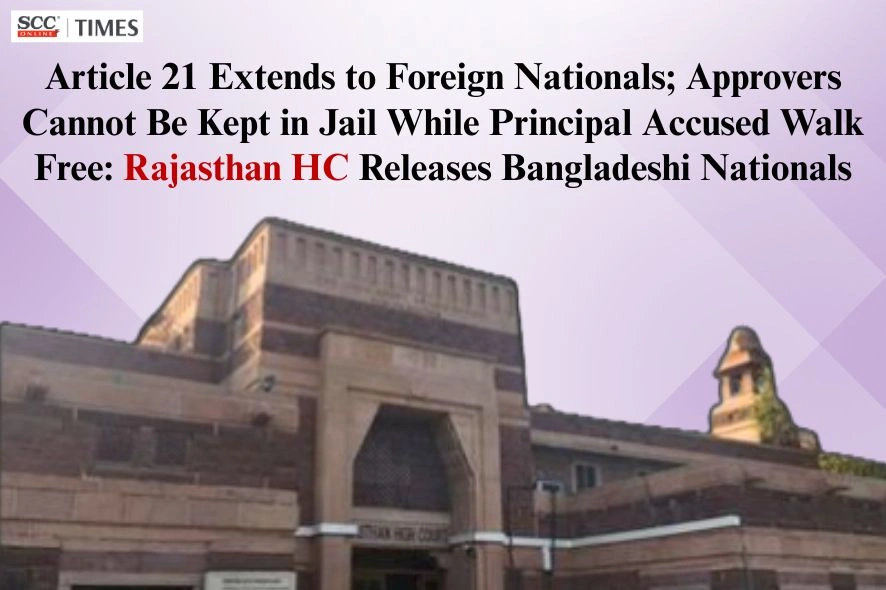
Rajasthan High Court: While considering a petition filed for releasing the petitioners, Bangladeshi national, on bail in offences involving illegal kidney transplantation and human trafficking, a Single Judge Bench of Anoop Kumar Dhand, J., held that right to fair and speedy trial is an integral part of Article 21 of the Constitution which is extended to the foreign nationals facing trial in India.
Thus, the Court ordered the release of petitioners.
Background
In the present case, an FIR was registered against certain accused persons, under Sections 419, 420, 471 and 120-B, Penal Code 1860 (IPC), regarding committing the alleged offence of illegal kidney transplantation and human trafficking, in connection of which the petitioners and the other co-accused persons were arrested. Subsequently, the petitioners became approver for the prosecution side and based on their statements recorded by the police, the co-accused persons were arrested and charge-sheeted.
Thereafter, the co-accused persons were granted bail, but the petitioners were not released on the sole ground that they became approver for the prosecution side. Petitioners contended that when the trial did not proceed any further, they approached the High Court with a prayer for releasing them on bail, but the Court issued a direction to the trial court to record the statements of the parties.
Considering that the statements of the petitioners have been recorded and they have been in custody since 23 April 2024, the petitioners pray for bail till conclusion of the trial.
Per contra, it was argued by the State that the petitioners should not be enlarged on bail since they came to India on a Medical VISA and the same had expired and thus, in case, they leave India, their chances to return to India were quite bleak.
Issues and Analysis
Considering the respondent’s objection that the petitioners’ prayer to release them on bail should not be considered, in terms of Section 306(4), Criminal Procedure Code 1973 (CrPC), as the trial had not yet reached its conclusion and was still continuing, the Court held that it found no substance in the same because the said provision merely stipulated that a person accepting a tender of pardon under Section 306(1) CrPC should be examined as a witness before the Magistrate taking cognizance of the offence and again at the subsequent stage of trial.
The Court further observed that the petitioners could not be made to remain in custody until the termination of the trial, thereby placing them in a position worse than the principal accused persons who had already been granted regular bail, particularly when their statements had already been recorded before the trial court.
The Court stated that the issue involved in the case at hand was as to whether or not an approver could be detained for an indefinite period even when the principal accused had been released on bail? and further stated that the same was addressed by the Court in Noor Taki alias Mammu v. State of Rajasthan11986 SCC OnLine Raj 11. The Court emphasised that the answer to the issue was clear and specific that the approver should be detained in custody until his statement is recorded.
The Court noted that in the case at hand, the statements of the petitioners had been recorded before the trial court, and they had been in custody since 23 April 2024.
Further, the Court stated that another issue involved in the present case was whether the petitioners were entitled to be released on bail? If yes, whether they could be allowed to leave India to go back to their native country Bangladesh?
The Court referred to Frank Vitus v. Narcotics Control Bureau, (2025) 3 SCC 1 and stated that Immigration and Foreigners Order, 2025, which repealed Foreigners Order, 1948 (Foreigners Order), explicitly states that “the discretion lies with the Immigration Officer concerned for granting permission to any foreigner to depart from India or not”.
The Court stated that the chances of conclusion of trial in the near future seemed very bleak and under Article 21 of the Constitution, they have fundamental rights of speedy trial. The Court further emphasised that “The protection under Article 21 of the Constitution, which guarantees the Right of Life and Personal Liberty, extends to all persons and this right is not confined to the Indian Citizens alone and it is available to the foreign nationals as well. The Right to Live with Dignity guaranteed under Article 21 is available to all human beings, including foreigners.”
Further, the Court stated that “a fair procedure, in the criminal trial is an essential component of Article 21 of the Constitution and it does not differentiate between Indian citizens and foreign nationals.” The Court held that foreign nationals, including the petitioners, who face trial in India are also entitled to Right to Live with Dignity under Article 21 of the Constitution and the said right has been established as a powerful shield of protection, ensuring that Right to Live with Dignity extends beyond borders, safeguarding all human beings.
The Court observed that prolonged detention without trial amounts to violation of the Right to Life and Personal Liberty contained under Article 21 of the Constitution. Considering that the petitioners’ detention continued for more than 24 months by now while all the principal and main accused persons were already granted bail and since the end of the trial was not in sight as more than dozens of witnesses were yet to be examined, the Court observed that detention of the petitioners for indefinite period would violate their right of speedy trial under Article 21 of the Constitution.
Decision
Thus, the Court allowed the petitions at hand subject to personal bonds being furnished by the petitioners of Rs 5,00,000 along with two sureties of Rs 2,50,000 to the satisfaction of the trial court. The Court further imposed a condition that the petitioners would appear before the trial court as and when called upon to do so.
The Court directed Principal Secretary, Department of Home, Government of Rajasthan, Jaipur, the Director General of Police, Police Head Quarters, Jaipur, the Commissioner of Police, Police Commissionerate, Jaipur, the Director, Department of Prosecution, Government Secretariat, Jaipur, and the Government Advocate-cum-Additional Advocate General to communicate this order to the Immigration Officer or Reporting Officer in terms of Sections 3 and 7, Immigration and Foreigners Act, 2025, Immigration and Foreigners Rules, 2025 and Foreigners Order.
Further, the Court directed the trial court to speed up the proceedings pending before it and take all appropriate steps and endeavours to conclude the trial expeditiously, as early as possible. The Court stated that considering the petitioners are foreign nationals, the trial should not be allowed to remain pending for an indefinite time and period. The Court directed the trial court to send letter to the jurisdictional Superintendent of Police to serve the summons/bailable warrants upon the prosecution witnesses for their appearance before the trial court in the witness box, so that the trial could conclude expeditiously. The Court further directed the trial court to not entertain any unnecessary and unwarranted delaying tactics of any of the accused persons to defer or adjourn the matter.
[Nurul Islam v. State of Rajasthan, 2026 SCC OnLine Raj 3394, decided on 21-5-2026]
Advocates who appeared in this case:
For the Petitioner: K.C. Sharma, advocate
For the Respondent: Rajesh Choudhary, GA-cum-AAG, Jitender Singh Rathore, Add.GA., Nehal Goyal, Vinod Kumar Sharma and Anirudh Singh, advocates
For the Instructor: Bharat Vyas, ASG, Sandeep Pathak, Rakesh Choudhary, Anima Chatturvedi, Anushka Khandelwal, advocates, V.R.S. Bajwa, Sr. Adv., Savita Nathawat, advocate, Tanay Goyal, advocate, Rajendra Prasad, AG, Rajesh Sharma and Kamini Pareek, advocates
Buy Constitution of India HERE

Buy Penal Code, 1860 HERE
Buy Code of Criminal Procedure, 1973 HERE

1. AIR 1987 Raj 52.