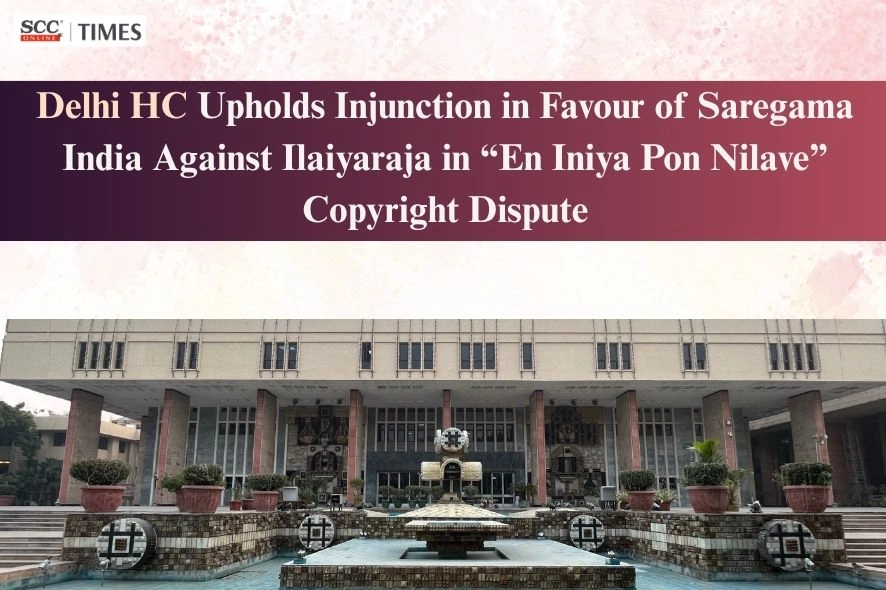
Delhi High Court: The instant appeal arose from Ilaiyaraja Saregama copyright dispute, concerning the iconic Tamil song “En Iniya Pon Nilave” from the film Moodu Pani, where the controversy centered on the ownership and scope of copyright in the underlying musical work, lyrics, and sound recording embodied in the song. The appellant, renowned composer, Ilaiyaraaja, challenged the Single Judge’s judgment dated 30 January 2025 which had confirmed the interim injunction in favour of respondent-Saregama India Limited (SIL) and restrained the appellants-defendants from using the recreated version of the song in the film Aghathiyaa. The Division Bench of C. Hari Shankar* and Om Prakash Shukla, JJ., concurred with the Single Judge’s judgment and held that though2 the appellant remained the first owner of copyright in the musical work contained in the disputed song, En Iniya Pon Nilave under Section 14(a)(vi), Copyright Act, 1957 (Copyright Act), however, he had no right in the lyrics or sound recording and could not assign those rights to Vels Film International Limited (VFIL).
The Court observed that:
“A song is just a song, a thing of joy to lighten a dreary evening. That is, till it becomes subject-matter of copyright conflict in a court of law, when it suddenly metamorphoses into much more.”
The Court held that the respondent, was the owner of copyright in the sound recordings contained in the film Moodu Pani, which included the sound recording of the song En Iniya Pon Nilave. The Court based its reasoning on following grounds:
-
copyright in the sound recordings in Moodu Pani, which would include the sound recording in the song En Iniya Pon Nilave, vested in Raja Cine Arts (RCA), and never resided in the appellant; and
-
RCA, by the agreement dated 25 February 1980, transferred copyright in the said sound recordings to the respondent.
Factual Matrix
The respondent instituted the suit alleging infringement of its copyright in the literary and musical works embodied in the song “En Iniya Pon Nilave”. According to respondent, the song had been unlawfully recreated for use in the upcoming film Aghathiyaa produced by VFIL.
The respondent pleaded that the producer of Moodu Pani, RCA, had executed an agreement dated 25 February 1980 with the respondent through Saraswati Stores. Under the agreement, RCA assigned rights in the sound recordings and underlying literary and musical works of the film to the respondent.
In January 2025, the respondent discovered promotional material for film Aghathiyaa containing a recreated version of the disputed song. A cease-and-desist notice was immediately issued to VFIL and Divo TV Private Limited. VFIL replied that it had obtained a licence from the appellant authorising adaptation and recreation of the song.
The respondent asserted that under Section 17 read with Section 2(f), Copyright Act, the producer of the cinematograph film became the first owner of copyright in the sound recordings and underlying works forming part of the film. Consequently, RCA had become the owner of copyright in the disputed song and had thereafter assigned those rights to the respondent.
The respondent further pleaded that the appellant, though the composer of the song, ceased to retain copyright in the musical work once it became part of the cinematograph film. Thus, the appellant had no authority to grant VFIL any licence in relation to the song.
The respondent also contended that the recreated version could not be termed an “adaptation” under Section 14(a)(vi) because VFIL had merely reproduced the original lyrics and musical composition and made a fresh recording thereof.
Also Read: Delhi High Court grants injunction protecting Saregama India’s copyrights in cinematic music
Single Judge’s Judgment
The Single Judge held that while Section 13(4) preserved certain rights of the composer, the producer of the film nevertheless became first owner of the soundtrack incorporated in the cinematograph film. It was held that the appellant had exhausted his right under Section 14(1)(v) once the song became part of the cinematograph film and thus, could not thereafter authorise creation of another sound recording based on the same song.
The Single Judge rejected the argument based on the second proviso to Section 17, holding that the 2012 Amendment was prospective and could not affect rights arising from a 1980 agreement. The defence of “adaptation” was also rejected on the ground that the defendants had not merely rearranged the composition but had used the lyrics and music to create a fresh sound recording.
Ultimately, the Single Judge concluded that the respondent was owner of the sound recordings and musical and literary works in the songs of Moodu Pani, including En Iniya Pon Nilave, and restrained VFIL from using the recreated version without licence from the respondent.
Issue for Determination
The Court identified the central issue as the “situs of the copyright” in the disputed song and specifically, whether the appellant retained the right to adapt the musical work after the song became part of the film Moodu Pani.
Analysis
At the outset, the Court noted that a song may appear to be “just a song” until questions of copyright transform it into a legal conflict involving “the intricate balance” between copyrights in music, lyrics, and sound recordings.
Interpretation of “Musical Work”
The Court noted held that Section 2(p), Copyright Act clearly defined “musical work” as music excluding lyrics. Consequently, the musical component of the disputed song constituted an independent copyrightable work. It was held that since the appellant was admittedly the composer, thus, he was the “author” of that musical work under Section 2(d)(ii).
Interpretation of Section 17, Copyright Act
The Court noted that Section 17 makes the author of a work the first owner of copyright in the work. It held that the appellant, as composer, was unquestionably the author of the musical work under Section 2(d)(ii) and by operation of Section 17, he became the first owner of copyright in the musical composition.
The Court categorically rejected the applicability of clauses (b) and (c) of the first proviso to Section 17. It observed that clause (b) did not apply to musical works or sound recordings in the manner suggested by the respondent and clause (c) also had no application because there was no employer-employee relationship or “contract of service” between RCA and the appellant.
Scope of Ilaiyaraaja’s Rights
The Court noted that “adaptation”, under Section 2(a)(iv), included arrangements or transcriptions of the musical composition. The Court emphasised that the right of adaptation extended only to the musical component and not to the lyrics or sound recording. The lyrics belonged to the lyricist, while the sound recording belonged to the producer.
The Court held that under Section 14(a)(vi), the appellant possessed the exclusive right to make adaptations of the musical work. However, the Court stated that the appellant’s copyright extended only to the musical component of the song and he had no rights over the lyrics, or the sound recording itself.
The lyrics of the disputed song were no man’s land, and Ilaiyaraaja would have no copyright over the lyrics and, consequently, none of the rights envisaged under Section 14(a) would be available to Ilaiyaraaja insofar as the lyrics in the disputed song were concerned.
The Court held that copyright in the lyrics vested in the lyricist, while copyright in the sound recording vested in the producer of the film.
Ilaiyaraaja was, therefore, entitled to contract with any third party for use, or for adaptation, of the musical work contained in the disputed song, i.e, the musical component thereof. That right could not, however, extend to doing anything involving the sound recording of the disputed song, or the lyrics thereof.
Effect of Section 13(4), Copyright Act
The Court noted that Section 13(4) stipulates that the copyright in a cinematograph film or a sound recording would not affect the separate copyright in any work in respect of which, or in respect of a substantial part of which, the film, or the sound recording, is made.
Thus, the Court held that even if the respondent validly held copyright in the sound recording of the song through RCA, such ownership could not extinguish the appellant’s independent copyright in the musical work. The Court described the appellant’s right in the musical work as “inviolate and sacrosanct”.
Ilaiyaraaja’s copyright in the musical work contained in the disputed song, therefore, continues to remain protected and, consequently, his right to exploit the musical work in the manner envisaged by Section 14(a)(iv) and (a)(v) read with Section 14(a)(vi), also remains inviolate and sacrosanct.
Agreement dated 17 March 2023 between Ilaiyaraaja and VFIL
Upon examining the clauses, the Court found that the agreement dated 17 March 2023 incorrectly represented the appellant as owner of the sound recording, and the underlying works including lyrics.
The Court held that the appellant could not have assigned rights over the sound recording or lyrics because those rights never vested in him. Therefore, while the appellant could lawfully authorise adaptation of the musical composition, he could not authorise use of the lyrics or the original sound recording.
Ilaiyaraaja could not, therefore, have assigned, to VFIL, the sound recordings in the film Moodu Pani either, which would include the sound recording relating to the disputed song En Iniya Pon Nilave.
Agreement dated 25 February 1980 between Saraswathi Stores (SIL’s agent) and RCA
Upon examining the 1980 agreement between RCA and Saraswati Stores/SIL, the Court found that the agreement expressly assigned gramophone recording rights and rights in the soundtrack to the respondent.
The Court held that the respondent validly acquired rights in the sound recordings associated with Moodu Pani. However, it was held that these rights did not extinguish the composer’s independent copyright in the musical work.
Decision
Drawing the distinction between the musical composition, the lyrics, and the sound recording, the Court held that:
-
The appellant remained the first owner of copyright in the musical work contained in the disputed song.
-
The respondent validly owned copyright in the sound recording contained in the film Moodu Pani, which included the sound recording of the song En Iniya Pon Nilave
-
Section 13(4) preserved the coexistence of these independent copyrights.
-
The appellant retained the statutory right to adapt the musical work under Section 14(a)(vi).
-
However, the appellant had no right in the lyrics or sound recording and could not assign those rights to VFIL.
-
The agreement with VFIL wrongly purported to transfer rights beyond those legally vested in the appellant,
-
The recreated version used not merely the musical composition but also the lyrics and sound recording elements, thereby infringing the respondent’s copyright.
Accordingly, the Court upheld the injunction against use of the recreated song in the manner proposed by VFIL while simultaneously recognising the appellant’s continuing copyright in the musical composition itself.
Also Watch: Kahaani 2 Copyright Dispute: Supreme Court Quashes Criminal Proceedings
[Ilaiyaraaja v. Saregama India Ltd., 2026 SCC OnLine Del 3846, decided on 21-5-2026]
*Judgment authored by Justice C. Hari Shankar
Advocates who appeared in this case:
Ms. Swathi Sukumar, Sr. Adv. with Mr. Naveen Nagarjuna, Mr. Ritik Raghuwanshi, Ms. Rishika Agarwal and Ms. Shrudula Murthy, Advs., Counsel for the Appellant
Mr. J. Sai Deepak, Sr Adv. with Mr. Ankur Sangal, Mr. Ankit Arvind, Mr. Shashwat Rakshit, Mr. Rishabh Rao, from Khaitan & Co., Counsel for the Respondent