Disclaimer: This has been reported after the availability of the order of the Court and not on media reports so as to give an accurate report to our readers.
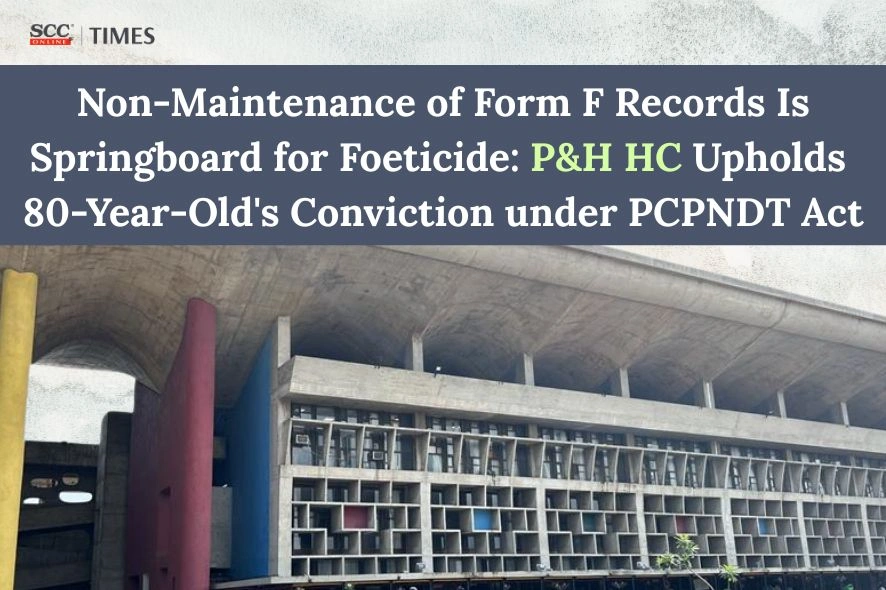
Punjab & Haryana High Court: In a criminal revision petition challenging conviction under Section 29, Pre-Conception and Pre-Natal Diagnostic Techniques (Prohibition of Sex Selection) Act, 1994 (PCPNDT Act) read with Rule 9(1) and (4), Pre-Conception and Pre-Natal Diagnostic Techniques (Prohibition of Sex Selection) Rules, 1996 (1996 Rules), the Single Judge Bench of Ramesh Chander Dimri, J., dismissed the revision petition and upheld the conviction of the 80 years old petitioner, owner of M/s Mittal Maternity & Scan Centre, Barnala. The Court held that improper maintenance of Form F records amounted to a clear violation PCPNDT Act and that even if the search was not conducted in strict compliance with Section 30, PCPNDT Act and Rule 12, 1996 Rules, the documents seized during such search remained admissible and could be relied upon.
Also Read: Punjab and Haryana HC acquits doctors in 19-year-old PCPNDT case due to procedural lapse
Background
In the present case, the complainant, appointed as Sub-Divisional Appropriate Authority under Section 17(2), PCPNDT Act through Punjab Government Gazette Notification dated 20 June 2001, alleged that the petitioner’s clinic was inspected on 19 January 2005 by a team headed by him in which they found that records required under the PCPNDT Act and 1996 Rules were not properly maintained, record keeping of Forms “F” was not as per PCPNDT Act guidelines and none of the 49 forms inspected bore signatures of the doctor conducting ultrasonography, 4 referral slips of ultrasound patients were not produced, and ultrasound films relating to those forms were also not produced.
The ultrasound machine was sealed by complainant, and he supplied a copy of the inspection report to the petitioner. Thereafter, registration of the clinic was suspended on 20 January 2005. The petitioner’s appeal before the District Appropriate Authority was rejected on 24 March 2005.
The trial court convicted the petitioner on 10 May 2010 under Section 29(1), PCPNDT Act punishable under Section 23, PCPNDT Act and sentenced her to rigorous imprisonment for 2 years along with fine of ₹5000. In appeal, the Additional Sessions Judge upheld the conviction but reduced the substantive sentence from two to one year. Aggrieved of the said dismissal, the petitioner is in revision before this Court.
Analysis
At the outset, the Court reiterated the limited scope of revisional jurisdiction under Section 401, Criminal Procedure Code, 1973 (CrPC) and observed that reappreciation of evidence was not appropriate for the High Court unless the lower court findings suffered from manifest illegality or gross miscarriage of justice.
Referring three-Judge Bench decision in Raj Kumar v. State of H.P., (2008) 11 SCC 76, the Court observed that the PCPNDT Act is a social welfare legislation enacted to prohibit sex selection and female foeticide and that Section 29, PCPNDT Act read with Rule 9, 1996 Rules mandates proper maintenance and preservation of records. The Court referred Federation of Obstetrics & Gynaecological Societies of India v. Union of India, (2019) 6 SCC 283, and noted that non-maintenance of records is springboard for commission of offence of foeticide, not just a clerical error.
The Court found that Forms F recovered from the petitioner’s clinic did not contain signatures of the doctor conducting ultrasonography which has been held by the Supreme Court as mandatory, also the petitioner had nowhere denied that the documents belonged to her clinic or that they were recovered during inspection. The Court noted,
“The said facts/omissions on the part of the petitioner and her clinic, therefore, are clear-cut violations of Section 29, 1994 (PCPNDT) Act read with Rule 9, 1996 Rules.”
For the petitioner contention regarding illegality of search, the Court observed that even assuming non-compliance of with Section 30, PCPNDT Act and Rule 12, 1996 Rules, documents seized during search are evidence in question, and relied upon Radha Kishan v. State of U.P., 1962 SCC OnLine SC 89.
The Court observed that although the procedure under Section 30, PCPNDT Act and Rule 12, 1996 Rules was not strictly followed during the search, documents Ext. C-3 to Ext. C-51 were relevant and admissible and clearly established violation of Section 29, PCPNDT Act read with Rule 9, 1996 Rules. The Court further noted that the petitioner never disputed the search or seizure of documents from her clinic and therefore could not challenge the impugned judgments on the ground of procedural non-compliance. The Court observed that although the petitioner was stated to be 80 years old, no leniency in sentence could be shown considering the violations and omissions committed by her under the PCPNDT Act and the 1996 Rules.
For the impugned judgment the Court found no manifest error on the point of law resulting in flagrant miscarriage of justice in the same and did not found the order to be perverse or unreasonable. Thus, finding no ground to interfere in the impugned judgments in exercise of its revisional jurisdiction under Section 401 CrPC, the Court dismissed the revision petition along with all pending applications.
[Pushap Lata v. State of Punjab, 2026 SCC OnLine P&H 8417, decided on 10-4-2026]
Advocates who appeared in this case:
For the petitioner: Aman Bansal, Advocate
For the respondent: Kuljeet Singh, Addl.A.G.