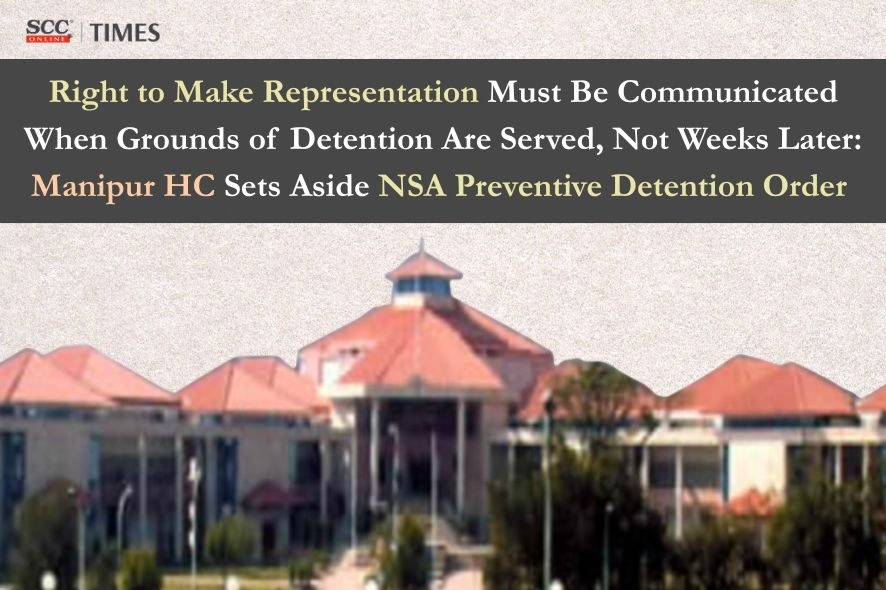
Manipur HC: In a writ of habeas corpus, a Division Bench of M. Sundar*, CJ., and Ahanthem Bimol Singh, J., set aside the impugned preventive detention order issued against the petitioner under Section 3(3), National Security Act, 1980 (NSA), as the grounds of detention issued to the petitioner by the detaining authority, did not state the petitioner’s right to make a representation to detaining authority and Central Government, thus violating Section 14 NSA and Article 22(5) of the Constitution. The Court applied the principles pertaining to Article 22(5) to preventive detention order under the NSA and held that the order stands vitiated for non-communication of his right to make a representation.
Background
A writ of habeas corpus was filed, assailing a preventive detention order dated 20 February 2026 which was passed in exercise of powers under Section 3(3) NSA by detaining authority, an order dated 2 March 2026 approving the impugned preventive detention order under Section 3(4) NSA and an order dated 16 March 2026 under Section 12(1) NSA confirming the same.
Three FIRs were filed against the petitioner on different occasions and in different police stations in Imphal, under Sections 16, 17 and 20, Unlawful Activities (Prevention) Act, 1967 (UAPA) and Section 25 (1-B) Arms Act, 1959, first being filed on 21 January 2024. Pursuant to the second FIR, the petitioner was arrested and eventually granted bail by the trial court on 4 August 2025. Petitioner was again arrested after the third FIR on 8 January 2026 for which the bail application filed on 15 February 2026, was pending. Meanwhile, the sponsoring authority wrote a letter on 20 February 2026 recommending preventive detention of petitioner under NSA and on such letter the detaining authority issued the impugned preventive detention order. Such order was approved and confirmed by the government under NSA. Grounds of detention were served on the petitioner on 24 February 2026 and bail application filed by him was withdrawn by him.
The Central Government sent a communication to detaining authority making it clear that the detaining authority has an obligation to inform the detenu about detenu’s right to make a representation to the Central Government. The detaining authority informed the petitioner through a communication dated 12 March 2026, of his right to make a representation to the Central Government. Moreover, 90 days had elapsed from the date of arrest, the prosecution had neither filed the charge-sheet nor filed an application under Section 43-D(2) UAPA seeking extension of remand and time for filing charge-sheet and therefore the petitioner was entitled to default bail, which was opposed by respondents.
Eventually, the preventive detention order was challenged in the present writ petition.
Analysis
The Court noted that the impugned order of preventive detention, it’s approval and confirmation, were challenged on two grounds: 1) The grounds of detention did not mention the petitioner’s right to make a representation to the detaining authority, though detaining authority had the power to revoke or modify the detention order for at least 12 days as per Section 14 NSA. 2) The grounds of detention did not mention the petitioner’s right to make a representation to the Central Government and he was informed regarding this later on 12 March 2026 and since under Section 14, the detaining authority had an obligation to inform detenu about such right at the earliest, such actions violated the right of petitioner under Article 22(5) of the Constitution and the provisions of National Securities Act, 1980. In response to the challenge, the respondents said that the right to make a representation to the detaining authority is implicit in the right to make a representation to the appropriate government and detaining authority acts as a conduit for the same.
The Court referred to the judgment in Kamleshkumar Ishwardas Patel v. Union of India, (1995) 4 SCC 51 stating that this case is an authority for the principle that the right of a detenu to make a representation vide Article 22(5) of the Constitution carries with it a corresponding obligation on the authority making the order of detention to inform the detenu of his right to make a representation against the order of detention to the authorities who are required to consider such a representation. The Court also took note of the fact that impugned preventive detention order was made on 20 February 2026 and the grounds of detention was served on the detenu on 24 February 2026.
In the light of Kamleshkumar judgment, it was the finding of the Court that the person detained must be informed of his right to make a representation to the authority that has made the order of detention at the time when he is served with the grounds of detention, so as to enable him to make such a representation and the failure to do so results in denial of the right to make representation qua a detenu. And if this is applied to the facts of the present case, then the detenu ought to have been informed on 24 February 2026 about his right to make a representation to the detaining authority which was not the case. The respondents refuted this saying that the right to make a representation to the detaining authority was implicit in the right to make a representation to the appropriate government, i.e., the State Government.
The Court stated, referring to Supreme Court’s ruling on scope of Article 22(5) with respect to non-communication of the right to make representation to detenu in State of Maharashtra v. Santosh Shankar Acharya, (2000) 7 SCC 463, that the detenu will have a right to make a representation to the detaining authority so long as the order of detention has not been approved by the State Government and consequently, non-communication of the fact to detenu that he has a right to make a representation to the detaining authority would constitute an infraction of valuable constitutional right guaranteed to the detenu under Article 22(5) of the Constitution and such failure on the part of the State would render the order of detention invalid.
Adopting the principle in Konsam Brojen Singh v. State of Manipur , 2006 SCC OnLine Gau 324, where it was held that the principles pertaining to rights under Article 22(5) would apply to preventive detention under NSA, the Court held that the impugned preventive detention order is clearly vitiated and is liable to be dislodged owing to non-communication to the detenu of his right to make a representation to the detaining authority when the grounds of detention was served on the detenu.
The Court observed that Article 22(5) imposes a dual obligation on the detaining authority, to communicate to the detenu the grounds as soon as the same is made and to afford the person detained “earliest opportunity” of making a representation against the order of detention. The detention order was made on 20 February 2026, grounds were drawn up on 23 February 2026 and served on the detenu on 24 February 2026 but the detenu was admittedly informed about his right to make a representation to the Central Government only on 12 March 2026 after the Central Government alerted the State Government about their duty to inform the detenu that he has a right to make a representation to the Central Government.
It was the finding of the Court that there is a twofold obligation under Article 22(5), the obligation to communicate the grounds as early as possible and also afford earliest opportunity to the detenu for making a representation.
Therefore, the Court held that since the petitioner was deprived of “earliest opportunity”, the obligation of the State was not discharged and this vitiates the impugned preventive detention order.
Decision
The Court allowed the writ petition and set aside the impugned preventive detention order, the order of its approval and confirmation made by respondents and the petitioner was directed to be set at liberty.
The Court refrained from deciding the question of non-application of mind by the detaining authority regarding the Central Government’s notification where certain associations were held to be “unlawful” as the petitioner was found to be member of one of such associations, as the petitioner did not raise this question. Thus, the Court left it open to be decided if it comes up in any other matter.
[Wahengbam Bimal Meitei v. District Magistrate, Imphal, 2026 SCC OnLine Mani 239, decided on 5-5-2026]
*Judgment authored by: Chief Justice M SundarAppearance:
Advocates who appeared in this case:
For Petitioners: L Shashibhushan, M Fakharuddin
For Respondents: Phungyo Zingkhai, W. Darakeshwar