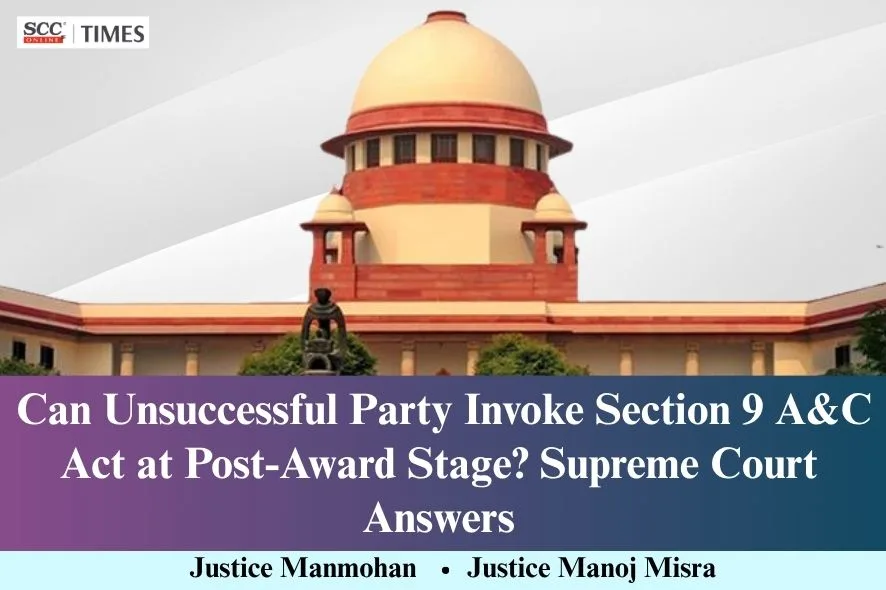
Supreme Court: In a batch of appeals arising from different High Courts having conflicting views on a substantial question of law, i.e., whether a petition under Section 9, Arbitration and Conciliation Act, 1996 (A&C Act), at the post-award stage, by a party that has lost in the arbitral proceedings and has no enforceable award in its favour, is maintainable in law, the Division Bench of Manmohan* and Manoj Misra, JJ., held that any party to an arbitration agreement, including an unsuccessful party in arbitration, may invoke Section 9, Arbitration and Conciliation Act at the post-award stage. However, the Court cautioned the courts to exercise care, caution and circumspection while dealing with a Section 9 application filed by an unsuccessful party in arbitration.
Background
In the instant matter, the impugned judgments record a clear divergence of judicial opinion. The Bombay High Court in Dirk India (P) Ltd. v. Maharashtra State Electricity Generation Co. Ltd., 2013 SCC OnLine Bom 481; Delhi High Court in Nussli Switzerland Ltd. v. Organizing Committee Commonwealth Games 2010, 2014 SCC OnLine Del 4834 and NHAI v. PNB, 2023 SCC OnLine Del 4810; Madras High Court in A. Chidambaram v. S. Rajagopal, OA No. 843 of 2024, decided on 22 November 2022 and Karnataka High Court in Padma Mahadev v. Sierra Constructions (P) Ltd., COMAP No. 2 of 2021, decided on 22 March 2021, had taken the view that an unsuccessful party cannot maintain a Section 9 petition post-award, primarily on the reasoning that interim relief at that stage is intended only to protect the “fruits of the award.”
In contrast, the Telangana High Court in Saptarishi Hotels (P) Ltd. v. National Institute of Tourism & Hospitality Management, 2019 SCC OnLine TS 1765; Gujarat High Court in GAIL (India) Ltd. v. Latin Rasayani (P) Ltd., 2014 SCC OnLine Guj 14836 and P&H High Court in DLF Home Developers Ltd. v. Orris Infrastructure (P) Ltd., FAO-CARB-51-2024 (O&M), decided on 21 February, 2025, held that even an unsuccessful party may invoke Section 9 if circumstances justify interim protection.
Issue for Determination
Whether a petition under Section 9, A&C Act at the post-award stage, by a party that has lost in the arbitral proceedings and has no enforceable award in its favour, is maintainable in law?
Analysis and Reasoning
Meaning of term “a party”
While interpreting the expression “a party” under Section 9, A&C Act, the Court reiterated the settled principle as per R.S. Nayak v. A.R. Antulay, (1984) 2 SCC 183 and Grasim Industries Ltd. v. Collector of Customs, (2002) 4 SCC 297, that where statutory language is clear, plain and unambiguous, it must be construed in its natural, ordinary and grammatical sense, without introducing words or limitations not contemplated by the legislature.
The Court also referred to R. v. Oakes, where it was observed that “where the literal reading of a statute… produces an intelligible result… there is no ground for reading in words or changing words according to what may be the supposed intention of Parliament.”
Applying the above discussed principle, the Court noted that Section 9 begins with the expression “a party”, which is defined under Section 2(h) as “a party to an arbitration agreement” and either provisions did not draw any distinction between a successful or unsuccessful party. The Court held that to read such a distinction into the statute would be impermissible.
The Court asserted that the very purpose of incorporating a definition clause is to assign a fixed meaning to a term, and unless ambiguity exists, courts are not required to reinterpret it. Any attempt to construe expression “a party” differently at the post-award stage would lead to an anomalous situation, where the same expression would include all parties before the award but only successful parties thereafter. It opined that “the statutory framework does not prescribe any qualification that would confine the availability of post-award relief under Section 9 solely to award-holders.”
Relying on Cox v. Hakes, (1890) 15 App. Cas. 506, 528, the Court rejected such contextual modulation as the same amounts to judicial amendment, which lies beyond the province of the Court.
Object and Scope of Section 9
Examined the object and scheme of Section 9, the Court noted that the provision expressly allows recourse to interim measures at three distinct stages, prior to commencement of arbitration, during arbitral proceedings, and after the award but before its enforcement under Section 36. On a plain reading, the provision does not impose any limitation based on the outcome of the arbitration. In Sundaram Finance Ltd. v. NEPC India Ltd., (1999) 2 SCC 479, the Court had already clarified that jurisdiction under Section 9 extends across all these stages.
The Court further compared Section 9 with Article 9, UNCITRAL Model Law, observing that the “Indian Parliament has consciously conferred an additional right upon parties to seek interim measures after the arbitral award has been rendered but prior to its enforcement.” This deliberate departure, without imposing any restriction on the class of parties entitled to invoke the provision, demonstrated legislative intent to confer a broad and unqualified right.
The Court asserted that the interpretation adopted in Dirk India (supra) had confined Section 9 relief at the post-award stage and by restricting the provision to protection of an enforceable award, the judgment had introduced a limitation unsupported by the language of Section 9. If such a restriction had been intended, the legislature would have expressly provided for it while consciously deviating from the UNCITRAL Model Law.
Consequently, the Court opined that the object and purpose of Section 9 is to ensure that parties retain the right to approach the Court for interim measures until the judicial process has reached its culmination.
Also Read: The Wide Scope of Section 9 of the Arbitration and Conciliation Act, 1996
Distinct Operation of Sections 34, 36(2) and 9
The Court held the mere availability of recourse under Section 34 or of a stay under Section 36(2) cannot operate as a bar to seeking protection under Section 9.
The Court noted that Sections 34 and 36 operate in distinct spheres. Section 34 provides a mechanism to set aside an award, while Section 36 governs its enforceability and the grant of stay. In contrast, Section 9 is concerned with protection of the subject matter or the amount in dispute.
The Court asserted that since an unsuccessful party cannot secure such protection under Sections 34 or 36, denying access to Section 9 would leave such a party remediless, particularly in situations where the award is stayed or is ultimately set aside. It emphasised that the final outcome of Section 34 proceedings may alter the rights of parties, and therefore access to interim protection cannot be conditioned upon the label of “successful” or “unsuccessful”.
Fallacy in Dirk India, Nussli Switzerland, Padma Mahadev and A. Chidambaram (supra)
The Court found that the reasoning in Dirk India (supra), Nussli Switzerland (supra), Padma Mahadev (supra) and A. Chidambaram (supra), was based on premise that courts, under Section 34, can only either set aside or uphold an award, and therefore interim protection post-award is relevant only for safeguarding its fruits.
In light of Gayatri Balasamy v. ISG Novasoft Technologies Ltd., where it is recognised that “courts exercising jurisdiction under Sections 34 and 37 possess the power to modify an arbitral award where the award is severable, by excising the invalid portion from the valid portion, and/or by correcting clerical, computational, or typographical errors, and/or by modifying post-award interest in appropriate circumstances.” The Court held that the assumption by the above-mentioned judgments is untenable in law.
Further, the Court referred to Section 43(4), which excludes the time spent in arbitral proceedings when computing limitation for fresh proceedings. This provision preserves the right of parties to re-agitate disputes, reinforcing the need for interim protection even for a party that has lost in arbitration. The Court also noted that under the Arbitration Act, 1940, interim protection was expressly confined to the successful party; the absence of such a restriction in the present statute indicates a conscious legislative departure.
Purposive Interpretation of term “a party”
Even on a purposive interpretation, the Court found no justification for excluding unsuccessful parties and identified several situations where such parties may legitimately require interim protection, such as where the award is alleged to be vitiated by fraud or lack of notice; where interim orders granted during arbitration need continuation; or where dissipation of assets may render eventual success in Section 34 proceedings illusory. The Court also illustrated cases of partial success, where rigid classification as “unsuccessful” may lead to injustice. It was held that in such circumstances, interim measures may be necessary to preserve the efficacy of the challenge proceedings.
Judgment in Hindustan Construction Co. Ltd. v. Union of India, (2020) 17 SCC 324 not binding
The Court clarified that although Hindustan Construction (supra) referred to Dirk India (supra), but it did not decide the present issue. Referring to MCD v. Gurnam Kaur, (1989) 1 SCC 101 and State of U.P. v. Synthetics & Chemicals Ltd., (1991) 4 SCC 139, the Court asserted that observations made Hindustan Construction (supra) cannot be treated as binding precedent under Article 141 on a question that was neither raised nor adjudicated in the matter.
Courts Interpret the Law, but they don’t Alter It
Referring Gwynne v. Burnell, (1840) 7 Cl. & F. 572, 696, the Court reaffirmed the limits of judicial interpretation, observing that courts interpret the law but do not alter it. It categorised the approach adopted by the High Courts in Dirk India (supra), Nussli Switzerland (supra), Padma Mahadev (supra) and A. Chidambaram (supra), as a “strained interpretation” of a provision that was “clear, categorical, and couched in simple and direct terms.”
Relying on Jugal Kishore Saraf v. Raw Cotton Co. Ltd., (1955) 1 SCC 248, DLF Qutab Enclave Complex Educational Charitable Trust v. State of Haryana, (2003) 5 SCC 622, the Court emphasised that purposive interpretation cannot override plain language except in cases of manifest absurdity, an exceptional threshold that was not met in the present case.
Threshold for Grant of Relief
While upholding the maintainability of Section 9 petitions by unsuccessful parties, the Court clarified that the threshold for granting interim relief to an unsuccessful party would be higher. Referring to Essar House (P) Ltd. v. Arcellor Mittal Nippon Steel India Ltd., (2022) 20 SCC 178, the Court stated that the grant of interim relief would continue to be governed by established principles such as prima facie case, balance of convenience, and irreparable injury.
“In rare and compelling cases, permitting the unsuccessful party to invoke Section 9 of the Act would prevent irreparable prejudice and preserve the efficacy of the challenge proceedings. However, the rights of such a party cannot be curtailed merely on the apprehension of possible misuse of a statutory provision.”
Decision
The Court held that any party to an arbitration agreement, including an unsuccessful party in arbitration, may invoke Section 9 at the post-award stage. However, it cautioned the courts to exercise care, caution and circumspection while dealing with a Section 9 application filed by an unsuccessful party in arbitration.
The Court held that the judgments in Dirk India (supra), Nussli Switzerland (supra), Padma Mahadev (supra) and A. Chidambaram (supra), insofar as they deny an opportunity to unsuccessful parties in arbitration to apply for relief under Section 9, did not lay down good law.
The Court further held that the contrary views expressed in Saptarishi Hotels (supra), Latin Rasayani (supra) and DLF Home Developers (supra), correctly reflect the statutory position.
[Home Care Retail Marts Pvt. Ltd. v. Haresh N. Sanghavi, 2026 SCC OnLine SC 670, decided on 24-4-2026]
*Judgment by Justice Manmohan
Buy Arbitration and Conciliation Act, 1996 HERE