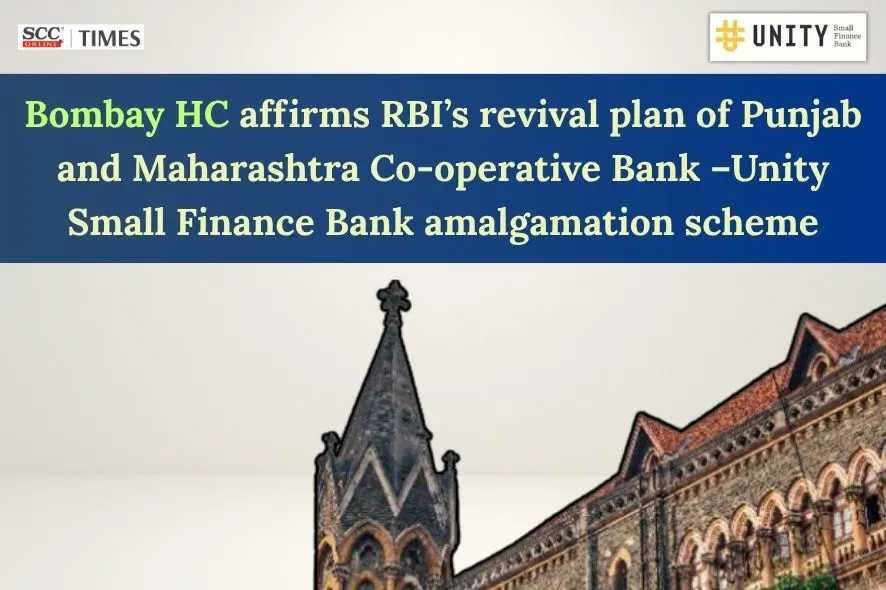
Bombay High Court: While hearing a batch of petitions challenging the Punjab and Maharashtra Co-operative Bank Ltd. (Amalgamation with Unity Small Finance Bank Ltd.) Scheme, 2022 (Scheme) notified on 25 January 2022, the Division Bench of Bharati Dangre* and Manjusha Deshpande, JJ., upheld the Scheme framed by Reserve Bank of India (RBI) under Section 45, Banking Regulation Act, 1949 (BR Act). The Court reiterated that its scope in matters of economic policy is extremely limited and unless the Scheme is arbitrary, irrational, or framed on extraneous considerations, there is no basis to interfere. Finding that the PMC Bank—Unity Bank amalgamation Scheme was prepared in public interest and in the interest of depositors and noting the precarious financial condition in which the bank stood at the time of inspection, the Court held that no illegality or infirmity had been demonstrated and rejected the challenge.
Background
The case arose from the collapse of Punjab and Maharashtra Co-operative Bank (PMC Bank), a multistate scheduled urban cooperative bank, whose financial position had deteriorated sharply following the revelation of serious financial irregularities in September 2019. RBI’s statutory inspection disclosed that the total exposure to the Housing Development and Infrastructure Ltd. (HDIL) group had been camouflaged and severely underreported, that the net worth and the capital to risk assets ratio (CRAR) had plummeted from positive figures to a huge negative, and that significant deposit erosion had occurred. PMC Bank’s net worth as on 31 March 2019 showed a steep fall and deposit erosion stood at 45.43 per cent. RBI thereafter imposed all inclusive directions under Section 35-A read with Section 56, BR Act to ensure preservation of PMC Bank’s scarce resources and to protect the interest of depositors. Withdrawal limits were gradually enhanced but PMC Bank’s condition continued to worsen, and the Board of Directors (BoD) was superseded under Section 36-AAA, BR Act.
RBI explored multiple options including capital infusion/merger, reconstruction under Section 45, BR Act, non-performing assets (NPA) recovery, and merger with a strong bank, however, none of the proposals were found feasible. Expressions of interest were invited and only one viable proposal remained. A draft Scheme was placed in the public domain on 22 November 2021 and suggestions and objections were invited. After considering them and carrying out certain changes, the Scheme was forwarded to the Central Government and notified with effect from 25 January 2022.
Petitioners, comprising retail depositors, institutional bodies, and others, contended that the staggered repayment schedule extending over 10 years was arbitrary, that the Scheme denied them interest after 31 March 2021 for five years and thereafter provided only simple interest at 2.75 per cent, and that the classification between “retail depositors” and “institutional depositors” was artificial and violative of Article 14 of the Constitution. It was also contended that the draft Scheme underwent only cosmetic alterations, that the reversal of interest credited between 1 April 2021 and 24 January 2022 was unconstitutional, that pro rata distribution should have been adopted as in liquidation under Section 43-A, BR Act, and that the delays in resolution and in the Deposit Insurance and Credit Guarantee Corporation’s (DICGC) payouts caused prejudice to larger depositors. It was argued that alternative solutions including merger with a public sector bank had been improperly rejected. Further, the institutional petitioners asserted that partnership firms and societies were incorrectly categorised.
The respondents submitted that PMC Bank’s net worth as on 30 September 2021 was negative at (—) 6737.61 crores, that deposit erosion had risen to 62.99 per cent, and that 83 per cent of the loan portfolio was nonperforming. It was urged that the staggered schedule was framed to protect the maximum number of depositors first, as more than 84 per cent of small depositors were able to withdraw their entire balances immediately through DICGC. It was emphasised that the classification was based on the nature of the entity and not on the quantum of deposit, and that the Scheme prevented liquidation, under which depositors would receive only Rs 5 lakhs. It was placed on record that as of 31 December 2025, 99.45 per cent of insured depositors had withdrawn the DICGC-released amounts and that the transferee bank had grown steadily.
Analysis and Decision
The Court appreciated the scope of the power of RBI, as contemplated in the BR Act and the various steps which it is competent to initiate for regulating the business of PMC Bank, when it took cognizance of its precarious financial condition on account of complete erosion of its capital in exercise of its supervisory jurisdiction. The Court observed that Section 35, BR Act authorises RBI, at any time and on being directed by the Central Government, to cause an inspection to be made of any banking company and its books and accounts.
The Court highlighted that the classification of the investors under the Scheme was aimed at securing public interest and protecting the interest of the largest number of depositors by continuing the operations of PMC Bank. The Court observed that while exploring various possibilities of infusing capital for revival of PMC Bank or its merger with a stronger bank vis-à-vis the cancellation of licence and liquidation, the expression of interest was invited through public advertisement for investment/equity participation, and upon Unity Small Finance Bank Ltd. (Unity Bank) coming forward, the Central Government sanctioned the Scheme of amalgamation on 25 January 2022. Further, considering the weak financial position of PMC Bank and since RBI is authorised to reduce the rate of interest, all deposits transferred from PMC Bank stopped accruing interest after 31 March 2021.
The Court observed that RBI, which also works as a Central Bank where the commercial banks are account holders, is referred to as the “Banker’s bank”, and it maintains banking accounts of all scheduled banks. It was emphasised that it is the duty of RBI to control the credit through cash reserve ratio (CRR), repo rate and open market operations, and as the Banker’s Bank, it facilitates the clearing of cheques between the commercial banks and helps the inter-bank transfer of funds and is also empowered to grant financial accommodation to scheduled banks.
The Court highlighted that the BR Act has conferred several powers upon RBI including the power to remove managerial and other persons from office, take over control, and supersede BoD in certain cases. It was noted that among the powers conferred on RBI is the power to apply to the Central Government for suspension of business by a banking company and to prepare a scheme of reconstruction or amalgamation under Section 45, BR Act, a power permitted to be exercised for a good reason and if RBI is of the opinion that it is in the “public interest” or in the “interest of the depositors” or in order to secure proper management of the banking company.
The Court referred to R.K. Garg v. Union of India, (1981) 4 SCC 675, wherein it was held that if RBI had issued directions of 1987 to safeguard the larger interest of the public and small depositors, it cannot be said that the directions are so unreasonable as to be declared constitutionally invalid. The Court further relied upon New Bank of India Employees’ Union v. Union of India, (1996) 8 SCC 407, where the Supreme Court observed that no scheme of amalgamation can be foolproof and a court would be entitled to interfere only when it comes to the conclusion that either the scheme is arbitrary or irrational or has been framed on some extraneous consideration.
The Court emphasised that Section 45, BR Act requires RBI to be satisfied, during the period of moratorium or at any other time, about the public interest, the interest of the depositors, or in order to secure the proper management of the banking company and this being the focus of RBI for amalgamation of the banking company with any other banking institution, it is permissible to have reduction of the interest or rights which the members, depositors and other creditors have in the banking company before its amalgamation, and such reduction shall be to such extent as RBI considers necessary in public interest or in the interest of the depositors or creditors or for maintenance of the business of the banking company.
The Court emphasised that RBI, in its economic wisdom, had formulated the Scheme which received final approval from the Central Government in the larger interest of the public and the depositors and does not suffer from any legal infirmity though it might have caused some inconvenience to a few. It was noted that the payment of minimum interest of 2.75 per cent after five years, though alleged to be arbitrary, does not deserve interference since Section 45, BR Act itself contemplates reduction of interest or rights of depositors and creditors, and as the Scheme intends to benefit the maximum depositors by returning the principal amount, it is a profitable deal, otherwise, given the negative net worth of PMC Bank, all depositors would have been deprived of their money had PMC Bank been put under liquidation. Unless it is shown that the decision of RBI and the Central Government is arbitrary or smacks of mala fides, the Court refrained from exercising judicial review.
The Court also highlighted that CRR is imperative to be maintained by every bank as a going concern and cannot be utilised to pay depositors, and that DICGC’s liability is governed by statute and had not been reduced.
Ultimately, the Court concluded that the objections did not justify disruption of the existing Scheme of amalgamation since the expert body like RBI had made a serious attempt to save an ailing bank and its depositors. Holding that the Scheme was framed in consonance with the statutory provisions and in larger public interest, the Court dismissed all writ petitions.
[Bhalchandra Dinkar Gondekar v. RBI, 2026 SCC OnLine Bom 2089, decided on 9-3-2026]
*Judgment authored by: Justice Bharati Dangre
Advocates who appeared in this case:
For the Petitioners: Virendra Tulzapurkar, Senior Advocate with Sangram Chinnappa, Dipika Sahani, Bhoomika Vyas and Shantanu Shetty, Ankit Lohia with Siddharth Joshi, Viloma Shah, Harshad Vyas and Viraj Raiyani i/b M/s. AVP Partners, Uday P. Warunjikar with Vaishnavi M. Gujarathi i/b Aditya P. Kharkar, Anilkumar Patil with Zeel Jain Aseem Naphade with Subrata Sen, Akash Loya, Sujit Lahoti, Tejasvi Nakashe and Haaris Koradia i/b Sujit Lahoti and Associates, Karl Tamboly with Bhavin Shah, Krupesh Bhosle and Maulik Tanna, Advocates
For the Respondents: Dhaval Patil i/b M/s. K. Ashar and Co., Shivam Mehra, Ravi Kadam, Senior Advocate, Ameya Gokhale, Rishabh Jaisani, Harit Lakhani, Richa Bharti and Ansh Kumar i/b Shardul Amarchand Mangaldas and Co., Ashish Kamat, Senior Advocate with Shlok Parekh, Mustafa Kachwala, Shantam Mandhyan, Shrishti Shetty and Sakshi Sri i/b Krishnamurthy and Co., Venkatesh Dhond, Senior Advocate with Prasad Shenoy, Parag Sharma, Aditi Phatak, Parichehr Zaiwalla, Ishita Desai, Megha More, Juhi Bhayani i/b BLAC Co., Shlok Parekh a/w Mustafa Kachwala, Shantam Mandhyan, Shrishti Shetty and Sakshi Sri i/b Krishnamurthy and Co., Kedar Dighe a/w Ashutosh Mishra, Mohamedali M. Chunawala with J. B. Mishra and Ashotosh Mishra