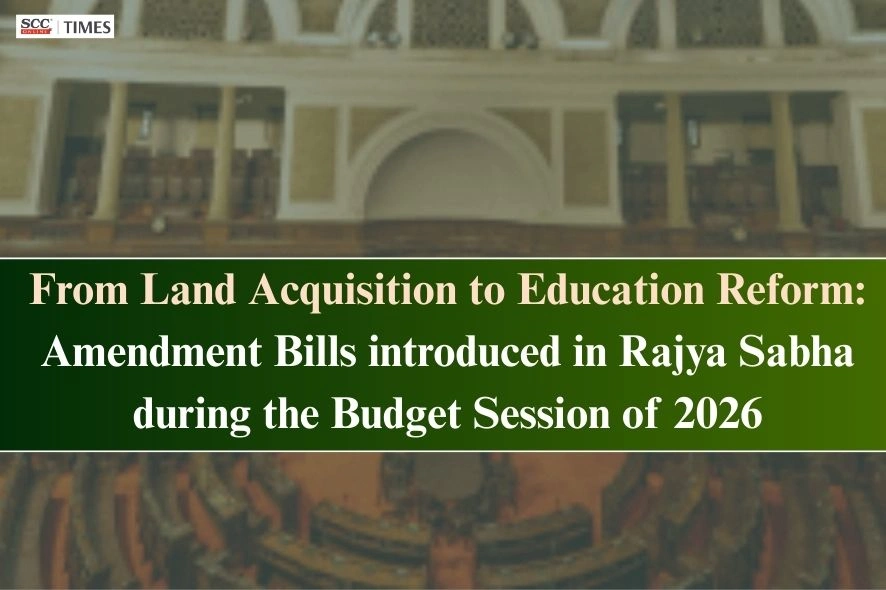
On 13 March 2026, several Private Members’ Bills were introduced in the Rajya Sabha during the Budget Session.
Following are Amendment Bills introduced in Rajya Sabha:
Right to Fair Compensation and Transparency in Land Acquisition, Rehabilitation and Resettlement (Amendment) Bill, 2025
This Bill seeks to strengthen safeguards for farmers and food security by amending Section 10 of the Right to Fair Compensation and Transparency in Land Acquisition, Rehabilitation and Resettlement Act, 2013. A new sub-section (5) prohibits acquisition of irrigated multi-cropped agricultural land in regions notified as climate-vulnerable.
Further, sub-section (6) mandates a Food Security Impact Assessment before any agricultural land is acquired, evaluating effects on productivity, food supply chains, and livelihoods, with findings made public and annexed to the Social Impact Assessment. Additionally, a Post-Acquisition Food Security Review within five years will ensure accountability for actual impacts on food production and security.
Bharatiya Nyaya Sanhita (Amendment) Bill, 2026
This Bill seeks to introduce a new Section 24 A to enhance punishment for offences committed under voluntary intoxication. It specifies that:
-
For offences punishable with death or life imprisonment, an additional fine of not less than ₹5 lakh will apply.
-
Where life imprisonment is prescribed, it shall mean imprisonment for the remainder of the offender’s natural life, plus a fine of not less than ₹3 lakh.
-
For all other offences listed (100, 101, 103, 104, 105, 109, 110, 111, 113, 117, 118, 119, 120, 121, 124, 140 or 143) punishment may extend to one and one-half times the maximum term of imprisonment and up to twice the maximum fine.
The enhanced punishment is in addition to existing provisions, ensuring stricter accountability when crimes are committed under intoxication.
Also read: From Parent Care Leave to Free Education: 13 New Bills Introduced in Rajya Sabha
Constitution (Amendment) Act, 2026
The Constitution Amendment Bills introduced propose two significant changes:
-
Insertion of Article 21B:
A new Article 21B mandates that the State shall provide free access to knowledge and information through public libraries and public library services to all persons, in such manner as may be determined by law. This amendment seeks to constitutionally guarantee access to public libraries, recognising them as essential institutions for democratic participation, social mobility, and informed citizenship.
-
Amendment to Article 366:
Clause (15A) is proposed to be inserted to define “minority” as a community whose population, based on religion or language, is two per cent or less of the total national population according to the latest census. However, where the population of such a community in a State, Union Territory, or district exceeds its national average, it shall not be treated as a minority in that region. This introduces an objective, region-sensitive demographic framework for minority identification.
Together, these constitutional amendments aim to democratise access to knowledge while ensuring that minority protections are demographically precise, regionally fair, and consistent with constitutional intent.
Right of Children to Free and Compulsory Education (Amendment) Act, 2026
This Bill proposes the following amendments to the Right of Children to Free and Compulsory Education Act, 2009:
Section 23: New sub-sections (4) to (7) are inserted to protect the service conditions of teachers appointed prior to this amendment. These provisions ensure that such teachers are not compelled to acquire additional qualifications or subjected to adverse consequences, including termination, denial of promotion, or loss of service benefits.
Section 23A: This section is introduced to explicitly guarantee that the service conditions, promotions, and retirement benefits of pre-existing teachers shall not be altered to their disadvantage due to newly prescribed qualification requirements, which shall apply prospectively only.
Section 38: A new clause (la) is added, empowering the appropriate Government to frame guidelines for the professional upgradation and training of existing teachers, without linking such upgradation to service security or continuity.
Section 39A: This section is introduced to authorise Governments to issue directions and clarifications to ensure that teachers appointed prior to the commencement of the Act are protected from adverse service consequences arising from changes in qualification norms.
Also read: Bill introduced in Lok Sabha to revise the definition of “transgender person”