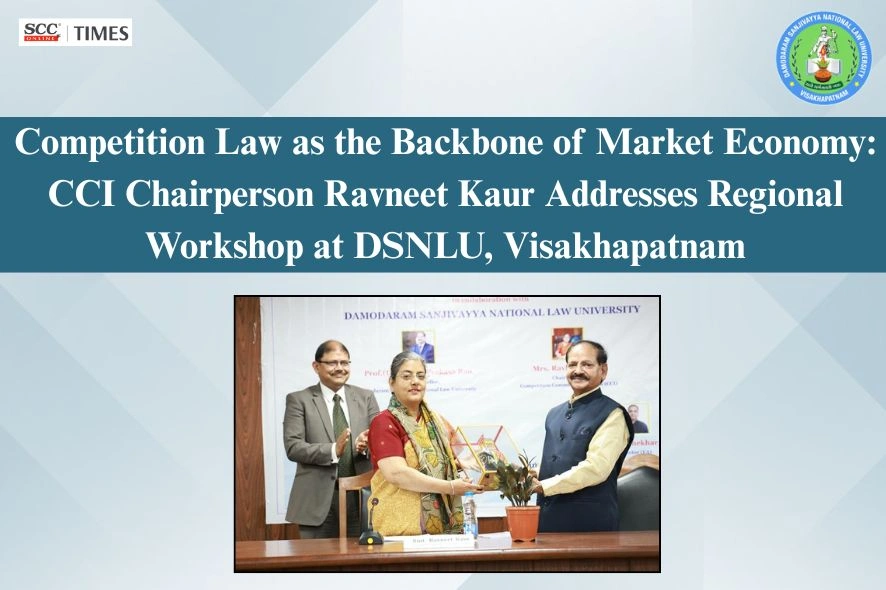
The Competition Commission of India (CCI), in collaboration with Damodaram Sanjivayya National Law University (DSNLU), Visakhapatnam, organised a Regional Workshop on Competition Law at the university campus on 27 February 2026. The programme, held at the Conference Hall, fetched together officials of the competition regulator, the Vice-Chancellor, faculty members, research scholars and law students for an in-depth engagement with contemporary developments in India’s competition law regime. The event formed part of the Commission’s broader competition advocacy initiative, which is designed to disseminate knowledge of competition law and policy among universities, emerging legal professionals and stakeholders in the market ecosystem. The workshop was held under the leadership of the Vice-Chancellor, Prof. (Dr.) D. Surya Prakasa Rao, with the coordination undertaken by the university centre for competition and anti-trust laws and with the support of other faculty members. The introductory of the programme by the vice-chancellor mentioned about the Dunkel Draft, prepared by GATT Director-General Arthur Dunkel in 1991 during the Uruguay Round, pushed for global trade liberalization, which indirectly influenced India’s economic policies leading to the Competition Act, 2002. The Vice Chancellor’s speech links WTO formation (1995) and TRIPS obligations to India’s economic reforms, IP law amendments (1995-2010), and the Competition Act, 2002, which replaced the MRTP Act to curb monopolies and foreign dominance post-liberalization. It highlights criticisms of WTO as “colonialism in a new form” but notes India/China’s benefits, with UNCTAD/NIEO protecting developing nations from MNC technology control. CCI’s role involves enforcing fair competition (anti-cartel, dominance curbs), awareness, and cases like the 2004-09 Andhra Pradesh seed failure ruling favoring farmers against suppliers. The keynote address was delivered by CCI Chairperson Ravneet Kaur, whose remarks framed competition law as central to the preservation of fair markets and consumer welfare in a rapidly transforming economy and technical sessions by — Shri Dheeraj Gupta, Advisor and Shri Shekhar, Director of CCI.
Competition Law and the Market Economy
In her keynote address, the Chairperson underscored that competition constitutes the lifeblood of a market economy and is indispensable for sustaining fair and efficient market structures. She emphasised that markets function optimally only when firms compete on the basis of innovation, efficiency and merit, rather than through anti-competitive practices or structural distortions. By ensuring that businesses do not rely on collusion, exclusionary conduct or unfair advantages, competition law protects consumer choice and helps secure improved product quality, competitive pricing and technological dynamism. Situating the discussion within the framework of the Competition Act, 2002, she explained that the statutory mandate of the Commission is centred on the twin objectives of protecting consumer welfare and maintaining freedom of trade, while simultaneously preserving a level playing field for enterprises of varying sizes. The Chairperson highlighted that the Commission’s intervention is calibrated to prevent practices that distort competition, thereby ensuring that markets remain open, contestable and aligned with the broader goals of economic development.
Institutional Role and Functional Pillars of the CCI
Elaborating on the institutional role of the Commission, the Chairperson outlined the principal functional pillars through which the CCI contributes to the regulation of India’s market economy, namely enforcement against anti-competitive conduct, regulation of mergers and acquisitions, and competition advocacy. With respect to enforcement, she noted that the Commission investigates and proceeds against a range of anti-competitive practices, including cartelisation and price-fixing arrangements, bid-rigging in procurement processes and various forms of abuse of dominant market position. Enterprises found to be in violation of the Act are subject to regulatory directions and monetary penalties designed both to remedy the specific infringement and to deter future misconduct. In this context, she drew attention to the Competition Amendment Act, 2023, which has significantly strengthened the enforcement architecture by, inter alia, enabling the computation of penalties on the basis of global turnover, thereby enhancing deterrence in relation to large multinational firms and complex conglomerate structures.
In relation to merger control, the Chairperson observed that the second pillar of the Commission’s work concerns the regulation of combinations, including mergers, acquisitions and amalgamations that meet prescribed jurisdictional thresholds. Such transactions are reviewed ex ante in order to assess whether they may give rise to an appreciable adverse effect on competition through heightened concentration, foreclosure of rivals or other structural concerns. She explained that recent legislative changes introducing a deal-value threshold have been particularly significant for the scrutiny of transactions in the digital economy, where target entities may command substantial data, user bases or technological capacities despite having relatively low tangible assets or turnover. The third pillar, competition advocacy, encompasses the Commission’s engagement with stakeholders through workshops, seminars, trainings and policy dialogues intended to build an informed culture of compliance. The workshop at DSNLU formed part of this advocacy function by providing a forum in which regulators and students could engage substantively with evolving issues in competition law and policy.
Competition Law as a Professional and Academic Field
Addressing the students and young researchers present, the Chairperson highlighted competition law as an expanding and intellectually demanding field of legal practice and scholarship. She underlined that expertise in competition law today is relevant not only to traditional litigation and advisory work but also to corporate compliance, regulatory decision-making and policy design in both domestic and international contexts. Graduates trained in this area may pursue careers in specialised competition law practice within law firms, in in-house roles within corporate legal departments, in governmental and quasi-governmental regulatory bodies, and in policy think tanks and research institutions. She further noted that competition law is increasingly salient for entrepreneurs and start-ups, particularly in digital and platform markets, where new entrants frequently encounter structural barriers erected by incumbent firms with significant market power. In the academic domain, she encouraged students to view competition law as a abundant site for doctrinal, comparative and empirical research, given the rapid evolution of jurisprudence and regulatory techniques.
Evolution of India’s Competition Law Framework
During the technical sessions, officials from the Commission traced the historical evolution of India’s competition law regime, situating the current framework within a broader trajectory of economic and legal reform. They recalled that the earlier regime was governed by the Monopolies and Restrictive Trade Practices Act, 1969, which was primarily concerned with preventing the concentration of economic power rather than with promoting competitive market structures as such. Following the economic liberalisation initiatives of 1991, it became increasingly evident that the MRTP framework was inadequate for regulating a liberalised and globally integrated market economy. Acting upon the recommendations of the Raghavan Committee, Parliament enacted the Competition Act, 2002, thereby establishing a modern competition law regime broadly aligned with international best practices. The Competition Commission of India commenced enforcement operations in 2009, and the merger control provisions became operational in 2011, marking a decisive shift from a control-oriented to a competition-oriented regulatory philosophy. Subsequent legislative amendments, including the 2023 reforms, have continued to refine the framework in response to emerging market structures and technological developments.
Substantive Provisions: Agreements, Dominance and Combinations
The sessions offered a structured exposition of the substantive provisions of the Competition Act relating to anti-competitive agreements, abuse of dominant position and regulation of combinations. With regard to Section 3, officials explained that the law prohibits agreements that cause or are likely to cause an appreciable adverse effect on competition. They distinguished between horizontal agreements, which are concluded between enterprises operating at the same level of the market, and vertical agreements, which link entities at different levels of the supply chain, such as manufacturers and distributors. Horizontal arrangements such as price-fixing cartels, bid-rigging in tenders and market-allocation schemes were identified as particularly pernicious due to their direct impact on prices, output and consumer welfare, and are therefore treated with a presumption of illegality. Vertical agreements, by contrast, including exclusive supply obligations, tie-in arrangements and resale price maintenance, are generally evaluated under a rule-of-reason framework that takes into account both their potential anti-competitive effects and their possible efficiency justifications.
On the question of dominance, speakers examined the contours of Section 4, clarifying that the Act does not proscribe dominance per se but only its abuse. Firms may legitimately attain a dominant position through innovation, superior efficiency or legitimate business expansion. Nonetheless, where a dominant enterprise engages in conduct such as imposing unfair or discriminatory pricing or trading conditions, denying market access to rivals, predatory pricing designed to eliminate competitors, or leveraging dominance in one relevant market to obtain advantages in another, such behaviour may attract scrutiny as abusive. The assessment of dominance entails a contextual evaluation of market share, financial and economic strength, barriers to entry, countervailing buyer power and the overall structure and dynamics of the relevant market. In relation to combinations under Sections 5 and 6, officials explained that enterprises engaging in mergers, acquisitions or amalgamations that cross prescribed thresholds are under an obligation to notify the Commission prior to consummation. The Commission’s review seeks to determine whether the proposed transaction is likely to substantially lessen competition, and may result in unconditional approval, conditional approval subject to structural or behavioural remedies, or, in rare cases, prohibition. It was noted that, in practice, a substantial proportion of notified combinations are cleared without modification, reflecting a regulatory approach that seeks to reconcile competition concerns with the imperative of facilitating economic growth and investment.
Digital Markets and Emerging Regulatory Challenges
A significant part of the workshop was devoted to the challenges posed by digital markets, artificial intelligence and data-driven business models for competition law enforcement and policy. Officials observed that digital platforms and technology-intensive firms often operate in environments characterised by strong network effects, scale and scope economies, and high levels of data concentration, all of which can contribute to the entrenchment of market power. They pointed to issues such as algorithmic pricing, automated decision-making, self-preferencing, gatekeeping conduct and the strategic acquisition of nascent competitors as illustrative of the new forms of potential anti-competitive behaviour that arise in such markets. The Commission’s recent market studies on artificial intelligence and competition policy were discussed as part of an evolving effort to understand these dynamics and to calibrate regulatory tools to address them without stifling innovation. The sessions thus highlighted the need for a responsive and forward-looking competition law framework that can accommodate rapid technological change while preserving the core objectives of fairness, contestability and consumer welfare.
Pedagogical Impact and Conclusion
The workshop concluded with an extended interactive session in which students engaged with the Chairperson and other officials on a range of doctrinal and policy questions, including the relationship between competition regulation and sector-specific regulators, the appropriate treatment of dominant firms in infrastructure and digital sectors, and the assessment of mergers in concentrated markets. In responding, the Chairperson reiterated that the Commission’s interventions are guided by the standard of appreciable adverse effect on competition and are designed to maintain a careful balance between necessary regulatory oversight and the facilitation of economic development and innovation. For the participating students and faculty, the workshop offered a valuable opportunity to gain first-hand insights into the functioning of India’s competition regulatory apparatus, the practical challenges of enforcement and the normative debates that animate contemporary competition policy. By fostering direct interaction between regulators, academics and emerging legal professionals, and by situating doctrinal exposition within the broader context of India’s evolving market economy, the Regional Workshop on Competition Law at DSNLU contributed meaningfully to the cultivation of a culture of competition compliance and scholarly engagement with this rapidly developing field.