Disclaimer: This has been reported after the availability of the order of the Court and not on media reports so as to give an accurate report to our readers.
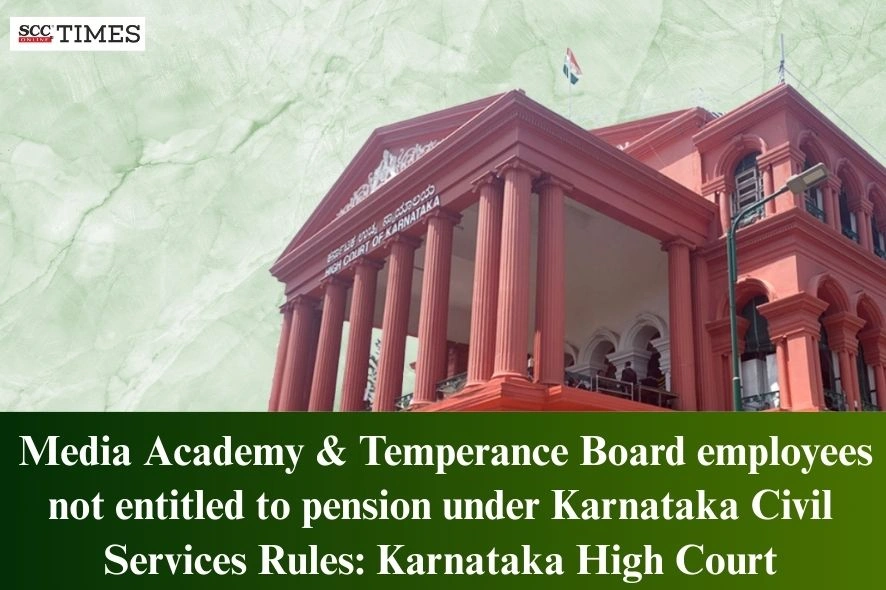
Karnataka High Court: In bunch of appeals and review petition challenging single-judge bench order dated 10-01-2022, granting pensionary benefits to employees of the Media Academy and Temperance Board under the Karnataka Civil Services Rules (‘KCSRs’), and directions in contempt proceedings for implementing those orders, a Division Bench of Anu Sivaraman* and Vijaykumar A. Patil, JJ., set aside the order and held that the employees of the Media Academy or the Temperance Board are not Government servants and hence, not eligible to pension under KCSRs
Brief Facts
In the instant matter, the writ petitioners were long-serving employees of the Karnataka Media Academy and the Karnataka State Temperance Board, bodies created by Government Orders in exercise of the State’s executive power.
Their posts had been created or approved by the Government, and in the case of the Media Academy, its bye-laws provided that service conditions “regarding pay, increment, leave… shall be governed by the Karnataka Civil Services Rules (‘KCSRs’)”, but no provision existed making their service pensionable under the KCSRs.
The Single-Judge bench had directed that these employees were entitled to pension as per KCSRs, leading to these appeals. The Court recorded that “the question raised in these appeals as well as the review petition is common” and proceeded to hear all matters together after condoning delay.
Moot Points
-
Whether employees of the Media Academy and Temperance Board are “Government servants” entitled to pension under the KCSRs?
-
Whether the absence of Cadre & Recruitment Rules or Government-approved appointments makes their service pensionable?
-
Whether the Single Judge’s directions granting pension were legally sustainable?
Parties’ Contentions
The State-appellants contended that the earlier decision in State of Karnataka v. Shankar M.R.,1 was completely different as it concerned a Grant-in-Aid Educational Institution, whereas the Media Academy and Temperance Board “are not Grant-in-Aid Institutions”. It was contended that the bye-laws did not make KCSR pension provisions applicable as Rules 222 and 223 of KCSRs clearly require that service must be “under Government” and exclude employees of Local Bodies and Grant-in-Aid institutions. It was contended that the omission of Rule 2-A by notification dated 29-01-2014 showed legislative intent to confine pension under KCSRs to Government servants. It was further contended that the employees subscribed to CPF and were not covered by KCSR pension rules.
The respondents-employees contended that the appointments were made to posts created or approved by the Government. It was contended that since KCSRs was applied to them in terms of pay and allowances, the Government was estopped from denying pension. It was stated that other Boards and statutory bodies had been extended pension benefits and denial of same to them amounted to discrimination. It was further contended that the Review petition was not maintainable since contempt proceedings were already initiated and the judgment had become final.
Court’s Analysis and Decision
The Court examined the definition of “Government servant” under Rule 2(d) of the KCS (CC&A) Rules and observed that a Government servant is one “who holds a civil post in connection with the affairs of the State.” The Court noted that the KCSR provisions relating to pension, i.e., Rule 222 and Rule 223, applies only where service is under Government, substantive and permanent, and paid by Government.
The Court asserted that although these bodies were created by Government Order there is no provision in the Bye-laws making the service of these employees pensionable in terms of the KCSRs. The Court held that the employees of the Media Academy or the Temperance Board are not eligible to pension as Government servants.
The Court emphasised that judgment in Shankar M.R.(Supra) involved an aided post, where pension flowed from the Grant-in-Aid Code. However, in the present case respondents are not Grant-in-Aid Institutions and there is no provision which makes their service pensionable.
The Court noted that respondents relied on Government orders granting pension to employees of Silk Board and similar institutions. The Court stated that this reliance, clearly prove that pension to non-government employees requires a specific Government order, and cannot be claimed as a matter of right. Thus, the Court held that any parity claim could not be enforced by judicial direction under Article 226 of the Constitution of India.
The Court held that “it would not be in the realm of judicial review… to decide whether the employment of the petitioners… is to be made pensionable or not,” as this determination lies exclusively with the Government.
The Court allowed all the writ appeals and review petition and set aside the Single Judge’s directions granting pension. The Court issued fresh directions and directed the Government to take up the request seeking pension and to pass an informed order, thereon after hearing the Media Academy and Temperance Board, within four months.
[State of Karnataka v. Yallagaiah G., 2025 SCC OnLine Kar 21766, Decided on 19-11-2025]
*Judgment by Justice Anu Sivaraman
Advocates who appeared in this case:
Sri. Reuben Jacob, AAG with Smt. Mamatha Shetty, AG, Counsel for the Appellants
Sri. Pruthveen Prahlad Kattimani, Counsel for the Respondent No. 1, 2 and 3
Buy Constitution of India HERE

1. W.P. No. 34512/1999, dated 17-03-1999.