








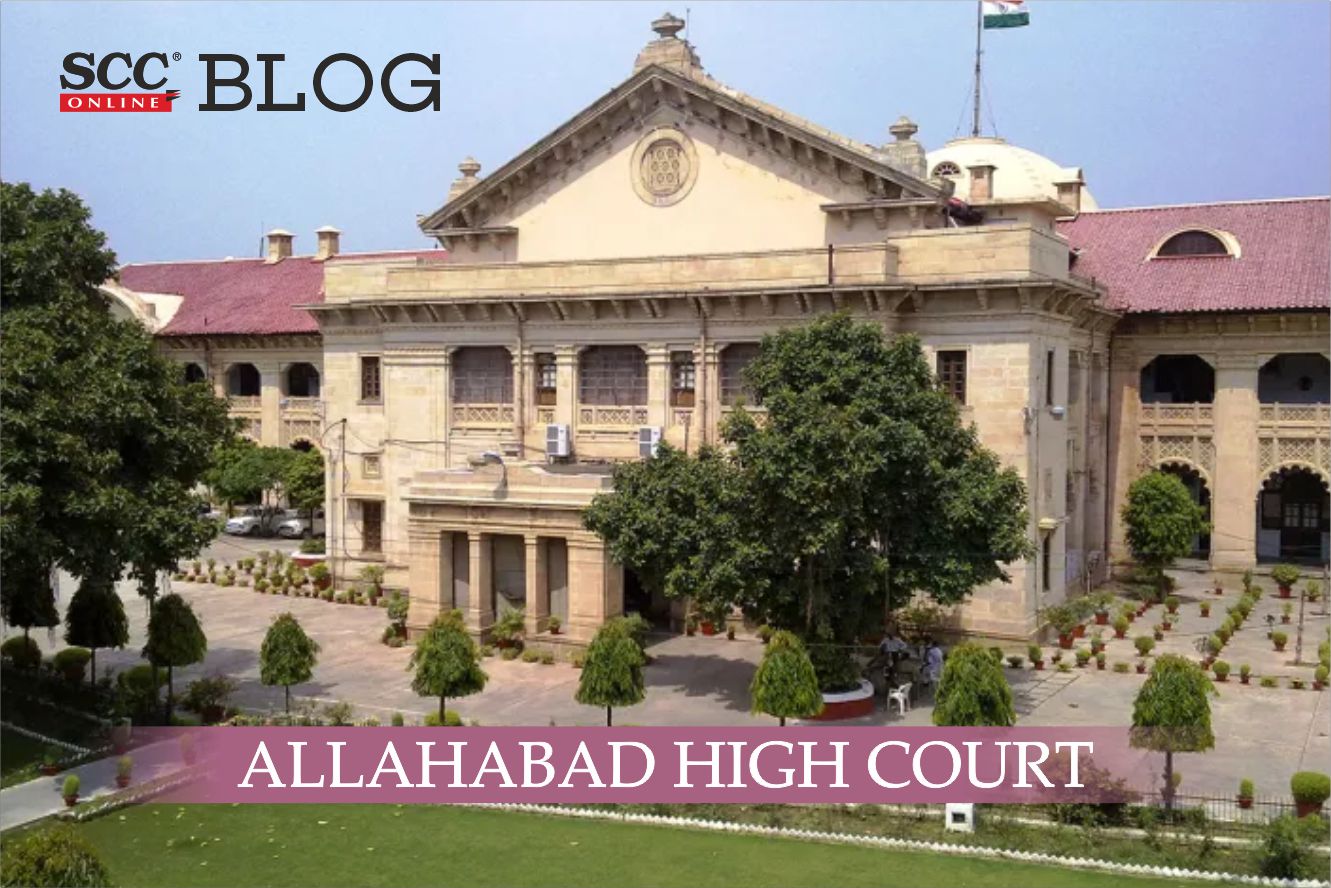
Allahabad High Court: In an anticipatory bail application filed by the applicants for offences under Sections 420, 467, 468, 471, 386, 120-B, 504, 506, 409, 34 of the Penal Code, 1860, Krishan Pahal, J. has held that that every judgement must be seen to its own context and facts and the precedents cannot be applied universally to every case. Hence, anticipatory bail was denied.
The applicants submitted that the present FIR has been instituted against them out of vengeance and the allegations in both the FIRs are in-verbatim of each other. Further, the present FIR is hit by Section 300 of Code of Criminal Procedure (CrPC) as the applicants have been put to double jeopardy by the said FIR.
The applicants have placed reliance on the decision in Upkar Singh v. Ved Prakash, (2004) 13 SCC 292, wherein, it has been laid down that the legal right of an aggrieved person to file counter case is permissible; further, it referred to the decision in Amitbhai Anilchandra Shah v. CBI, (2013) 6 SCC 348, wherein, it has been stated that the second FIR on same set of facts is barred and it is clearly violative of fundamental rights enshrined under Article 14, 20 & 21 of the Constitution of India; and, in T.T. Antony v. State of Kerala, (2001) 6 SCC 181 , wherein, it has categorically been stated that the second FIR with respect to the same offence is barred.
The applicants have also relied upon the judgement of this Court in Suresh Babu v. State of U.P., Criminal Misc. Anticipatory Bail Application No. 3532 of 2022, wherein it has been stated that when the investigation is going on against a Government Servant and the proceedings under Section 82 of Code of Criminal Procedure (CrPC) have been undertaken, the accused person is entitled for anticipatory bail.
Further, the informant has relied upon the judgement passed in Lavesh v. State (NCT of Delhi), (2012) 8 SCC 730, wherein it has been held that a proclaimed offender is not entitled to anticipatory bail as he has not cooperated with the investigation.
The Court viewed that the judgements of Upkar Singh (supra) and T.T. Antony (supra) cannot help the applicants, as the said judgements are not applicable to the present case, wherein it has been held that second FIR is not barred, although the said facts are different as they pertain to a cross-case. Further, the decision in Suresh Babu (supra) is also not applicable to the present case as the accused in the said case had no criminal history and was a government servant and, thus, he was granted anticipatory bail.
The Court observed that the decision in Lavesh (supra), holds good in the present case, as the applicants are proclaimed offenders as the proceeding under Sections 82 and 83 CrPC are almost complete, and they have criminal antecedents in many cases.
The Court referred to the ruling in Quinn v. Leathom, [1901] A.C. 495, wherein Lord Halsbury said that “a case is only an authority for what it actually decides. I entirely deny that it can be quoted for a proposition that may seem to follow logically from it. Such a mode of reasoning assumes that the law is necessarily a logical code, whereas every lawyer must acknowledge that the law is not always logical at all.” Thus, it was observed that every judgement must be seen to its own context and facts, and the precedents cannot be applied universally to every case. Hence, anticipatory bail was denied.
[Lakhan Singh v. State Of UP, 2022 SCC OnLine All 687, decided on 30.9.2022]
Advocates who appeared in this case:
Counsel for Applicant: Advocate P.K. Singh,
Advocate Vijay Kumar Mishra
Counsel for Opposite Party: Advocate Aman Kumar Dwivedi
Advocate Kamlesh Kumar Dwivedi
Advocate Manoj Kumar Singh









0 replies