Inside Supreme Court verdict on importance of question of jurisdiction at the stage of granting interim relief
“No tribunal, far less a civil court, in exercise of judicial power ought to play ducks and drakes with the rights of the parties.”

Bringing you the Best Analytical Legal News


“No tribunal, far less a civil court, in exercise of judicial power ought to play ducks and drakes with the rights of the parties.”
“Clause 29A(d) of Article 366 of the Constitution of India refers not to the transfer of property in the goods to the buyer but to the transfer of the right to use any goods for any purpose for consideration.”
Supreme Court also directed the meeting of Municipal Corporation, Chandigarh scheduled for 7-02-2024 to be deferred till further orders.
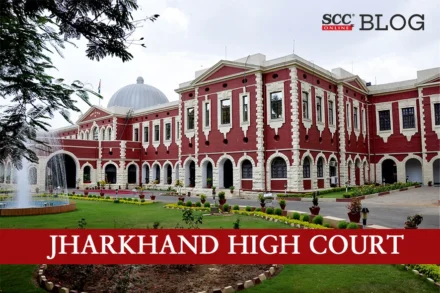
Jharkhand High Court said that one of the issues involved relates to determination of valuation of excisable goods and/or rate of duty of excisable goods, amongst other things, for the purpose of assessment.
Supreme Court concluded that both the Courts below “completely misread the material available on record”.
Any dilution of the forfeiture provided under Rule 9(5) of SARFAESI Rules would result in entire auction process under SARFAESI Act being disregarded by mischievous auction purchasers through sham bids, thereby undermining the overall object of the Act of promoting financial stability, reducing NPAs and fostering a more efficient and streamlined mechanism for recovery of bad debts.
This report covers the Supreme Court’s Never Reported Judgment dating back to the year 1952 on mortgage transaction.
The identification of forests in Goa is based on forest tree composition, canopy density and minimum area.
‘Eviction proceedings under Section 16(1)(i) and (k) of the Maharashtra Rent Control Act, 1999 have different degrees of urgency, the former has a lesser degree of urgency than later, and it is within the jurisdiction of the Court to test this factor.’
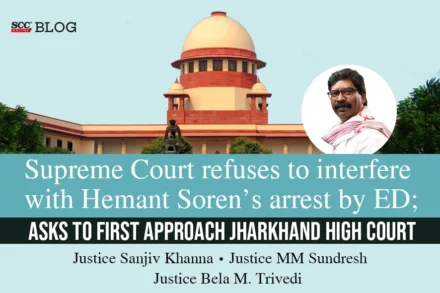
The Court took note that Soren had earlier filed a plea under Article 226 of the Constitution before the High Court but opted for withdrawal of the same to approach the Supreme Court.
Supreme Court reiterated that in addition to punishing a contemnor for disobeying its orders, the Court can also ensure that such a contemnor does not continue to enjoy the benefits of his disobedience by merely suffering the punishment meted out to him.
“A commercial dispute, which ought to have been resolved through the forum of Civil Court has been given criminal colour by lifting from the penal code certain words or phrases and implanting them in a criminal complaint.”
The Bench had earlier deferred the hearing dated 10 Jan to 24 Jan, and yet again the matter got deferred.
The Supreme Court gave directions to the Central Empowered Committee, entrusted with monitoring and compliance of the orders of the Supreme Court on Environment, to promote transparency and efficiency in its functioning.
“The caste or religion of parties should not be mentioned in the memo of parties of a petition/proceeding filed before the Court, irrespective of whether any such details have been furnished before the Courts below.”
The Court observed that merely for being deployed in Assam, IPS Officers could not be denied benefit under 2007 Rules applicable across the board to their ilk serving across the country.
In December 2023, the Supreme Court had granted interim protection to the Vice Chancellor and other officials of SHUATS from arrest
Supreme Court clarified that the review orders and not deliberations had to be made public.
The High Court referred to Section 437 of CrPC for grant of bail in a non-bailable offence in three specific circumstances.
Referring to the ‘doctrine of necessity’, Supreme Court said that had the Working President did not convene the meeting, the elections of the executive body would have been in limbo for an unreasonable amount of time.