Congress Leader Challenges BJP MLA Pratima Bagri’s Scheduled Caste Certificate; MP HC Orders Scrutiny
Congress Leader Pradeep Ahirwar had filed a complaint against BJP MLA Pratima Bagri questioning the validity of her Scheduled Caste Certificate.
The Court noted that the cumulative financial impact, as reflected in the investigation, indicated that students were compelled to incur an additional expenditure of approximately Rs 53 lakhs which could not be brushed aside as incidental or insignificant.
The Court remarked the trial Judge did not spare any time to peruse/follow the settled and binding legal position and, on extraneous reasons, dismissed the application for grant of default bail, despite accrual of an indefeasible right to the accused due to non-filing of charge-sheet within the stipulated period.
The present contempt petition was filed against the State Government for not following the undertakings given by them before the Court in several PILs filed regarding overloaded trucks.
The accused persons had posted an Instagram reel where they, along with others, stating, “Iran Ka Sath Dene Ja Rahe Hai Sab Milkar Allahu Akbar Hindustan Ka Musalman Na Kal Dara Tha Na Ham Aaj Darengey.”
The Court held that there was no error in the jurisdiction or reasoning in the impugned order because as per admitted income of the wife, her monthly income would be Rs 1.66 lakhs, and even if it had been reduced, it would still be 1.25 lakhs.
“When there are provisions for imposing a heavy fine on a quasi-judicial officer, it is expected that they would decide the matter in a judicial manner”
A woman advocate challenged the Rewa Bar Association Elections claiming that there was no reservation of 30 per cent for women candidates in violation of the Supreme Court’s directions.
A petition was filed against widening of NH 46 as it passes through an important tiger and wildlife corridor, and any construction was likely to affect the movement of wild animals.
“Justice is administered strictly in accordance with law and on the basis of legally admissible material placed on record, and not on emotional considerations or theatrical conduct in the Courtroom.”
The Madhya Pradesh High Court examined whether anticipatory bail could stand when additional, more serious offences had already been taken cognizance of by the Magistrate.
The Madhya Pradesh High Court held that to show that consent was vitiated by a misconception of fact based on a promise to marry, it must be proven that the promise was false from the outset, made in bad faith, and directly influenced the woman’s decision to engage in the sexual act.
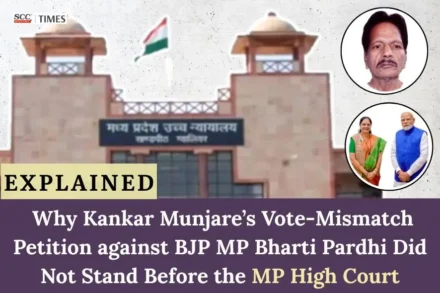
BSP Candidate Kankar Munjare approached the High Court alleging irregularities in the vote count at Polling Station 88, prompting judicial scrutiny of the 2024 parliamentary election process in Balaghat.
“Although the Trial Court might be right in obtaining spot inspection report, but that report should have been considered after recording evidence of witnesses and the trial Court should have come to a conclusion as to whether temporary injunction order was breached by any of the parties or not, but nothing of that sort has been done.”
Larsen And Toubro Limited filed the present petition aggrieved by the inaction on the damage caused to the water pipelines laid down by them under the Jal Jeevan Mission.
“Now the convenience of the wife/lady is not the paramount consideration for deciding the transfer applications and alternatives to transfer proceedings have been provided.”
“Ex gratia is not a legally mandatory payment like gratuity, it is discretionary, based on employer policy. The purpose of ex gratia is to provide immediate financial relief to the family of the deceased employee.”
The present writ petition was filed by an advocate seeking provision of amenities for specially abled persons to access the Court premises.
“Present case appears to be a case of mental depravity arising out of sibling jealousy, which needs to be addressed before it takes unruly dimensions in the society.”
The Court held that decisions relating to eligibility criteria, age limits, and closure of registrations fall within the executive policy domain of the State and are not amenable to judicial review in the absence of arbitrariness, statutory violation, or unconstitutionality.