
Timely Wage Payments Now Mandatory for Ministries, CPSEs and Contractors
Govt has ordered strict compliance with timely wage payments across ministries, CPSEs, and contractors.

Bringing you the Best Analytical Legal News


Govt has ordered strict compliance with timely wage payments across ministries, CPSEs, and contractors.
The Haryana Government has introduced a simplified compliance framework allowing establishments to rely on a single registration under the Occupational Safety, Health and Working Conditions Code, 2020.
Maharashtra Govt has issued clarification easing registration requirements for establishments covered under OSHWC Code 2020 and the Maharashtra Shops and Establishments (Regulation of Employment and Conditions of Service) Act, 2017.

UP Government has announced the revision of minimum wages effective April 2026 in response to labour unrest in Noida and Greater Noida, aiming to ensure fair wages and sustained industrial harmony.
Ministry of Labour and Employment has revised Variable Dearness Allowance rates for multiple scheduled employments with effect from 1 April 2026.
The Reference under Section 10 of the Industrial Dispute Act, 1947 cannot be quashed merely because no prior demand was served on the employer.
Gujarat Govt amends Shops and Establishments Act, revising employment and service conditions for establishments with 20 or more workers.
“Every woman shall be entitled to maternity benefit at the rate of her average daily wage for the period of her actual absence, including the day of her delivery as well as the days immediately preceding and following her delivery.”
‘The classification between the Indian and foreign employee is based on the economic duress which is caused to the Indian employees, if they are mandated to contribute to the fund/scheme irrespective of quantum of salary they draw, which is absent in case of the foreign employees for the reason that they come to India for employment for shorter period of 2 to 5 years.”
The appeal challenges the NCLAT’s order upholding a purported lay-off by Resolution Professional, which the appellant claims was a disguised and unlawful retrenchment. The Court is set to examine whether IBC overrides ID Act provisions and whether such retrenchments can legally occur under the garb of lay-offs during insolvency proceedings.
RGNUL Punjab’s CASLW has launched “Shram,” a weekly newsletter on contemporary labour and employment law issues, inviting submissions that explore evolving workplace rights and legal developments.
2025 SCC Vol. 5 Part 3: Explore the latest Supreme Court Cases on the Arbitration, IBC, CPC, Contract, Criminal Law, Education Law, Labour Law and Land Acquisition.
The employees ignored multiple communications from the petitioner-employer urging them to return to duty and moreover, there was no evidence that any of the employees made a genuine attempt to report back.
Explore the latest Cases reported in SCC’s High Court Cases (HCC)Volume on Industrial Dispute, Transfer of Employees, Departmental Enquiry, Compulsory Retirement and much more.

A quick legal roundup to cover important stories from all High Courts this week.
The Court stated that there was no award passed by the Labour Court directing the respondent to pay the benefits claimed by the petitioner.
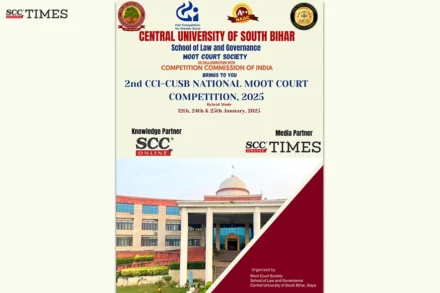
CUSB, The Central University of South Bihar, with NAAC accreditation grade A++ and categorised in Category 1 by UGC
Supreme Court noted that as per the employee in the case at hand, comes within the meaning of “workman” as given in Section 2(s) of the I.D. Act and the management without following the legal procedure, relieved him from service abruptly and hence, the same is illegal termination.
Looking at the punishments awarded to the co-delinquents for same incidents/transactions and acts of connivance and testing the impugned action on the anvil of Article 14 as well as keeping in mind the long and unblemished spell of service of the respondent, save and except, the Single Judge was inclined to convert the punishment from ‘dismissal’ to one of ‘compulsory retirement’.
An update on new additions of case laws to SCC’s High Court Cases volume.