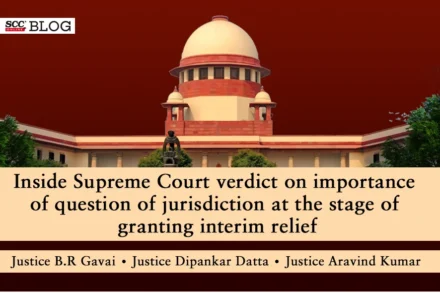
Inside Supreme Court verdict on importance of question of jurisdiction at the stage of granting interim relief
“No tribunal, far less a civil court, in exercise of judicial power ought to play ducks and drakes with the rights of the parties.”

Bringing you the Best Analytical Legal News


“No tribunal, far less a civil court, in exercise of judicial power ought to play ducks and drakes with the rights of the parties.”
“Where the plaint is returned under Order VII Rule 10 of the Civil Procedure Code, 1908, on its presentation before the appropriate Court of jurisdiction, the suit will be treated as a fresh suit, and will have to start de novo, and all proceedings before the earlier Court will be rendered a nullity.”
It is no defence to state that others have also infringing the marks/labels of the Plaintiff as the Defendant cannot seek shelter behind other infringers or potential infringers.
“The suit was instituted in 1996 and was at the fag end of the trial. The Defendant’s cross-examination was ongoing and if the proposed amendment is allowed, it will change the nature and character of the suit.”
Whilst the court is not unduly bound by the texts or Order XXXVIII Rule 1 and 2 or Order XXXVIII Rule (5) or any other provisions of CPC, the substantial principles for grant of such interim measures cannot be disregarded.
“The approach adopted by the High Court is incorrect and contrary to the well-entrenched principles of considering an application under Order VII Rule 11 of CPC.”
At this juncture, examining whether the petition filed before the NCLT can be said to be a ‘dressed-up’ petition, would necessarily require a detailed exercise to be carried out by this Court to render findings either way clearly impinging upon the exclusive jurisdiction of the NCLT in deciding such a question.
The Law Commission recommended an amendment of Section 75 CPC and insertion of new Rule 10A, 10B and 10C in Order 26 to meet its objective that there should be a special provision empowering the court to issue commissions for conducting scientific inquiries, when such an inquiry is needed for determination of any issue before the court as observed in its Fifty-Fourth Law Commission Report.
“This is a case that clamours for the exercise of judicial conscience to address the conundrum of whether an individual’s right to recover arrears in maintenance subsists even after the expiry of the period stipulated in section 125(3) CrPC.”
“Scrupulous adherence to Order VII Rule 11 of Civil Procedure Code, 1908 can curtail litigation like the present one, which aside from clogging the litigation also keeps the parties embroiled in litigation with a false hope of some relief.”
“The Court cannot create a deeming fiction on its own, where the statute does not do so. In the absence of any provision which deems a revocation petition under Section 64 of the Patents Act to be a suit, a Court cannot, even in the interests of expediency, so hold.”
“In certain situations, it may be expedient to leave it to the arbitrator to determine the issue as to whether stamping is insufficient, and if so, the arbitrator will take recourse to Section 33 of the Stamp Act, 1889.”
The phraseology “right to sue survive” used under Order 22 Rule 1 means right to seek relief. The general rule is that cause of action whatsoever existing in favour or against a person at the time of his death survives to or against his legal representatives.
In the case at hand, the Security was a ‘shop’, which was not owned by the surety, but by the Municipal Corporation, Lucknow.
The Court said that allegations of fraud require special pleadings in terms of Order VI, Rule 4 CPC, 1908.
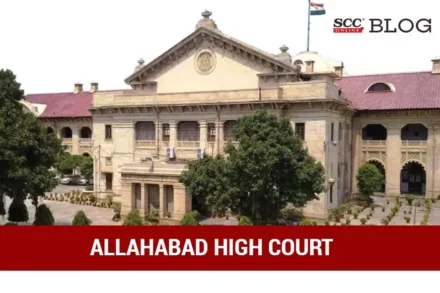
In a suit instituted by the Hindu worshippers to secure their right to darshan and pooja of deities Virajman within the premises of the Gyanvapi Mosque Complex, the Allahabad High Court said that merely seeking right to worship Hindu deities does not change the Mosque’s character into a Temple.
by Vasanth Rajasekaran†
Cite as: 2023 SCC OnLine Blog Exp 50
Allahabad High Court said that the High Court has to remain conscious of the fact that being the highest Court of the State, it is guardian of the people and being 3rd pillar of the Constitution, it safeguards interest of the people as a whole, the small sub-sects, tribe then bigger sub-sect community and full circle of the people, all fall within the protection of the Constitution.
by Prerona Banerjee† and Vishal Sinha††
The Supreme Court said that before examining the defendants’ ground of res judicata to oppose the eviction petition, several aspects may have to be looked into, like whether such an issue was substantively at issue in the previous suit and similar such other questions may crop up.