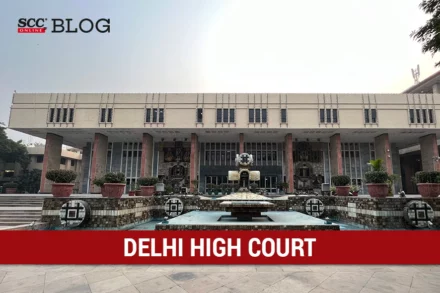
Supreme Court Collegium recommends elevation of three Judicial Officers from the Delhi Higher Judiciary to the Delhi High Court
The Supreme Court Collegium Resolution was passed dated 12-04-2023.
The Delhi High Court Mediation and Conciliation Centre, known as Samadhan organized the Inaugral Session of National Conference on “Mediation: At the
The Delhi High Court observed that Cinema Ventures Private Limited, the defaulting entity, neither filed the undertaking as assured to the court nor made any payment but rather continued to be in the possession of the property.
The Delhi High Court held that Pan masala, gutka or any other form of chewing tobacco is meant for human consumption will fall under the ambit of Section 3(1)(j) of Food Safety and Standards Act, 2006.
The Delhi High Court reprimanded the contention of the applicant stating that since the complainant was a lawyer and was, thus, well aware about nuances of writing a complaint and had, therefore, twisted the facts and police had lodged a false complaint against the applicant. It was opined that a person’s profession of being an advocate cannot be held against him.
The amendment in Section 153-C of the Income Tax, 1961 was brought and the words “belongs or belong to” were substituted by the words “pertains or pertain to” after a ruling by Delhi High Court in Pepsico India Holdings Private Limited v. ACIT, 2014 SCC OnLine Del 4155.
The Delhi High Court directed the Ministry of Information and Broadcasting along with other relevant Ministries to hold the consultation with film producers, OTT platforms operating in India, television broadcasters, association of theater owners, organizations consisting of disabled persons, distributors of films and any other stakeholders it may consider appropriate.
The Delhi High Court stated that the Constitution of India conferred a large gamut of rights upon Indian citizens and there existed a smaller bouquet of rights which were also recognised and conferred in respect of non-citizens.
The Delhi High Court held that “the petition was a mala fide attempt to throw mud on the reputation of the incumbent and is a gross abuse of process.”
Delhi High Court observed that in absence of any cogent, supervening circumstances necessitating cancellation of bail of the respondent/accused, the Court cannot merely cancel the bail so granted.
Delhi High Court noted that the applicant was working at Justdial in December 2016 as a Relationship Manager and was actively involved in supplying data to his co-accused persons and his link with the said co-accused persons.
The Review Report submitted by IIT Kanpur on DOAS Technology for the Measurement of Gaseous Air Pollutants in Ambient Air recommended DOAS technologies for regulatory measurements of ambient air quality under NAAQS.
The petitioner Satyendar Kumar Jain is an influential person and has the potential to tamper with the evidence as indicated by his conduct during custody.
The Delhi High Court opined that that technicalities and procedural defects, which do not go to the root of the matter, should not be permitted to defeat a just cause, more so in cases where suits are initiated or defended on behalf of public corporations.
The concept of exporting goods into the international market at lower prices came to be known as ‘Dumping’. The General Agreement on Tariffs and Trade (GATT) recognises the right of countries to bring in anti-dumping frameworks to deal with issues relating to dumping.
The Delhi High Court took note of the fact that Article 25 of the Constitution of India does not bestow such a right.
Delhi High Court held Bella Estate Jhuggi dwellers not entitled to rehabilitation under Delhi Slum and JJ Rehabilitation and Relocation Policy 2015.
The delay on part of the petitioner in approaching the Court had led to the conclusion of admission process, due to which the candidates with lower merit would got admission which stood crystalised. Therefore, no exceptional circumstances existed in warranting issuance of directions to admit the petitioner in the academic year 2022-23.
“A protest cannot be allowed to endanger others, damage property, restrict essential services and such a protest cannot receive constitutional protection. The acts of violence and violent speech that instigates violence and endangers rule of law, damage public property and peace are not protected under the Indian Constitution.” opined the Delhi High Court
The Delhi High Court observed that there was an unexplained substantial delay in issuing the impugned Show Cause Notice dated 09-11-2017 and thus, is inexcusable in the eyes of law