
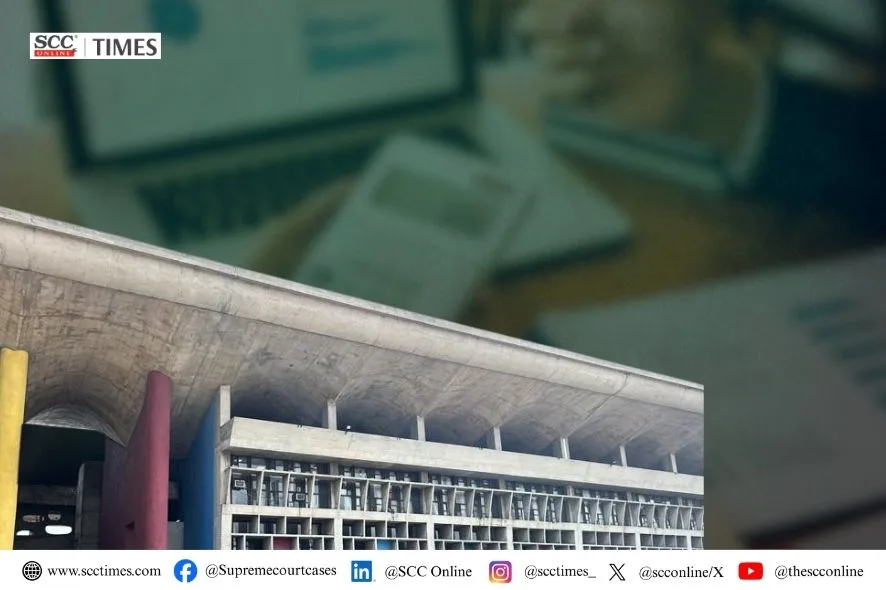
Punjab & Haryana High Court: In a bunch of 424 writ petitions concerning the scope of Section 16(2)(c), Central Goods and Services Tax Act, 2017 (CGST Act), the Division Bench of Ashwani Kumar Mishra*, CJ. and Rohit Kapoor, J. held that the provision did not suffer from any constitutional infirmity and rejected the prayer to read it down so as to restrict its application to cases of fraud, collusion or non-existent transactions.
However, the Court held that the provision could not be invoked in a routine or mechanical manner against a purchasing dealer. It issued 14 guidelines for proper officers and directed that the impugned show-cause notices and orders be reconsidered in light of those guidelines.
Background
In the case at hand, the petitioners were purchasing dealers registered under the CGST Act and the corresponding State Acts, who had availed Input Tax Credit (ITC) on purchases made from various suppliers. The proceedings arose from show-cause notices and orders, many issued under Sections 73 and 74, CGST Act, which denied or sought to reverse ITC on the ground that the tax charged by the selling dealers had not been deposited with the Government. In many cases, the action followed the retrospective cancellation of the supplier’s registration or the reflection of a nil or short tax liability in the supplier’s return.
The petitioners challenged the vires of Section 16(2)(c) as contrary to the maxim lex non cogit ad impossibilia and as violative of Articles 14, 19(1)(g), 21, 265 and 300-A of the Constitution. In the alternative, they sought that the provision be read down so that responsibility for the supplier’s failure to deposit tax was fastened upon the purchaser only in exceptional circumstances, such as where the supplier was non-existent or the transaction involved fraud.
The petitioners submitted that the original GST scheme of matching and reconciliation through Forms GSTR-1, GSTR-2, GSTR-2A and GSTR-3, and Sections 41 and 42, were never implemented in full. They argued that without that machinery, a purchaser had no means of knowing whether the supplier had deposited the tax.
The Revenue submitted that ITC was a statutory concession and not a vested right, and that actual payment of tax was an indispensable condition under Section 16(2)(c). It submitted that investigations had revealed non-genuine transactions, circuitous routing of payments, immediate cash withdrawals, and discharge of the supplier’s output tax solely through ineligible ITC. It argued that, once a prima facie opinion of fraudulent availment was formed, the burden under Section 155 lay on the claimant. It also contended that the writ petitions against show-cause notices were premature.
Issues
The questions that arose for consideration were:
-
whether Section 16(2)(c), CGST Act, which made availment of ITC conditional on actual payment of tax by the supplier to the Government, was ultra vires the Constitution on the ground that it required the purchasing dealer to perform an impossible act, or whether the provision was required to be read down;
-
what obligation was cast upon a purchasing dealer, who had already paid the tax component to the supplier, to ensure that the supplier deposited such tax with the Government; and
-
whether, and in what manner, Section 16(2)(c) read with Section 155, CGST Act could be invoked by the proper officers against purchasing dealers, and what directions were required to be issued for disposal of the connected writ petitions.
Analysis
The Court clarified that, since the petitions raised common questions concerning the statutory framework governing ITC under the GST regime, it would not examine the individual facts of each case and would refer to specific instances only wherever necessary.
Whether Section 16(2)(c), CGST Act was constitutionally valid or required to be read down
The Court examined the statutory scheme originally envisaged under the CGST Act and observed that it contemplated an elaborate mechanism for matching and verification of returns furnished by the purchasing and selling dealers. The details furnished by the selling dealer were to be communicated to the purchasing dealer, enabling the latter to verify and reconcile the particulars of inward supplies and ascertain whether the corresponding tax liability had been discharged. The Court observed that, had the original statutory scheme been implemented in its entirety, there would have been little scope for the purchasing dealer to complain about the obligation imposed under Section 16(2)(c). However, Sections 42 and 43, which contemplated matching and reconciliation of returns, were never operationalised and were subsequently omitted with effect from 1 October 2022. Section 41 was substituted and the mechanism of provisional availment of ITC followed by subsequent matching was done away with. Rule 37-A was thereafter introduced with effect from 26 December 2022 to provide for reavailment of reversed ITC upon subsequent compliance by the supplier.
The Court observed that Section 16(2)(c) was an integral part of the statutory scheme and could not be construed as a standalone provision, divorced from the other provisions containing the mechanism for its implementation. The Court referred to the principle laid down by the Supreme Court in Bhawani Cotton Mills Ltd. v. State of Punjab, 1967 SCC OnLine SC 39, concerning the imposition of tax liability upon a person who was otherwise not liable to pay such tax, and accepted the petitioners’ contention that, where the substantive provisions providing for matching and verification of returns had not been implemented, enforcement of the liability under Section 16(2)(c), without the corresponding mechanism contemplated under the statute, would render the provision vulnerable to challenge.
The Court, however, observed that the challenge to the constitutional validity of Section 16(2)(c) was, at best, feeble. It held that the “condition that the tax charged in respect of a supply must have been actually paid to the Government is not a condition extraneous to the concept of ITC, it constitutes its very foundation”. The availability of ITC being a statutory concession, the legislature was competent to prescribe the conditions subject to which such benefit could be availed. The Court held that the vice complained of did not inhere in the provision itself but arose when it was severed from the statutory scheme and invoked in a routine and mechanical manner. The possibility of improper or arbitrary application of a statutory provision in individual cases could not, by itself, constitute a ground for invalidating the provision.
The Court also took note of Maruti Enterprise v. Union of India, (2026) 161 GSTR 111 : 2026 SCC OnLine Guj 4013 wherein the constitutional validity of Section 16(2)(c) had been upheld, and the dismissal of the special leave petition by the Supreme Court in Bhandari Scrap Traders v. Union of India, (2026) 161 GSTR 150 : 2026 SCC OnLine SC 1570, with the observation that no parity could be drawn between the provisions of the Delhi Value Added Tax Act, 2004 and the CGST Act. Judicial discipline, therefore, also weighed against reading down the provision on the lines of Gheru Lal Bal Chand v. State of Haryana, 2011 SCC OnLine P&H 13205 and On Quest Merchandising India (P) Ltd. v. State (NCT of Delhi), (2018) 56 GSTR 177 : 2017 SCC OnLine Del 11286, so as to restrict its operation only to cases involving fraud, collusion or non-existent transactions. The challenge to the constitutional validity of Section 16(2)(c) read with Section 155, CGST Act was accordingly repelled.
What was the obligation of a purchasing dealer who had already paid tax to the supplier?
The Court held that Section 16(2)(c) read with Section 155 could not be invoked as a standalone provision to mechanically saddle the purchasing dealer with the liability to reverse ITC on account of the supplier’s failure to deposit tax. It observed that Section 76, CGST Act specifically provided for recovery of tax collected by a supplier but not deposited with the Government. Indiscriminate invocation of Section 16(2)(c) would render the statutory mechanism under Section 76 otiose and lead to an anomalous situation where the person actually liable to deposit the tax would be spared, while the purchasing dealer, despite having already paid the tax component to the supplier, would be burdened with reversal of ITC.
The Court further noticed that, prior to the introduction of Rule 37-A, there was no specific statutory mechanism for reavailment of reversed credit even if the supplier subsequently deposited the tax along with interest. Even after the introduction of Rule 37-A, the purchasing dealer was required to bear the consequence of the supplier’s default in the first instance and could reavail the credit only upon subsequent compliance by the supplier. The Court also observed that purchasing dealers could not be expected to remain liable indefinitely or to trace the whereabouts of suppliers years after the transactions had taken place.
The Court further observed that the position would stand on a different footing where the material on record indicated collusion, fraud, a non-existent supplier, non-receipt of goods or services, or other circumstances rendering the claim to ITC inadmissible. In such cases, the issue would not merely be one of subsequent non-payment of tax by the supplier but would also concern the purchasing dealer’s own entitlement to ITC.
Further, the Court observed that the incidence of tax must remain on the person liable to pay tax. In the GST regime, the ultimate incidence of tax is on the ultimate purchaser and the tax collected at different stages is made available as ITC, subject to the conditions prescribed under the Act. Where the purchasing dealer has already paid the tax component to the supplier, reversal of ITC would expose such dealer to a further tax burden in respect of the same transaction. Such consequence could not be viewed in isolation but had to be examined in the context of the statutory mechanism governing reversal and subsequent reavailment of ITC and the liability of the selling dealer.
In what manner could Section 16(2)(c) read with Section 155 be invoked against purchasing dealers?
The Court examined the burden of proof under Section 155, CGST Act and observed that the original statutory mechanism enabled the purchasing dealer to verify and reconcile the relevant tax information furnished by the selling dealer. The details of outward supplies furnished in Form GSTR-1 were communicated to the purchasing dealer in Form GSTR-2A, enabling the latter to verify the details of inward supplies and reconcile the same with the supplier. The original statutory scheme, therefore, contained safeguards enabling the purchasing dealer to ascertain whether the selling dealer had deposited the tax or not.
However, since the original scheme was never implemented in its entirety, the GST mechanism did not enable the purchasing dealer to ascertain whether the return furnished by the supplier was correct or whether the admissible tax had actually been deposited. The Court observed that the burden under Section 155 had been placed upon the person claiming ITC in the context of the original mechanism which permitted the purchasing dealer to verify the supplier’s compliance. The absence of such mechanism assumed significance while examining the manner in which the burden could be enforced against the purchasing dealer.
The Court found that, in a large number of cases before it, Section 16(2)(c) had been invoked in a routine manner merely because the registration of the supplier had subsequently been cancelled, without examining the circumstances leading to such cancellation. It held that Rule 37-A could not be relied upon as a general justification for retrospectively denying ITC merely on account of subsequent cancellation of the supplier’s registration. Referring to G.R. Infra Projects Ltd. v. State of M. P., (2026) 162 GSTR 612 : 2025 SC OnLine MP 9980 and Tata Steel Ltd. v. Union of India, (2026) 162 GSTR 1 : 2026 SCC OnLine SC 1702, the Court further held that, where Section 74, CGST Act was invoked, the foundational facts leading to an inference of fraud, wilful misstatement or suppression of facts on the part of the purchasing dealer had to emanate from the show cause notice itself. Such deficiency could not subsequently be made good by way of a counter affidavit or subsequent explanation before the Court. The fraud committed by the selling dealer could not, by itself, be attributed to the purchasing dealer unless the show-cause notice disclosed the circumstances connecting the purchasing dealer with such fraud.
The Court, therefore, held that Section 16(2)(c) was required to be read and invoked in consonance with the broader statutory scheme governing ITC, including Sections 41, 73, 74, 75(12), 76, 79 and 155, CGST Act and Rules
Guidelines
The Court laid down the following guidelines governing invocation of Section 16(2)(c), CGST Act:
1. The provision shall not be invoked routinely or mechanically. Retrospective cancellation of the supplier’s registration, a nil or short liability in the supplier’s return, or an alert or complaint may be a starting point for inquiry but shall not by themselves be the basis for denial or reversal of ITC.
2. Before issuing a show-cause notice, the proper officer shall apply his mind and record satisfaction regarding the particulars of the supplier, invoices, periods and ITC involved, the precise nature of the default, the circumstances of the supplier’s failure, and the proceedings initiated against the supplier and their status.
3. The investigation shall establish some direct link between the purchasing dealer and the suppliers to show violation of the conditions of Section 16(2).
4. The show-cause notice shall disclose these particulars and the material relied upon, and the documents relied upon shall be supplied to the noticee.
5. Where Section 74 (or Section 74-A for the applicable period) is invoked, the notice shall itself contain the foundational facts of fraud, wilful misstatement or suppression, and the supplier’s fraud shall not be attributed to the purchaser unless connecting facts are disclosed.
6. The burden under Section 155 lies on the purchasing dealer, who may discharge it by producing the tax invoice, e-way bills, transport receipts, weighbridge slips, and stock and consumption records, all of which the proper officer shall consider and deal with it in the order.
7. Where denial is premised on retrospective cancellation of the supplier’s registration, the officer shall examine the grounds and the date of cancellation and whether they bear on the genuineness of the particular supply.
8. The statutory remedy against the supplier is a relevant consideration. The officer shall ascertain the status of proceedings against the supplier, coordinate with the jurisdictional officer, avoid realising the same tax twice, and permit availment or reavailment of credit under the proviso to Section 41(2) and Rule 37-A, subject to Section 17(5)(i).
9. The framework applicable to the tax period in question shall be applied, namely the periods before 1 October 2022, from 1 October 2022, and from 26 December 2022. A later amendment, including clause (aa) of Section 16(2) with effect from 1 January 2022, shall not be applied to an earlier period.
10. The registration of a purchasing dealer shall not be cancelled, much less retrospectively, merely because ITC was availed on purchases from a supplier whose registration was later cancelled, without independent satisfaction as to a ground under Section 29(2).
11. A personal hearing shall be afforded under Section 75(4), and a request for cross-examination of third persons whose statements are relied upon shall be decided by a reasoned order.
12. The order shall set out the facts and the basis of decision as required by Section 75(6), deal with the reply and documents, and record a specific finding on each disputed condition of Section 16(2), and on fraud, wilful misstatement or suppression where Section 74 is invoked.
13. A deposit made during investigation, whether through Form GST DRC-03 or otherwise, shall not by itself dispense with the requirement that the notice disclose the foundational facts.
14. The guidelines shall govern all pending and future proceedings.
The Court commended to the Government and the GST Council several policy suggestions, including a portal alert on initiation of cancellation proceedings against a supplier, real-time verification of tax payment against invoices, alerts on supplier default in compliance with Rule 86-B, random physical verification of registrations at the threshold coupled with biometric and PAN/Aadhaar based authentication, and notification of supplies such as scrap from the unorganised sector under the reverse charge mechanism. .
Directions
While disposing of the writ petitions, the Court issued the following directions:
1. Where proceedings were at the show-cause notice stage, the petitioners were at liberty to file a reply or supplementary reply with supporting material within 8 weeks. The proper officer was then to decide by a reasoned and speaking order after a hearing, keeping the guidelines in view.
2. Where a notice did not disclose the particulars or material contemplated by the guidelines, the proper officer was to supply them to the noticee.
3. Where a supplementary notice or corrigendum introduced a new ground or provision, the noticee was at liberty to object, and the objection was to be decided in the fresh order.
4. Where orders had already been passed, the proper officer was to revisit the matter in light of the guidelines after a personal hearing. The officer could issue a supplementary notice or corrigendum with the required particulars, give the petitioners an opportunity to reply, and pass a fresh reasoned order.
5. The impugned orders were not interfered with but were to abide by the fresh orders to be passed.
6. Any amount deposited or recovered, including by reversal of ITC or debit to the electronic credit or cash ledger, was to abide by the fresh decision and be adjusted or refunded with admissible interest, where warranted.
7. No fresh coercive recovery action was to be taken on the impugned notices or orders until the proper officer decided the matters.
8. All pleas on merits, on fact and law, to be left open.
9. Nothing in the judgment precluded the department from proceeding against defaulting selling dealers in accordance with law.
Decision
Thus, the Court upheld the constitutional validity of Section 16(2)(c) read with Section 155, CGST Act, while holding that the provision could not be invoked in a routine or mechanical manner, divorced from the statutory scheme governing ITC. It accordingly laid down fourteen guidelines regulating its invocation by the proper officers and directed reconsideration of the pending proceedings in accordance with the said guidelines, after affording the purchasing dealers an opportunity of hearing. The impugned orders were not set aside but were directed to abide by the fresh orders to be passed by the proper officers.
The writ petitions were accordingly disposed of.
[Shaurya Alloys (P) Ltd. v. State of Punjab, CWP No. 34296 of 2024 (O&M), decided on 1-10-2026]
*Judgment authored by Chief Justice Ashwani Kumar Mishra
Advocates who appeared in this case :
For the Petitioners: Sandeep Goyal, Senior Advocate, Aakriti, Mukul Singla, Naveen Bindal, Aman Bansal, Bharat Jain, Rahul, Anjali Bansal, Bhavna Aggarwal, Puneet Agrawal, Mansi Khurana, Vineet Jakhar, Avneet Singh, Vishav Bharti Gupta, Mamta Gupta, Shalu, Varun Bansal, Alok Bansal, Jaswinder Singh Bedi, Chetan Jain, Porush Jain, Amit Bajaj, Nirbhay Garg, Jatin Bansal, Urvashi Dhugga, Kavita, Peyush Pruthi, Muskaan Gupta, Tanya Kumar, Vivek Sharma, Umang Goyal, Tarang Goyal, Alok Mittal, Prabhpreet Singh, Tanheer Singh, Rakesh Bhatia, Shivam Sharma, Shruti Garg, Satyam Aneja, Rohit Kaura, Paras Jain, Ankit Awal, Mohit Bassi, Krati Singh, Khushbu Sood, Samiksha Uniyal, Amrinder Singh, Aditya Pandit, Nitin Bhasin, Bharti Bhatia, Vivek Salathia and Shubham Mehta, Advocates, Chetan Mittal, Senior Advocate, Himanshu Gupta, Ritvik Garg, Mukul Panpher, Pratyaksh Jain, Advocates
For the Respondents: Saurabh Kapoor, Additional Advocate General, Punjab, Samdisha Kaur, AAG, Punjab, Sourabh Goel, Additional AG, Haryana, Sourabh Goel, Senior Standing Counsel, Himanshi Gautam, Drishti Saraf, Samridhi Jain and Ekakshra Mahajan Mandhra, Advocates, Rishabh Kapoor, Senior Standing Counsel, Naman Jain, Senior Standing Counsel, Keerti Sandhu, Advocate, Pridhi Sandhu, Senior Standing Counsel, Manpreet Kanda, Advocate, Ajay Kalra, Senior Standing Counsel, Isha Janjua, Advocate, Prashant Rana, Junior Standing Counsel, Gurinderjit Singh, Senior Standing Counsel, Chetna Thakur, Sanjiv Ghai and Manpreet Singh, Advocates, Sukant Gupta, Senior Advocate, Navdeep Monga, Chaitanya Gupta and Rajan Jaswal, Advocates, Neha Awasthi, Senior Standing Counsel, Rajesh Sethi, Senior Standing Counsel, Arun Biriwal and Anshuman Sethi, Advocates, Sharmila Sharma, Senior Standing Counsel, Navnit Sharma, Sidhi Bansal, Ridhi Bansal and Sarthak Gupta, Advocates, Ajay Jagga, Additional Standing Counsel, Aryaman Jagga, Advocate, Aanchal