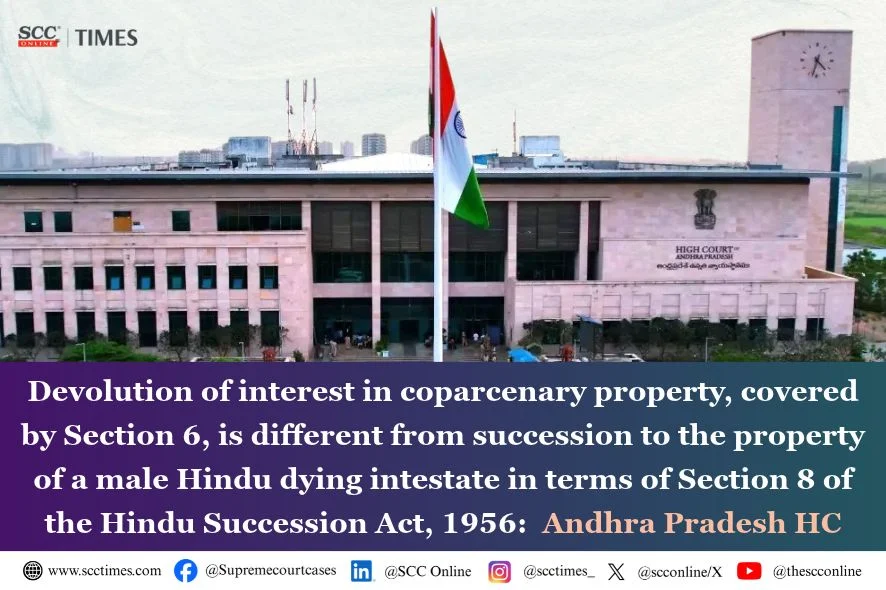
Andhra Pradesh High Court: In a review application filed under Order XLVII Rule 1 read with Section 114 of the Code of Civil Procedure, 1908, seeking review of the judgment dated 13-03-2025 passed by the Andhra Pradesh High Court in the second appeal arising from the judgment and decree dated 08-05-2024 passed by the VI Additional District Judge, Kurnool, in the appeal against the judgment and decree dated 03-07-2018 passed by the Principal Senior Civil Judge, Kurnool, in the partition suit, A. Hari Haranadha Sarma* and K. Manmadha Rao, JJ., dismissed the application and held that no grounds for exercising review jurisdiction under Section 114 read with Order XLVII Rule 1 CPC were made out.
Background
The plaintiff instituted a suit for partition, contending that he was the son of the defendant and a coparcener entitled to a half share in the suit schedule properties, which constituted Hindu undivided joint family properties. His grandfather, Sambhasiva Reddy, had died in 1990, following which the properties came into the possession of his children. The plaintiff sought partition and separate possession of his share, stating that efforts to resolve the dispute and divide the properties amicably had failed. The defendant contested the suit, denying that the plaintiff was in joint or constructive possession of the properties and asserting that the plaintiff’s mother had deserted him. He further claimed that he had two sons through another woman, who had also received shares in the properties.
The Trial Court, upon considering the oral and documentary evidence found that the properties were ancestral in nature and that the defendant had failed to establish his claim regarding the other sons and passed a preliminary decree directing division of the suit schedule properties into two equal shares. In appeal, the VI Additional District Judge, Kurnool, partly allowed the defendant’s appeal, holding that item Nos. 1 and 2 were the self-acquired properties of the defendant’s father, and could not be treated as ancestral properties. However, finding no evidence that item Nos. 3 and 4 were the defendant’s exclusive properties, the First Appellate Court upheld the plaintiff’s entitlement to a half share in those items and dismissed the suit insofar as item Nos. 1 and 2 were concerned. The First Appellate Court also found that the entitlement of the defendant’s other sons was not established.
The plaintiff challenged the First Appellate Court’s decision before the High Court in a second appea and vide judgment dated 13 March 2025, the High Court dismissed the second appeal, holding that item Nos. 1 and 2 had devolved upon the defendant from his father under Section 8 of the Hindu Succession Act, 1956, and had thereby ceased to retain their character as joint family properties. The Court, relying on Satish Vishanji Fatnani v. Mohanlal Dungarmal Futnani, 1985 0 Supreme (Mad) 245, upheld the finding that the plaintiff could not claim a share in those properties as a coparcener, while affirming the decree in respect of item Nos. 3 and 4.
Aggrieved, the plaintiff filed the present review application under Section 114 read with Order XLVII Rule 1 CPC, contending that the defendant had died during the pendency of the first appeal and that he was consequently entitled to a half share in all the suit schedule properties. He also relied on Rohit Chauhan v. Surinder Singh, (2013) 9 SCC 419 and Sk. Bhikan v. Mehamoodabee, (2017) 5 SCC 127 to contend that a son acquires a right by birth in joint family property. The respondents opposed the application and submitted that no ground for review had been made out and that review jurisdiction could not be exercised as an appellate power to re-examine the merits of the decision.
The issues under consideration are:
1. Whether the grounds contemplated under Section 114 read with Order XLVII Rule 1 CPC were made out to warrant exercise of the power of review in respect of the judgment dated 13 March 2025 passed in the second appeal?
2. What is the result of the application?
Analysis and Decision
Placing reliance on Government of NCT of Delhi v. K.L. Rathi Steels Ltd., (2024) 7 SCC 315 and Malleeswari v. K. Sugana, 2025 SCC OnLine SC 1927, the Court reiterated that review jurisdiction under Section 114 read with Order XLVII Rule 1 CPC can be exercised only by a person aggrieved and on the grounds of discovery of new and important matter or evidence despite due diligence, mistake or error apparent on the face of the record, or any other sufficient reason. Relying on the principle laid down in Chhajju Ram v. Neki, 1922 SCC OnLine PC 11, the Court clarified that “any other sufficient reason” must be analogous to the first two grounds. It further observed that an error apparent must be self-evident and capable of being identified without a long-drawn process of reasoning; a patent error is distinct from a mere erroneous decision. A review jurisdiction cannot be equated with appellate jurisdiction, and a review court cannot sit in appeal over its own order or permit a rehearing of the matter.
The Court noted that, on the plaintiff’s own witness’s evidence, the defendant’s father purchased the land and the house site. The defendant received a portion on partition among his brothers. No theory of a joint family nucleus, or of purchase from such a nucleus, was “even whispered”. The right of a coparcener in coparcenary property is distinct from the right over separate property. Devolution under Section 6 of the Hindu Succession Act is different from succession under Section 8.
The Court held that when a propositus dies intestate leaving a son, the son alone is a Class I heir and takes the self-acquired property under Section 8. The grandson cannot claim heir status. The properties therefore ceased to be joint family properties in the defendant’s hands. Items 3 and 4 stood on a different footing, as it was not the defendant’s case that they were non-ancestral.
The Court cited Arshnoor Singh v. Harpal Kaur, (2020) 14 SCC 436 wherein it was stated that
“7.5. After the Hindu Succession Act, 1956 came into force, this position has undergone a change. Post 1956, if a person inherits a self-acquired property from his paternal ancestors, the said property becomes his self-acquired property and does not remain coparcenary property.
7.6. If succession opened under the old Hindu law i.e. prior to the commencement of the Hindu Succession Act, 1956, the parties would 26 be governed by Mitakshara law. The property inherited by a male Hindu from his paternal male ancestor shall be coparcenary property in his hands vis-à-vis his male descendants up to three degrees below him. The nature of property will remain as coparcenary property even after the commencement of the Hindu Succession Act, 1956.”
Also Read: Self-acquired property of Mitakshara Hindu who died before 1956 devolves solely upon his male heir: Kerala HC
Reading Section 8 together with the undisputed ownership of the defendant’s father, and with no material to show a joint family nucleus, the Court held that the finding on items 1 and 2 could not be an error apparent on the face of the record “by any stretch of imagination”. Therefore, where there is clear reasoning, even an alleged error of appreciation cannot be a ground for review.
The Court held that if the plaintiff wishes to claim that the properties are partitionable on the defendant’s death, as legal heir alone or along with others, that is a separate and subsequent cause of action. The remedies for it lie outside the present litigation. The Court clarified that it was expressing no opinion on the plaintiff’s entitlement to partition or otherwise.
Thus, the point was answered against the review petitioner, no ground under Section 114 read with Order 47 Rule 1 CPC was made out, and the application was dismissed with no order as to costs.
[S. Bhaskar Reddy v. S. Raghu Rami Reddy, I.A. No. 1 of 2025 in S.A. No. 456 of 2024, order dated 30-10-2026]
*Judgment authored by: Justice A. Hari Haranadha Sarma
Advocates who appeared in this case:
For the Appellant/Review Petitioner: J. Janakirami Reddy
For the Respondents: Varun Byreddy