








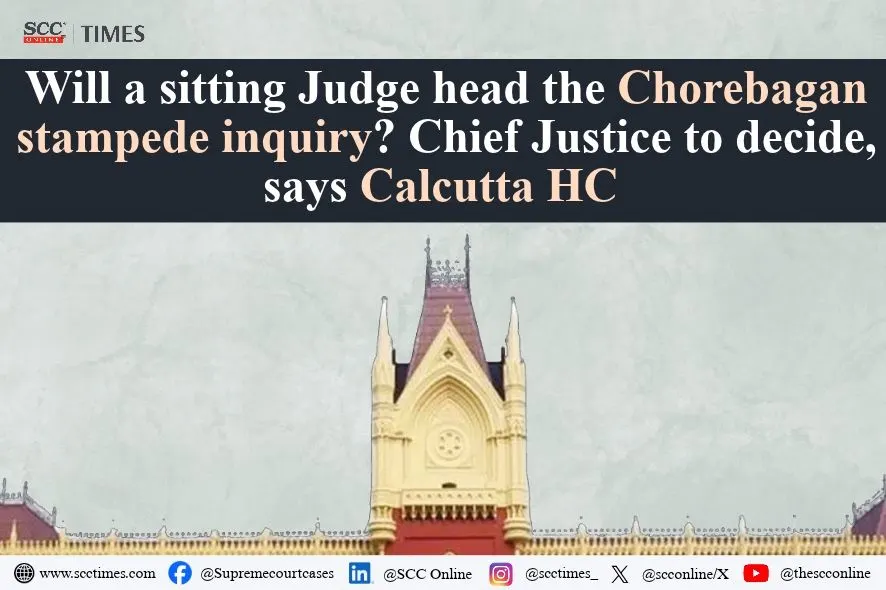
Calcutta High Court: In a public interest litigation (PIL) seeking an inquiry into the Chorebagan Sarbojonin Durga Puja pandal stampede in Kolkata on 17 October 2026, which resulted in 19 deaths and injuries to about 25 persons, the Division Bench of Ravindra Vithalrao Ghuge, CJ., and Md. Shabbar Rashidi, J., by order dated 20 October 2026, took note of the State Government’s decision to constitute an inquiry commission and observed that whether a serving Judge of the High Court should be spared to head it was for the Chief Justice to decide on the administrative side. The Bench added that, if no serving Judge was spared, it would be for the State Government to constitute the Commission under the Commissions of Inquiry Act, 1952 by appointing a retired Judge of the High Court, strictly in accordance with law. The petition was kept pending.
Background
In the petition that was taken up by the Vacation Bench, the petitioner submitted that the tragedy was preventable and sought the appointment of a retired Judge to head a Commission of Inquiry into the alleged failures leading to the stampede. It was alleged, among other things, that the pandal had narrow and inadequate entry and exit gates, insufficient police personnel for crowd regulation, poor lighting, and no adequate emergency response arrangements. It further alleged that an announcement made over the microphone by the organisers triggered a sudden surge in the crowd.
The State informed the Court that the Chief Secretary had written to the Chief Justice on 18 October 2026, seeking the assistance of a serving Judge to head the proposed Inquiry Commission. The communication included proposed terms of reference for the inquiry. The State submitted that it would constitute the Commission under Section 3, Commissions of Inquiry Act, 1952.
Analysis and order
The Court considered the Supreme Court’s decision in T. Fenn Walter v. Union of India, (2002) 6 SCC 184, which discussed the circumstances in which sitting Judges may be appointed to Commissions of Inquiry. The Court noted the sanctioned strength of the Calcutta High Court was 72 Judges, while the Court was then functioning with 50 Judges, with 2 Judges due to demit office in October and November 2026, after which the Court would function with 48 Judges.
The Bench observed that the decision on whether a serving Judge could be spared to chair the Commission was for the Chief Justice to take on the administrative side. If no sitting Judge were made available, the State Government would be required to act in accordance with the Commissions of Inquiry Act, and could constitute a Commission headed by a retired Judge of the Calcutta High Court.
The Court reproduced the State Government’s proposed terms of reference, which included ascertaining the sequence and causes of the stampede; examining crowd density, entry and exit arrangements, weather conditions, public announcements and crowd-control measures; assessing the preparedness and response of organisers, police, emergency services and civic authorities; and examining CCTV footage, video recordings, forensic findings and other relevant evidence.
The proposed inquiry would also examine whether permissions and crowd-management plans complied with applicable rules and guidelines, whether any negligence or dereliction of duty was attributable to the organisers or public authorities, and what measures should be recommended to prevent similar incidents. The terms also included consideration of assistance, compensation, and rehabilitation for victims and their families.
The Court clarified that it would not monitor the inquiry, and that the State Government would deal with the report submitted by the Commission. Although the petitioner’s counsel expressed satisfaction with the proposed terms of reference and requested that the petition remain pending, the Bench kept the matter pending and left all contentions open, including the question of maintainability.
[Tapas Kumar Dey v. State of W.B., 2026 SCC OnLine Cal 16640, decided on 20-10-2026]
Advocates who appeared in this case:
For the petitioner: Mr Kalyan Bandyopadhyay, Senior Advocate, Mr Suman Sengupta, Mr Anit Kr. Das, Mr Ashish Dutta, Mr Zoaib Rauf and Mr Rahul Kr. Singh, Advocates.
For the State: Mr Billwadal Bhattacharyya, Ld. AAG, Mr D.N. Ray, Ld. GP, Mr Anindya Basu, Mr Pratip Mukherjee, Mr Indradeep Pal and Mr Bikash Kumar Sriwastav, Advocates.





0 replies