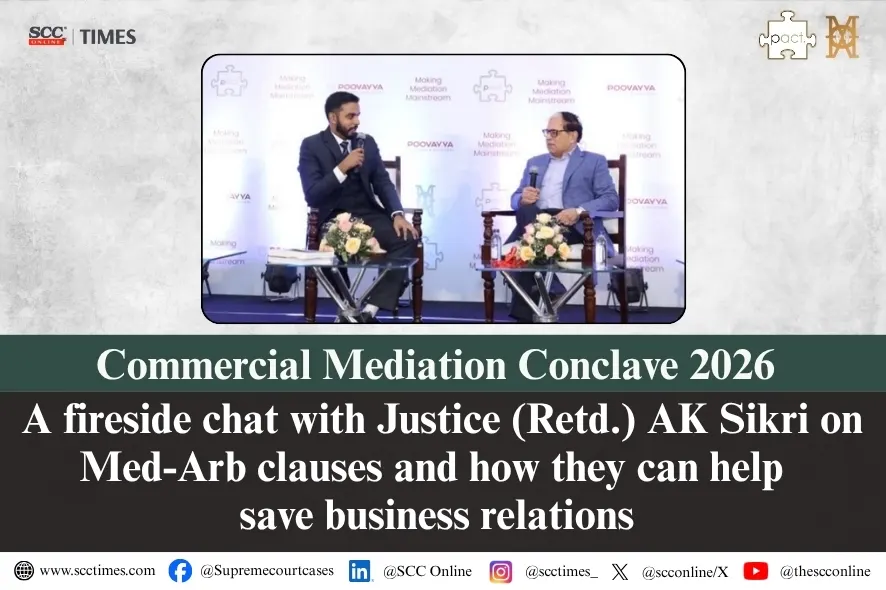
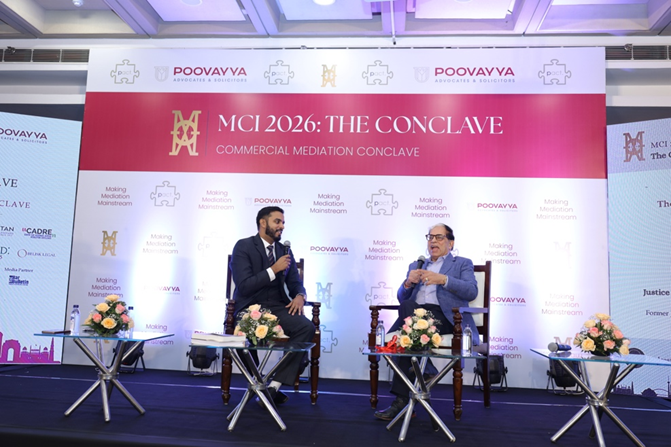
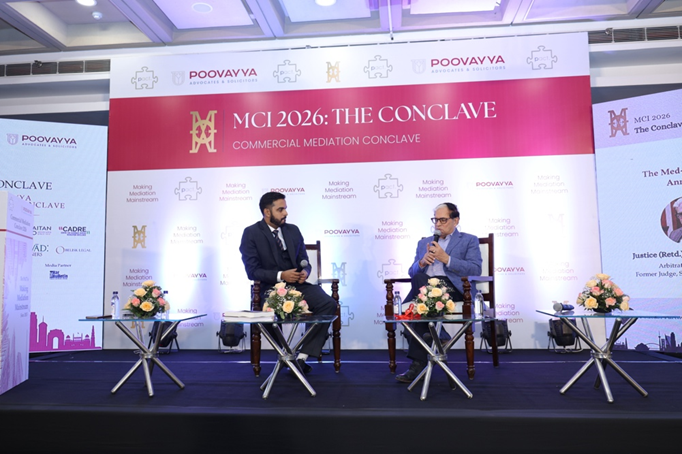
The Commercial Mediation Conclave 2026, organised by The PACT and Poovaya & Co., featured a fireside chat titled “The Med-Arb Clause and How It Can Save Total Annihilation of Business Relations.” The session brought together Justice (Retd.) Arjan Kumar Sikri, Arbitrator and Mediator and a former judge of the Supreme Court of India, in conversation with Jonathan Rodrigues, host of The Mission Mediation Podcast.
Framing the med-arb clause
Opening the discussion, Mr Rodrigues observed that the conclave had, for once, approached mediation as a commercial proposition rather than as what he called a charity case squeezed between litigation and arbitration. He introduced the med-arb clause as the session’s subject, noting that in most commercial disputes only a handful of the ten or twelve issues in contention genuinely require arbitration, while the rest could realistically be mediated, provided the parties had thought to build that option into their contract from the outset. His question to Justice Sikri was direct. If a med-arb clause is, in principle, something everyone favours, why do clients and their lawyers so rarely put one into their contracts?
A mindset that has not caught up with acceptance
Justice Sikri traced the puzzle back two decades. Section 89 of the Code of Civil Procedure, introduced in 2002, first opened the door to court-referred mediation, and a Supreme Court-backed pilot project followed in 2005 and 2006. He recalled attending, as a Delhi High Court judge at the time, the inauguration of court-annexed mediation at the Tis Hazari Courts in Delhi, and the open hostility it met from the lawyers present, who regarded ADR, in his retelling, as standing for an alarming drop in revenue rather than alternative dispute resolution. Twenty years on, he said, that resistance has largely dissolved. Lawyers broadly accept mediation’s value today, and it is now commonplace to hear at conferences that mediation, compared with arbitration, is markedly cheaper and faster to conclude.
What has not followed, in his account, is a change in contracting practice. The acceptance has not “percolated down” into a habit of writing mediation, or a med-arb sequence, into commercial contracts. He located part of the explanation in mediation’s own history in India. Because mediation became familiar to most people through court referral, an assumption took hold, particularly outside the metropolitan centres, that mediation only happens once a court sends the parties to it. He contrasted this with jurisdictions such as the United States, where parties routinely consult professional mediators directly and voluntarily, in much the way they consult lawyers, well before any dispute reaches litigation or arbitration.
A second, more candid explanation
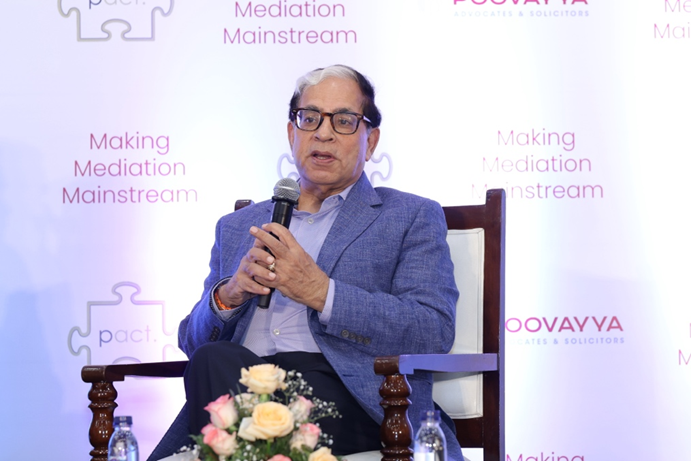
Invoking Chatham House rules to speak more freely, Justice Sikri offered a second reason. Commercial contracts are typically vetted by law firms, and arbitration, once a dispute escalates, can generate substantially more billable work for lawyers than a comparatively short mediation. He put it to the audience as a possible, if uncomfortable, factor behind law firms’ reluctance to insert med-arb clauses into the contracts they draft. He was careful to add a counterpoint, however, drawn from jurisdictions where mediation has taken firmer root. There, he said, mediation has itself become a significant source of income, not only for mediators but for counsel who appear in mediation proceedings, so the belief that mediation threatens a lawyer’s earnings does not hold up in practice. He argued that convincing general counsel of this was just as important as convincing external lawyers, given how much influence GCs now carry within their organisations, in some cases sitting on the board itself.
He tied this back to a broader conviction; one he said he had also set out in an article of his own. The narrative, in his view, should never be mediation versus arbitration. Mediation is, he argued, a better form of access to justice in a wide range of circumstances, capable of producing win-win outcomes that an adjudicatory process such as arbitration or litigation cannot by its nature deliver. Given the scale of India’s court backlog, he added, a genuine expansion of mediation would relieve pressure on the courts and, in turn, on arbitration as well, rather than displacing either.
Mr Rodrigues welcomed this framing as the right one for the commercial dispute space, mediation as a means to an end rather than a competitor to arbitration. He illustrated the billing problem in practice with an anecdote about a friend at a leading law firm who had paused a Singapore International Arbitration Centre reference, two months in, to attempt mediation through the Singapore International Mediation Centre. The mediation settled within two weeks, the client was satisfied and then came the invoice. The client balked at paying for arbitration work once the matter had in fact been resolved through mediation, leaving the partner to answer to the firm’s management for the shortfall. Mr Rodrigues’s point was that a med-arb clause, together with an explicit understanding that mediation counsel work would be billed separately, could have avoided the dispute over fees entirely.
Complexity is not a bar to settlement
Justice Sikri added two further observations on why lawyers hesitate. Commercial disputes, particularly cross-border ones, are often document-heavy and legally complex, feeding a perception that such matters are simply unsuited to mediation. He countered this with an anecdote relayed to him by Justice Sundaresh Menon, Chief Justice of Singapore, who recounted that as a lawyer he had himself doubted whether a complicated case already on the arbitration track could be mediated, only to see it settle within two days once mediation was attempted.
Asked whether India’s comparatively thin mediator infrastructure was a genuine constraint on wider adoption of med-arb, Justice Sikri accepted that it was a real consideration, though not, in his view, a lasting one. Arbitration is used in roughly 60 to 70 per cent of commercial matters in India, and party autonomy allows virtually anyone the parties agree on, a retired judge, a lawyer, even an engineer for a technical dispute, to sit as arbitrator, with no fixed qualification requirement. Mediation, by contrast, requires trained mediators, and India does not yet have mediation centres or a trained mediator pool to match its arbitration infrastructure. He recalled that this capacity concern was among the reasons the Mediation Act, 2023 did not, in its final form, make pre-litigation mediation compulsory, a provision that had been debated at the drafting stage. He argued, however, that this should not be treated as a permanent obstacle, since disputes under any given contract typically arise over years rather than all at once, giving the ecosystem time to build the necessary infrastructure gradually.
Can a mediator later act as arbitrator
Before opening the floor, Mr Rodrigues put what he called one last controversial question. If Justice Sikri, appointed as mediator, guided a mediation some way toward progress without a final settlement, could he then step in as the arbitrator on the same dispute? Justice Sikri’s answer began with the general principle. One who acts as mediator should not act as arbitrator, or vice versa, for reasons he said did not need spelling out. He noted, however, that Section 30 of the Arbitration and Conciliation Act, 1996 permits an already-appointed arbitral tribunal to refer parties to mediation or conciliation during the arbitration itself, and, where both parties consent, allows the same person to act as mediator in that setting. This, he stressed, is a legally distinct situation from a med-arb clause, under which mediation is attempted before any arbitrator is appointed at all, so that a wholly separate tribunal is constituted if mediation fails.
He illustrated this from his own practice as arbitrator, recalling cases where he sensed early that a dispute was ripe for settlement and, depending on what the parties wanted, either referred them to an independent mediator or, at their request, mediated the matter himself, on the understanding that he would not resume as arbitrator if that mediation failed. Nearly all such matters settled, he said. One case stood out. Referred to him for mediation by a High Court, eighty per cent of the dispute was resolved, but the remaining twenty per cent turned on a genuinely contested legal question. Rather than report the mediation as a failure and send the whole matter back to be litigated afresh, he persuaded the parties to formalise a settlement on the eighty per cent that had been agreed, and, at the parties’ own suggestion, to let him decide the narrow legal issue comprising the remaining twenty per cent as arbitrator, by consent, without reopening pleadings. The point was argued on written submissions within about a fortnight, and he issued his award on that limited question shortly after.
Mr Rodrigues described this as an example of what mediators call a mediator’s proposal, where a mediator who has already brought the parties most of the way to agreement effectively helps them across the finish line, leaving them free to accept or decline the final piece.
Why caucus confidentiality is the real obstacle
The floor was then opened to the audience. A law student challenged the general rule against a mediator later acting as arbitrator, on the reasoning taught to her, that a mediator merely facilitates the parties’ own conversation without deciding anything for them, while an arbitrator must reach a reasoned decision on fact and law, so the two roles, being functionally distinct, should not in principle be incompatible in the same person.
Justice Sikri’s answer centred on the caucus, the confidential session a mediator holds separately with each party. In caucus, he explained, parties often disclose their real interests and positions candidly, sometimes admitting to matters that would embarrass or expose them, precisely because they trust that what is shared stays with the mediator unless they themselves agree to have it passed on. If parties know that the same person could later become the arbitrator and thus the final decision-maker should mediation fail, that trust collapses, and most mediations conducted on that basis would fail as a result. He linked this to Justice Menon’s anecdote about the trust built through mediation, observing that parties in caucus have, in his own experience, admitted to matters bordering on fraud, personal affairs in the case of founder disputes, or improper conduct such as concealment of funds, disclosures they would never make if the person hearing them might later sit in judgment over the same facts as arbitrator.
A second questioner asked about Section 30 of the Arbitration and Conciliation Act more specifically, given that a tribunal already exercising jurisdiction can facilitate settlement with consent, whether tribunals in fact have a larger role to play in encouraging independent mediation than the med-arb clause itself, since practice in India today more closely resembles a Section 30 pathway than a true med-arb sequence.
Justice Sikri agreed that tribunals do have a meaningful role here, while maintaining the distinction he had drawn earlier. Under a genuine med-arb clause, mediation is attempted first, before any arbitrator is appointed, and a separate tribunal, constituted through the ordinary mechanism of party nominees and a presiding arbitrator, or a sole arbitrator, is formed only if that mediation fails. Under Section 30, an arbitrator already appointed and seized of the matter may, on forming the view that settlement is achievable, refer the parties to mediation or, with consent, personally facilitate it. In his own practice, he said, he refers such matters to an independent mediator more often than not, and where the parties instead ask him to mediate personally, he would ordinarily decline to resume as arbitrator if that mediation failed, notwithstanding that the Act permits the same person to continue in both roles where both parties consent.
Closing
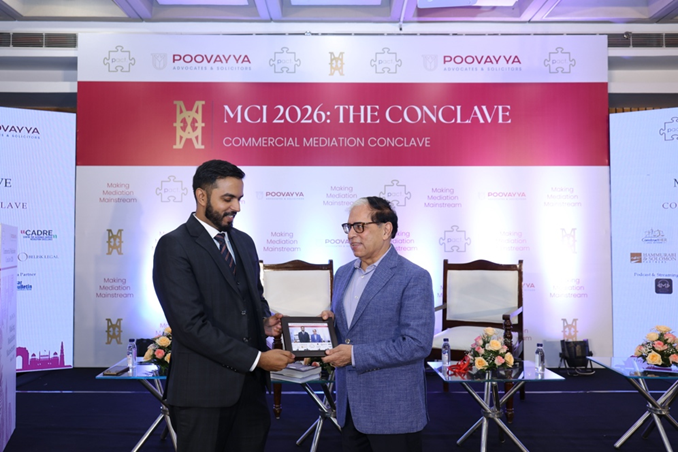
Mr Rodrigues closed the session by inviting attendees interested in drafting a med-arb clause to write to The PACT for sample wording, describing it as three lines capable of averting what he called a total annulation of a business relationship. He ended with an image he returned to more than once through the conclave, that just as a newborn child is given its vaccinations, a new contract should be given a mediation clause at birth, because something, in the life of any commercial relationship, will eventually go wrong.
“So when a contract is born, why don’t we put a mediation clause in it? Because you know that something’s going to go wrong someday, it is a given.”