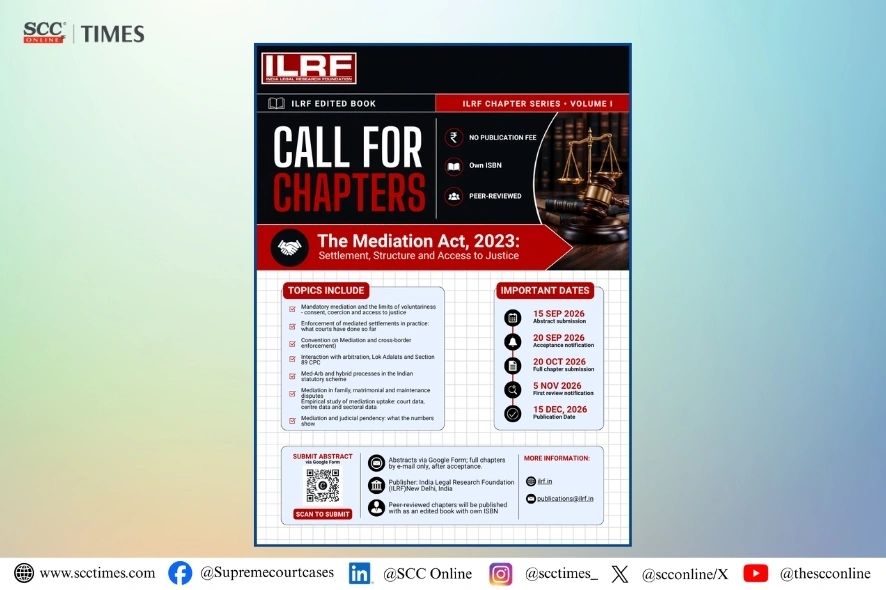
The India Legal Research Foundation (ILRF) is making a call for chapters in the form of research papers and conceptual papers for an edited book titled “The Mediation Act, 2023: Settlement, Structure and Access to Justice” — Volume I of the ILRF Chapter Series, to be published with its own ISBN.
About the Book
Dispute resolution in India has long been organised around the courtroom. The Mediation Act, 2023 attempts something different: it moves mediation from the margins of practice into the statutory mainstream, making it a first step rather than a last resort.
The Act introduces pre-litigation mediation, gives the mediated settlement agreement the status and enforceability of a decree, and creates an institutional architecture of mediation service providers, mediation institutes and a Mediation Council of India.
These are structural changes, not procedural tinkering. They alter where a dispute begins, who resolves it, what a settlement is worth, and how competence is certified in a profession that has until now grown largely without regulation.
The harder questions are empirical and normative. Does a statutory obligation to attempt mediation produce genuine settlement, or a new queue before the old one? Can consent survive compulsion? Is an enforceable settlement agreement an access-to-justice gain for the litigant with the weaker bargaining position, or a risk? Who is accredited to mediate, and on what standard?
Several years into the Act, we still lack a consolidated body of Indian scholarship that reads the statute closely, tests it against data, and places it alongside comparative frameworks such as the Singapore Convention on Mediation.
This volume attempts to build that record. The purpose of the edited book is to examine the design of the Mediation Act, 2023, document its working on the ground, and identify what reform the next amendment cycle should carry.
Contributors are therefore requested to choose one of the sub-themes listed below and submit an abstract through the Google Form linked under How to Submit?; full chapters are invited by e-mail only after the abstract is accepted.
Eligibility
The call is open to practitioners and mediators, ADR faculty and mediation centre coordinators, research scholars, LL.M. and final-year LL.B. students, and policy professionals.
Single-authored or co-authored submissions are accepted, with a maximum of two authors per chapter. Academicians, research scholars, advocates and students are requested to circulate this call among their faculties, colleagues and research groups.
About the Publisher
The India Legal Research Foundation (ILRF) is a legal research and policy think tank working across access to justice and legal research, capacity building, and legal awareness.
This edited book is Volume I of the ILRF Chapter Series, published with its own ISBN.
Theme
ILRF invites chapters from interested contributors in areas broadly based on the following theme: “The Mediation Act, 2023: Settlement, Structure and Access to Justice”
Sub-themes
-
Pre-litigation mediation: statutory design, exemptions and thresholds
-
Mandatory mediation and the limits of voluntariness — consent, coercion and access to justice
-
The mediated settlement agreement as a decree: status, challenge and execution
-
Enforcement of mediated settlements in practice: what courts have done so far
-
Institutional mediation and mediation service providers
-
The Mediation Council of India: mandate, powers and regulatory design
-
Mediator accreditation, training and standards of competence
-
Confidentiality and privilege in mediation
-
Online dispute resolution and community mediation under the Act
-
Comparative study: mediation frameworks in other jurisdictions and lessons for India (e.g., the Singapore Convention on Mediation and cross-border enforcement)
-
Mediation and the Commercial Courts Act: overlapping mandates
-
Interaction with arbitration, Lok Adalats and Section 89 CPC
-
Med-Arb and hybrid processes in the Indian statutory scheme
-
Mediation in family, matrimonial and maintenance disputes
-
Mediation in commercial, insolvency and startup disputes
-
Government as a party: mediation in disputes involving the State
-
Power asymmetry and party protection in mediation
-
Empirical study of mediation uptake: court data, centre data and sectoral data
-
Costs, timelines and settlement rates compared with litigation
-
Mediation and judicial pendency: what the numbers show
-
Capacity building for mediators and the ADR skills gap
Note: The above sub-themes are only illustrative. The editorial team welcomes papers on other topics related to the central theme given above. Chapters with original data, case analysis, empirical surveys, or a critical approach will be given particular preference.
Submission Guidelines
-
All manuscripts should be prepared in English only.
-
Please use ‘Times New Roman’, font 12 pt. for running text and 14 pt. for headings; the paper should be A4 (Portrait) and in MS Word.
-
The manuscript should have all margins (i.e. L/R/T/B) 1 inch (2.5 cm), 1.5 line spacing, and left-justified only.
-
Manuscripts including tables, figures and references should be around 3,000 — 6,000 words, along with an abstract of not more than 250 words.
-
The paper or chapter should be an original and unpublished contribution.
-
All rights to the selection of chapters are reserved by the editorial team.
-
Each manuscript must be accompanied by an undertaking of the author(s), sent along with the chapter.
-
The manuscript should carry page numbers.
-
Use footnotes in a uniform Bluebook (latest edition) citation style throughout, and no endnotes. Authors should ensure accurate citations to case law, statutes, books, journal articles, and online sources.
-
A chapter once submitted to this edited book should not be simultaneously submitted to other journals or elsewhere for consideration.
-
The author(s) name, designation and official/residential address, along with e-mail ID, should appear below the main title of the chapter, followed by the abstract and then the text.
-
No chapter will be accepted without the UNDERTAKING of the author, or if it is not typed in Times New Roman.
-
The author(s) must ensure that all content in the manuscript is original, properly attributed, and legally accurate. Submitting text generated entirely by AI or copying works (Similarity must stay below 10 percent) without correct citations constitutes academic and professional misconduct.
Submission Deadline
-
Abstract (300—500 words, with five keywords, proposed title and author bio of 100 words): 15 September, 2026
-
Communication of acceptance of abstract: 20 September, 2026
-
Full chapter (3000-6000 words) : 20 October, 2026
-
First Review: 5 Nov, 2026
-
Publication Date: 15 December, 2026
How to Submit?
Stage 1 — Abstract (Google Form only)
-
Contributors must first identify a sub-theme and submit their abstract only through the official Google Form:
https://docs.google.com/forms/d/e/1FAIpQLSexfkmyKrSetZfKxq6saYmXSchm9-TQaTTY-rIgGF-dNQy7vQ/viewform?usp=publish-editor Abstracts sent by e-mail will not be considered.
-
The form will require the following information: • Full name of the author(s) • Designation • Institutional affiliation (if any) • Contact details (e-mail ID and phone number) of the author(s) • Proposed title of the chapter • Author bio (100 words)
-
Upload the abstract through the form as an MS Word (.doc / .docx) file, named “Author Name — Abstract — Vol. I Mediation Act”.
Stage 2 — Full chapter (e-mail only, after acceptance)
-
Authors should prepare the full chapter only after receiving the abstract acceptance mail from ILRF.
-
Full chapters will be accepted over e-mail only, sent in soft copy to publications@ilrf.in with the subject line “Vol. I — Mediation Act — Full Chapter”, in reply to the acceptance mail.
-
The e-mail must include the full chapter in MS Word (.doc / .docx) format, along with the author(s) ‘signed undertaking. We will not consider chapters submitted through the Google Form or without an abstract acceptance mail, will not be considered.
-
Please note that no publication charge is levied. Contributors who wish to obtain a physical copy of the book must purchase it themselves.
Contact Information
For queries, write to publications@ilrf.in or visit ilrf.in.