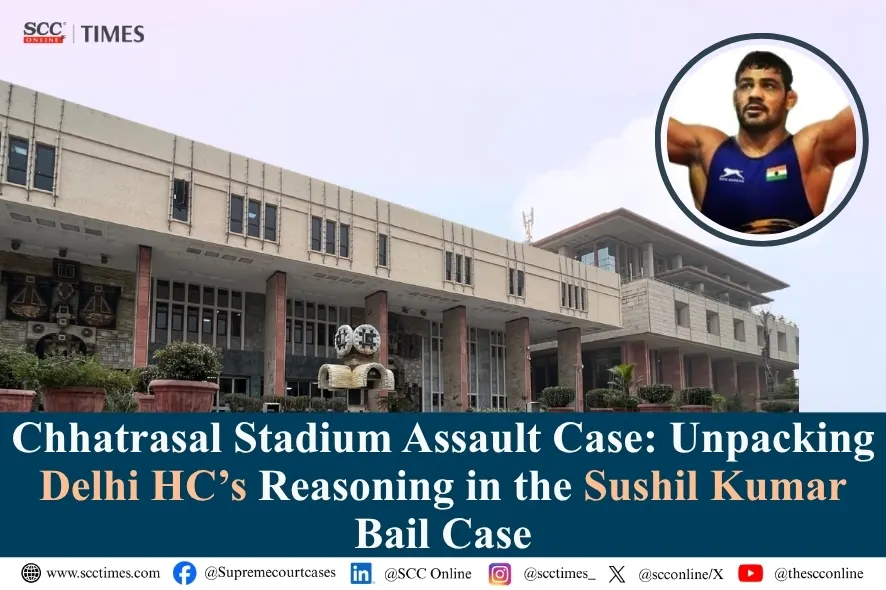
Delhi High Court: In a regular bail application filed by Sushil Kumar in connection with the Chhatrasal Stadium assault case, a Single Judge Bench of Purushaindra Kumar Kaurav, J., declined to enlarge the petitioner on bail, holding that the circumstances projected by him did not constitute a genuine change in circumstances warranting a departure from the view earlier taken by the Supreme Court.
The Court observed that the petitioner’s reliance on the deposition of complainant Ashok Dhankad and the fact that certain prosecution witnesses had turned hostile could not, at this stage, be treated as a change in circumstances, particularly when the Supreme Court had earlier expressed concerns regarding the petitioner’s societal standing and influence and the possibility of interference with the trial. The Court further held that, even otherwise, the gravity of the allegations, including the premeditated assault resulting in death, recovery of a firearm, existence of forensically untampered video evidence, the petitioner’s conduct prior to arrest and the apprehension of influencing the trial continued to weigh against the grant of bail. Accordingly, the Court dismissed the bail application, while clarifying that its observations would not prejudice the trial on merits.
Background
The present application under Section 483 Nagarik Suraksha Sanhita, 2023 [corresponding to Section 439 Criminal Procedure Code, 1973 (CrPC)] was filed by Sushil Kumar seeking regular bail in FIR No. 218 of 2021 registered at PS Model Town (Crime Branch), Delhi, for offences under Sections 308, 325, 323, 341, 506, 188, 269 and 34 Penal Code, 1860 (IPC) and Sections 25, 54 and 59 of the Arms Act, 1959. The prosecution case arose from an incident in the intervening night of 4-5 May 2021, when, pursuant to a PCR call regarding gunfire at Chhatrasal Stadium, police found several persons grievously assaulted in the stadium parking area. The investigation alleged that the injured persons had been abducted from Shalimar Bagh and Model Town and brought to the stadium, where they were assaulted by the petitioner and his associates with lathis, dandas and hockey sticks, with some accused allegedly carrying firearms. One of the injured, Sagar Dhankhad, subsequently succumbed to his injuries, leading to the addition of Section 302 IPC.
The investigation resulted in a chargesheet and supplementary chargesheet against 23 accused persons, of whom 20 stood arrested, for various offences, including murder, attempt to murder, kidnapping, rioting, criminal intimidation and offences under the Arms Act,1959. Charges were framed on 15 October 2022 and the trial was at the stage of prosecution evidence, with a large number of witnesses cited. The petitioner had earlier been granted interim bail on five occasions, for periods of 8, 3, 7, 9 and 2 days respectively, and had surrendered on each occasion. His first regular bail application was rejected by the Trial Court on 22 July 2024. However, the Delhi High Court subsequently granted bail on 4 March 2025, primarily noting that several material eyewitnesses and injured witnesses had turned hostile and that the trial was unlikely to conclude in the near future.
The said order was subsequently set aside by the Supreme Court in Ashok Dhankad v. State (NCT of Delhi), 2025 SCC OnLine SC 1690, which took into account, inter alia, the petitioner’s alleged prolonged evasion of arrest, the gravity of the allegations, recovery of a loaded firearm, the existence of forensic video evidence and the petitioner’s alleged influence over witnesses. The Supreme Court directed the petitioner to surrender while expressly reserving liberty to seek bail afresh upon a change in circumstances.
The petitioner surrendered on 20 August 2025 and thereafter moved a fresh regular bail application before the Trial Court. The application was dismissed on 6 February 2026, with the Trial Court observing that although the witness who had identified the petitioner in examination-in-chief had subsequently turned hostile during cross-examination, the earlier deposition could not be disregarded at that stage and several material witnesses were yet to be examined. The petitioner had consequently approached the Court seeking regular bail on the ground of the changed circumstances arising during the pendency of the trial.
Issues For Consideration
Two questions, therefore, fall for determination:
-
whether the circumstance projected by the petitioner, the examination of the complainant Ashok Dhankad and his alleged failure to support the prosecution, constitutes such a change in circumstances as would justify a departure from the view taken by the Supreme Court while cancelling the earlier grant of bail;
-
assuming that threshold to be crossed, whether the petitioner is, on an overall conspectus, entitled to be enlarged on regular bail
Analysis
The Court, after perusing the Trial Court’s report, noted that out of 222 prosecution witnesses, only 48 had been examined and that the trial was being principally protracted on account of the cross-examination of witnesses by each of the 23 accused individually. The Court reiterated that although a successive bail application is maintainable, the applicant must demonstrate a genuine change in circumstances, and the Court entertaining such an application is required to examine the grounds on which the earlier bail was rejected or cancelled. Relying on Kalyan Chandra Sarkar v. Rajesh Ranjan, (2005) 2 SCC 42 and Babu Singh v. State of Uttar Pradesh, (1978) 1 SCC 579, the Court held that a subsequent bail application cannot be used to indirectly overrule an earlier order of a superior court in the absence of fresh grounds. The Court found that the circumstance relied upon by the petitioner, namely the deposition of Ashok Dhankad and the fact that certain witnesses had turned hostile, did not constitute a change in circumstances, as the Supreme Court’s earlier decision was founded not merely on the status of particular witnesses but on the broader concern regarding the petitioner’s societal standing and influence and the possibility of interference with the trial.
The Court further held that, even assuming that the threshold of a changed circumstance had been met, the ordinary parameters governing grant of regular bail continued to weigh against the petitioner. Taking note of the nature and gravity of the allegations, the premeditated and gruesome assault resulting in death, recovery of a firearm, forensically untampered video evidence, the petitioner’s conduct prior to arrest, and the apprehension of influence over the trial, the Court held that the principles that “bail is the rule and jail the exception” operate within the settled parameters governing grant of bail. It declined to undertake a meticulous examination of the evidence already recorded or to assess whether the deposition of Ashok Dhankad supported or detracted from the prosecution case, observing that such appreciation of evidence fell within the domain of the Trial Court at the stage of final adjudication.
Decision
Accordingly, the Court held that the petitioner had failed to establish either a genuine change in circumstances within the meaning of the liberty reserved by the Supreme Court or an independent case for grant of regular bail under Section 439 CrPC/Section 483 BNSS. The bail application was therefore dismissed.
Also Read: Athar Khan denied bail in Delhi riots case| SCC Times
[Sushil Kumar v. State (NCT of Delhi), 2026 SCC OnLine Del 5953, decided on 6-8-2026]
Advocates who appeared in this case:
For the Petitioner: R.S. Malik, Sahil Malik, Mamta, Aditya Solanki, Vanshak Jain, Keshav Bharadwaj, Rohit Kumar Dalal & Abhishek Kumar, Advocates
For the Respondent: Raghuinder Verma, APP for State, ACP Mangesh Tyagi Crime Branch, Joginder Tuli, Joshini Tuli, Taniya Qureshi & Komal Jha, Advocates