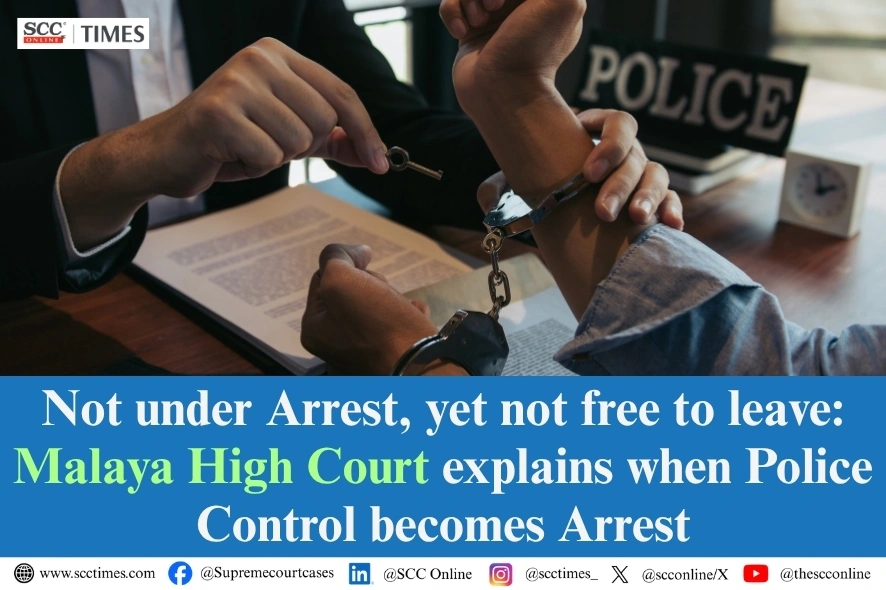
Malaya High Court: The case arose from a candlelight vigil held at Dataran Merdeka during the COVID-19 pandemic, following which the plaintiffs were required by police officers to accompany them to Dang Wangi District Police Headquarters (IPD Dang Wangi) for documentation and enforcement purposes. Anand Ponnudurai, J., considered whether, despite the police officers’ insistence that the plaintiffs were “not under arrest”, they had in fact been deprived of their liberty. The Court held that, viewed objectively, the plaintiffs were under arrest once they were compelled to accompany the police and were no longer free to leave. Thus, the plaintiffs had been deprived of their liberty in a manner, which amounts to arrest in law.
The Court further held that the plaintiffs established battery to a limited extent and infringements of their rights under Articles 5(1) and 5(3) of the Federal Constitution. However, the claims founded on Article 10(1)(b) of the Federal Constitution and the tort of misfeasance in public office were dismissed.
Background
On 19-8-2021, during the period in which COVID-19 restrictions were in force, the plaintiffs attended a candlelight vigil held at Dataran Merdeka. Subsequently, police officers attended the location and instructed participants to disperse. Following the event, the plaintiffs were required to surrender their identity cards and were directed to proceed to IPD Dang Wangi. They were transported there in police vehicles and remained at the police station for approximately four hours, during which statements were recorded and compounds were issued.
The plaintiffs commenced proceedings alleging unlawful arrest, false imprisonment, assault and battery, denial of access to legal representation, infringement of constitutional rights, and misfeasance in public office. The defendants contended that the police were lawfully discharging their duties in enforcing the COVID-19 regulations and that any force used was lawful and necessary.
The matter had originally proceeded to a full trial before Justice Eddie Yeo over several days in 2025, during which 24 witnesses testified. Following Justice Eddie Yeo’s untimely demise in early 2026, the case was transferred to Justice Anand Ponnudurai, who recalled one witness and heard the final defence witness before delivering judgment. The action was commenced by 16 plaintiffs, of whom 13 remained by the conclusion of trial after some withdrew their claims.
Analysis, Law, and Decision
1. Whether the plaintiffs were under arrest in law? If yes, whether the arrest was authorised by law?
The Court stated that an arrest might occur without formal words of arrest, the production of handcuffs or any elaborate ceremony. Similarly, the mere assertion that a person is “not under arrest” cannot determine the issue if, viewed objectively, that person’s liberty has in fact been restrained. Thus, whether an arrest has occurred is a question of law, which is to be determined objectively upon the totality of the circumstances.
The Court noted that the plaintiffs’ identity cards had been retained by the police, that they were informed they were required to proceed to IPD Dang Wangi, that requests to travel independently were refused, and that they were ultimately transported in police vehicles. Upon arrival at the police station, they remained under police control until the completion of the documentation process. Thus, the Court concluded that a reasonable person in the plaintiffs’ position would not have believed that he or she was free to leave. Accordingly, the plaintiffs had been deprived of their liberty in a manner amounting to an arrest in law.
The Court accepted that the police were engaged in enforcement of laws during the COVID-19 pandemic and possessed powers to investigate suspected breaches of the applicable regulations. However, the Court stated that whilst the police possessed powers of investigation and enforcement, a corresponding statutory basis which rendered the arrest of the plaintiffs was not identified.
The Court concluded that the absence of lawful authority should not be conflated with bad faith, improper motive or deliberate abuse of power. The present case illustrates that executive action undertaken in good faith may nevertheless exceed the legal powers conferred by statute. The Court further held that the punishment prescribed under the COVID-19 regulations rendered the alleged offence a non-seizable offence requiring a warrant of arrest. The regulation in question carried a maximum penalty of a fine not exceeding RM1,000 or six months’ imprisonment, rendering the alleged breach a non-seizable offence that required a warrant of arrest. As it was undisputed that no warrant had been obtained, the Court concluded that the arrests were not authorised by law and were therefore unlawful.
2. Whether subsequent detention at IPD Dang Wangi was lawful?
The Court stated that the present case was not the one involving prolonged incarceration over several days. The plaintiffs were never subjected to custodial interrogation of an oppressive nature, placed in lockups for an extended period or denied the basic necessities of life. The evidence also did not support the suggestion that the plaintiffs were deliberately detained for an ulterior purpose or as a form of punishment. Thus, the Court concluded that the plaintiffs’ detention at IPD Dang Wangi constituted false imprisonment arising directly from the unlawful arrests.
The Court clarified that this conclusion should not be understood as suggesting that every investigative detention following an arrest is necessarily unlawful. If in the present case, the arrests were authorised by law, the Court’s assessment of the subsequent detention might have been different. It is the absence of lawful authority for the arrests which ultimately proves determinative in the present case.
3. Whether the defendants committed assault and battery?
The Court stated that every unwanted physical contact constitutes a battery unless justified by law. Where force is lawfully exercised pursuant to statutory powers, such contact will generally be justified, provided the force used is no more than reasonably necessary in the circumstances. Conversely, where the underlying arrest is unlawful, any legal justification for the use of force falls away.
The Court accepted that physical contact occurred when certain plaintiffs were compelled to board police vehicles and when some were pulled or escorted after refusing to comply with police instructions. However, it found no evidence of gratuitous violence, oppressive conduct, or excessive force. As the arrests were unlawful, the physical contact used to affect them lacked legal justification and therefore constituted battery. The Court further held that the marking of identification numbers on the plaintiffs’ forearms, although done for administrative purposes, was carried out without consent and likewise amounted to battery.
4. Whether the plaintiffs were unlawfully denied access to legal representation?
The Court agreed that constitutional rights should not yield to administrative convenience. While operational considerations are relevant, they cannot be decisive where the exercise of a fundamental liberty is concerned. Accordingly, the Court found that the plaintiffs were denied reasonable and timely access to legal representation while detained at IPD Dang Wangi, thereby establishing a breach of their constitutional rights under Article 5(3) of the Federal Constitution.
The Court stated that the evidence did not establish that the plaintiffs were threatened, coerced, or improperly induced into making statements, nor that the police deliberately prevented legal consultation for an ulterior or improper purpose. The constitutional infringement lay in the failure to afford timely and meaningful access to legal advice, rather than in any oppressive conduct during the recording of statements. This distinction is directly relevant to the nature of the remedy to be awarded. While constitutional rights must be vindicated, any remedy must remain proportionate to the nature and gravity of the infringement established by the evidence.
5. Constitutional complaints
The Court stated that the constitutional guarantees are often tested most acutely during periods of public emergency or heightened public concern. It is precisely during such periods that the Courts must remain vigilant in ensuring that executive powers continue to operate within the legal boundaries prescribed by Parliament. In the present case, there were three constitutional infringements of considerable importance, namely the unlawful deprivation of personal liberty, the failure to afford timely and meaningful access to legal representation as well as the markings on the forearms.
The Court held that the unlawful arrests and detention constituted a violation of Article 5(1) of the Federal Constitution, which protects personal liberty except in accordance with law. The Court also held that the delayed access to legal representation infringed Article 5(3). Additionally, the marking of identification numbers on the plaintiffs’ forearms constituted a further infringement of their constitutional rights because the same objective could have been achieved through less intrusive means.
However, the Court rejected the plaintiffs’ claim founded on Article 10(1)(b). The Court held that the police acted because they believed the gathering contravened legislation then in force and not because they sought to suppress political expression. Accordingly, no separate violation of the Constitutional right to assemble was established.
6. Whether the plaintiffs established the tort of misfeasance in public office?
The Court observed that misfeasance in public office requires something more than unlawful conduct by a public officer. The tort requires proof of bad faith, targeted malice, or a knowing or reckless misuse of public power.
While the police officers had exceeded the limits of their lawful authority, the Court accepted that they genuinely believed they possessed the power to require the plaintiffs to accompany them to IPD Dang Wangi. The evidence did not disclose hostility, spite, political targeting, or any deliberate abuse of power. The Court therefore held that the plaintiffs failed to establish the requisite mental element and dismissed the claim for misfeasance in public office.
7. Relief and Damages
Considering the overall evidence, the Court considered that an award of RM15,000 to each plaintiff fairly and appropriately reflected the injuries established in the proceedings. The award also recognised the importance of the Constitutional rights infringed while remaining proportionate to the nature and duration of the detention and the absence of aggravating features.
[Nur Qyira Izzati Binti Yusri v. Mohammad Jazlan Bin Shahrif, Civil Suit No. WA-21NCVC-255-12 of 2021, decided on 28-7-2026]
Advocates who appeared in this case:
For the Plaintiffs: New Sin Yew, Kee Hui Yee, Asma Azmi and Tan Xu Yin (Messrs AmerBON).
For the Defendants: SFC Siti Aishah binti Ramlan and FC Anis Najwa binti Nazan (Attorney General’s Chambers).