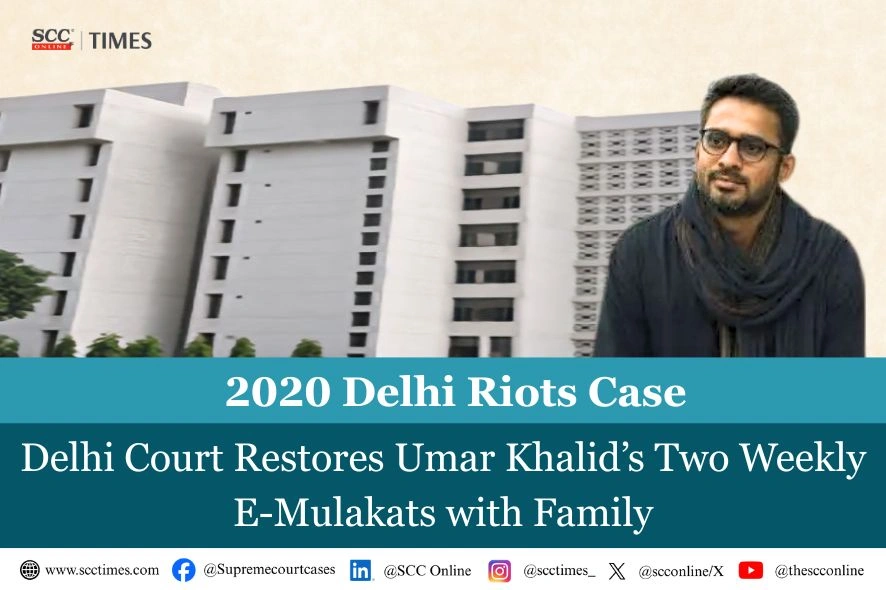
Karkardooma Court, New Delhi: Sameer Bajpai, Additional Sessions Judge., allowed the application filed by accused, Umar Khalid, seeking permission to have 2 e-mulakats (video meetings) per week with his mother and other family members, after noting that the applicant had not violated any rule of the Delhi Prisons Rules, 2018.
In February 2020, Delhi NCR was gripped by violence and communal tensions owing to riots, which subsequently led to registration of FIR. The prosecution alleged a pre-planned criminal conspiracy involving several accused persons, including the applicant. It was alleged that the conspiracy was hatched with the object of orchestrating riots in the National Capital Territory of Delhi as a form of protest against the enactment of the Citizenship Amendment Act, 2019 (CAA) and the proposed National Register of Citizens (NRC). It was further alleged that the conspiracy culminated in the deliberate incitement of widespread communal violence on and around 22nd, 23rd, and 24th February 2020. The acts allegedly committed during this period were not spontaneous but were the outcome of coordinated efforts to inflame tensions, mobilise crowds and execute violent actions across various parts of Delhi. The riots resulted in grave consequences, including the loss of 54 lives, among them a senior police officer and an Intelligence Bureau official, as well as grievous injuries to several police personnel and civilians. In addition, extensive damage was caused to over 1,500 public and private properties, alongside substantial intangible harm to public order, social harmony, and the nation at large.
The accused counsel argued that he had been allowed 2 e-mulakats per week for the past six years while in judicial custody. Since May 2026, this facility had been reduced to one e-mulakat per week. He had not violated any prison rule that would justify the reduction.
However, the Assistant Superintendent of Central Jail submitted that, under the applicable prison rules, the accused was entitled to only 1 e-mulakat per week, and the earlier practice of allowing two had therefore been discontinued.
The Court noted the applicant had been using 2 e-mulakats in a week for last six years and had not violated any rule of the Delhi Prisons Rules, 2018. It allowed the application and directed that applicant be permitted 2 e-mulakats per week with his mother and other family members.
Also Watch: Inside the Supreme Court’s Ruling on Umar Khalid & Sharjeel Imam
[State v. Tahir Hussain, 2026 SCC OnLine Dis Crt (Del) 27, decided on 13-7-2026]
Advocates who appeared in this case:
For the Applicant: Sh. Sahil Ghai Adv. (through Webex) and Ms. Loveleen Kukreja (in Court)
For the Respondent: Sh. Madhukar Pandey, Sh. Akhand Pratap Singh and Sh. Anirudh Mishra, Special P.P for the State (in Court) alongwith Sh. Ayodhya Prasad, Adv. and Legal Assistant to SPP, Sh. Sulabh Gupta and Ms. Ananya Bose (Through VC) and Sh. Saravjeet Singh, Ms. Ishika Singla, Sh. Utkarsh Singh, Ms. Apoorv Paliya, Adv. (in Court).
Assisted by Special Investigating Team (Riots), A.D.C.P. Sh. Pramod Singh Kushwaha and ACP Sh. Vivek Tyagi, Special Cell and Retd.ACP Sh. Lalit Mohan Negi, Consultant (through VC), Inspector Sushil Kumar, Inspector Suhaib Ahmad and Pairvi Officer from Special Cell (in Court).
Sh. Brij Mohan Meena, Asstt. Supdtt. from Central Jail No.1, Tihar, New Delhi.