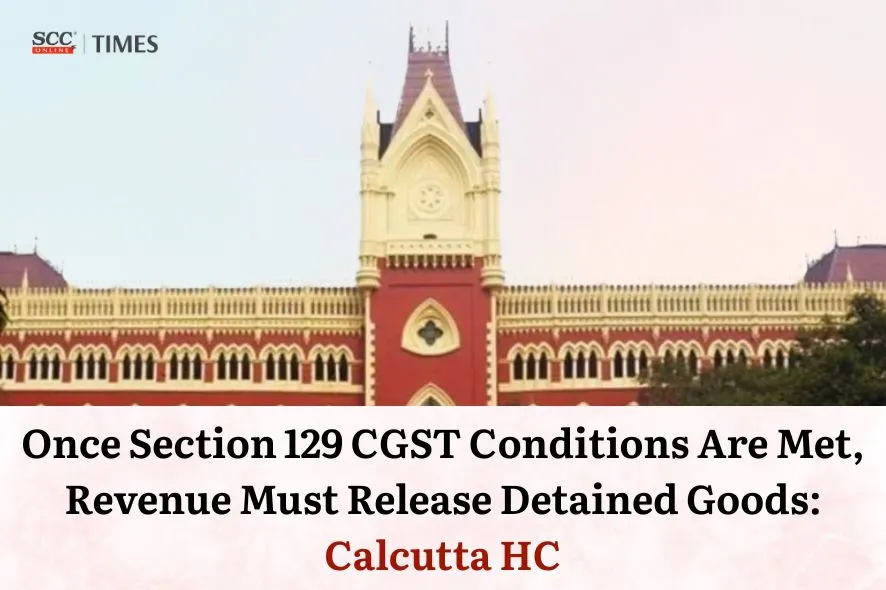
Calcutta High Court: The Single Judge Bench of Justice Aniruddha Roy directed the release of the consignment of areca nuts, subject to compliance of the provisions laid down under Section 129(1)(a), Central Goods and Services Tax Act, 2017 (CGST Act, 2017). The Court held that,
“The provisions under the taxing statute should be interpreted and construed strictly and literally, liberal interpretation is not permitted. The legislature while legislating the provision thought it fit not to detain the goods but to release the same subject to fulfilment of the conditions made under Section 129 CGST Act, 2017.”
Background
The case arose when the petitioner as a consignor had transported dried areca nuts for a quantity of 34,650 kg pursuant to an order placed by the consignee at New Delhi. During the transit, the truck was intercepted by the Central Goods and Services Tax (CGST) Authority. The Revenue Authority had issued a show-cause notice on 30 March 2026 under Section 129(3), CGST Act, 2017 read with Section 20, Integrated Goods and Services Tax (IGST Act, 2017). After the submission of the reply by the petitioner, the prima facie finding of the Revenue Authority was that, the documents tendered appear to be defective and the genuineness of the goods in transit and tendered documents required further verification.
The Revenue Authority then passed its order dated 6 April 2026 and issued the demand for a total sum of ₹51,87,380 for 35,530 kg of nuts and additionally on account of conveyance a sum of ₹2,00,000.
The petitioner filed the instant writ petition claiming release of the consignment in terms of Section 129, CGST Act, 2017. The petitioner mentioning his willingness to pay the penalty prayed for the release of the consignment specifying the perishable nature of the goods which, if not released, will suffer its natural decay, jeopardising his rights and interests.
Decision and Analysis
The Court emphasised that the provisions under the taxing statute should be interpreted and construed strictly and literally, liberal interpretation is not permitted. The Court on a meaningful and harmonious reading of the provisions under Section 129, CGST Act, 2017 found that, the provision for release of the detained goods is there in the statute upon payment of penalty, either in favour of the owner or in favour of any person other than owner who comes forward to make payment of such penalty.
The Court observed that the legislature while legislating the provision thought it fit not to detain the goods but to release the same subject to fulfilment of the conditions made under Section 129, CGST Act, 2017. Once the provision for release of goods are complied with, it can safely be construed that the legislative intent was not to create any charge or lien over the goods against or in relation to the demand raised by the Revenue. Therefore, once the provisions laid down under Section 129, CGST Act, 2017 is satisfied, it is the obligation upon the Revenue to release the goods.
The Court held that the Revenue has not come up with any concrete or unimpeachable evidence neither has it mentioned in its order for demand dated 6 April 2026 which would suggest prima facie that, the petitioner is not the owner of the consignment. On the mention of the case Assam Supari Traders v. Union of India, 2025 SCC OnLine Cal 6670 by the respondents, the Court clarified that the ratio decided in the said judgment would not apply in the facts of the present case.
The Court further held that, subject to compliance of the provisions laid down under Section 129(1)(a), CGST Act, 2017, the consignment shall be released in favour of the petitioner in accordance with law. The consignment shall be released positively within the next 3 clear days from the date of deposit of the amount by the petitioner in terms of Section 129(1)(a), CGST Act, 2017.
The Court directed that if the petitioner fails to file statutory appeal within 3 weeks from date, as undertaken by him or beyond the period of limitation, if any, prescribed under the law, and the demand attains its finality, the Revenue Authority shall be free to proceed against the petitioner to realize the demand in accordance with law.
The Court further clarified that in the event, the petitioner pays the penalty in terms of Section 129(1)(a), CGST Act, 2017 irrespective of payment on account of the conveyance by the conveyance owner, the consignment shall be released in favour of the petitioner.
[Ranjeet Kumar Poddar v. Commr. CGST, 2026 SCC OnLine Cal 5291, decided 14-5-2026]
*Judgment authored by: Justice Aniruddha Roy
Advocates who appeared in this case:
For the Petitioner: Akshat Agarwal, Sandip Guha Roy, Advocate
For the Respondent: Ratan Banik, Bishwa Raj Agarwal, Advocate