Disclaimer: This has been reported after the availability of the order of the Court and not on media reports so as to give an accurate report to our readers.
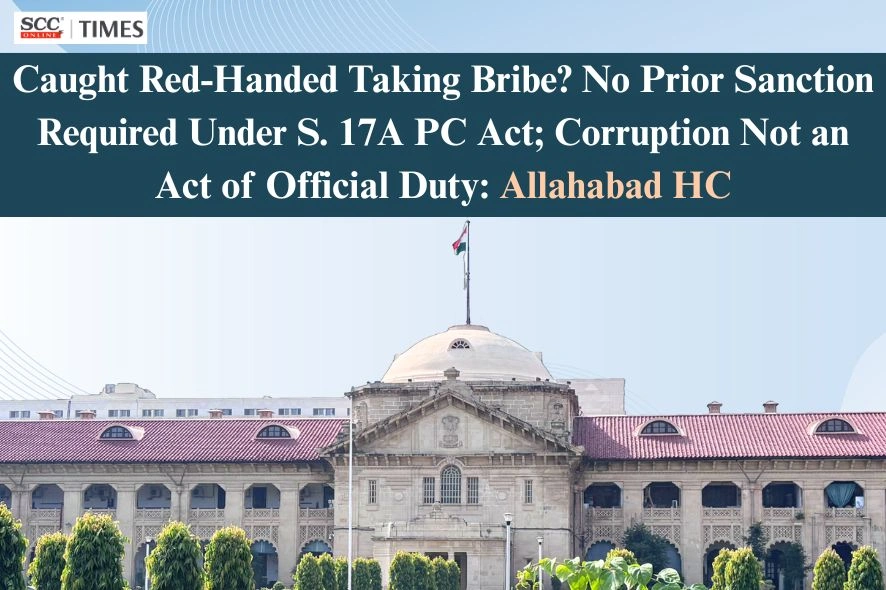
Allahabad High Court: In an application filed under Section 528, Nagarik Suraksha Sanhita, 2023 (BNSS), challenging the rejection of discharge, framing of charges, and validity of prosecution sanction, the Single Judge Bench of Subhash Vidyarthi, J., upheld the impugned orders, holding that no additional sanction under Section 218 BNSS [erstwhile Section 197 Criminal Procedure Code, 1973 (CrPC)] is required once sanction under Section 19, Prevention of Corruption Act, 1988 (PC Act) has been granted, as acts of corruption cannot be treated as acts done in discharge of official duty and conspiracy under Section 61(2), Nagarik Suraksha Sanhita, 2023 (BNSS) is not independent of the substantive offence. It was further held that in trap cases where the accused is caught red-handed, prior sanction under Section 17-A, PC Act is not required and subsequently the Court dismissed the petitions.
Background
The instant case arose from a complaint made on 3 February 2025 alleging demand of Rs 25,000 for permitting the complainant to join the post of Assistant Branch Post Master (ABPM) under Grameen Dak Sewa (GDS). After discreet verification, CBI registered FIR under Section 7, PC Act and Section 61(2) BNSS, against Ramesh Kumar Tudu and Brikesh Pandey. A trap was laid on 4 February, 2025 by CBI during which the applicant Achche Lal allegedly received the bribe amount on the instructions of a co-accused, while another co-accused, Brikesh Pandey, was also present. All accused were apprehended on the spot.
Separate prosecution sanction orders were then issued on 30 July 2025. It was stated by the sanctioning authority that after examining the complaint, FIR, verification and trap memos, recorded conversations, witness statements and other material on record, and upon due application of mind, it was concluded that the applicants had committed offences under Section 61(2) BNSS and Section 7, PC Act, and warranted prosecution.
The applicants’ discharge applications were rejected on 30 January 2026 by Special Judge, Anti-Corruption, CBI, and charges were framed by the trial court on 21 February 2026, leading to the present challenge.
Analysis and decision
The Court noted that in the present case, the charges are of commission of offence under Section 61(2) BNSS and Section 7, PC Act. The Court relied upon Neera Yadav v. CBI, (Bharat Sangh) 2005 SCC OnLine All 1217, where the Full Bench held that sanction granted under Section 19 would be sufficient for prosecution for the offence under Section 120-B, Penal Code, 1860 (IPC) also, which is equivalent to Section 61(2), BNSS. Further, the Court observed that the offences under Section 7, PC Act and Section 61(2) BNSS cannot be said to constitute “acts in discharge of official duty” and, therefore, no sanction is required for those acts.
The Court followed the law laid down by the Supreme Court in Parkash Singh Badal v. State of Punjab, (2007) 1 SCC 1, Dinesh Kumar v. AAI, (2012) 1 SCC 532, and CBI v. Ashok Kumar Aggarwal, (2014) 14 SCC 295, which was that the validity of sanction order has to be examined during the trial and not at pre-trial stage.
The Court further followed CBI v. Santosh Karnani, 2023 SCC OnLine SC 427, where the accused could not be arrested at the spot during the trap and he had absconded, yet the Supreme Court held that the investigation against a person accused of demanding a bribe does not require any previous approval of the Central Government.
The Court also relied upon Ashok Kumar Choudhary v. CBI, Neutral Citation: 2026:AHC-LKO:22051, wherein it was held that under Section 17-A, PC Act, no prior sanction is required when an accused is caught during a trap. Applying this principle, the Court noted that in the present case, Achche Lal was caught red-handed accepting a bribe and Brikesh Pandey was also arrested during the trap proceedings. Therefore, in light of the first proviso to Section 17-A and the ruling in CBI v. Santosh Karnani, 2023 SCC OnLine SC 427, the Court found that prior sanction was not necessary, and the argument that the proceedings were invalid due to a defective sanction order was therefore rejected by the Court.
Applying the aforesaid principles, the Court held that there was no error or illegality in the orders dated 30 January 2026 and 21 February 2026, and dismissed the petition finding no merits.
[Achche Lal v. CBI, 2026 SCC OnLine All 3353, decided on 23-4-2026]
Advocates who appeared in this case:
For the petitioner: Jai Prakash Awasthi and Ayushi Upadhyaya
For the respondent: Aakash Prasad
Buy Code of Criminal Procedure, 1973 HERE
Buy Prevention of Corruption Act, 1988 HERE