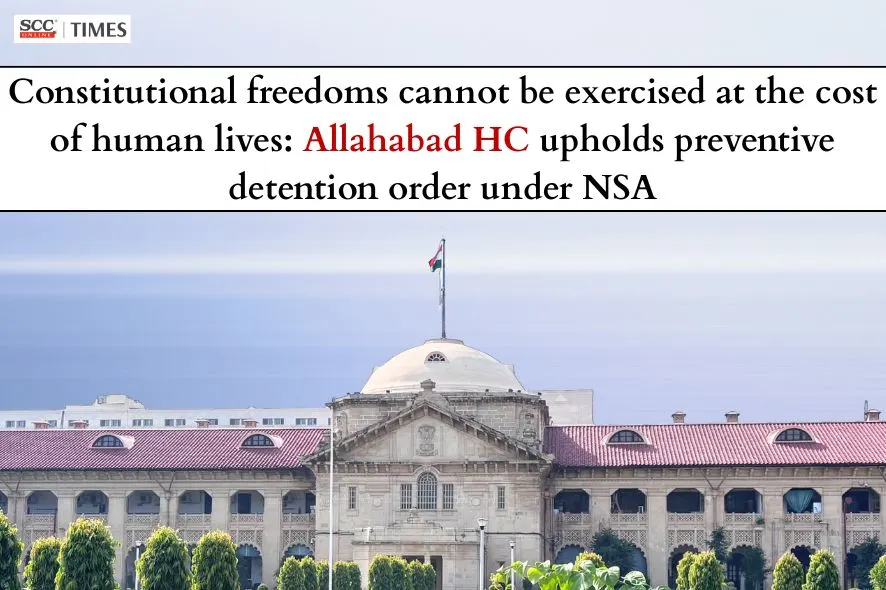
Allahabad High Court: In a Habeas Corpus petition filed against the order of preventive detention dated 02 July 2025, the Division Bench of Abdul Moin and Babita Rani,* JJ., upheld detention order as the impugned order was passed in accordance with the National Security Act, 1980 (NSA) and the incident affected public order and not merely law and order.
Background
In the instant matter, the petitioner challenged his preventive detention under the NSA on the ground that he was illegally detained pursuant to an order dated 02 July 2025 passed by the District Magistrate, Mathura. The detention order was based on an incident dated 15 June 2025 in which the petitioner along with others had carried out digging and construction work at a particular spot despite objections by other residents which resulted in collapsing of 5 houses, death of 3 persons, cracks on about half dozen houses. The incident triggered protests, road blockade, closure of shops and deployment of PAC, Fire Brigade, NDRF, SDRF and senior police officials reaching on the spot to control the situation. Subsequently, an FIR was lodged under Section 105 Nyaya Sanhita, 2023 (BNS) and the petitioner was arrested. The petitioner’s arrest was challenged on the following grounds:
-
Validity of detention order on ground of disturbance of ‘public order’
-
Alleged delay in deciding the legal representation of the detenue
-
Apprehension of grant of bail while detenue already being in custody and
-
Alleged extraneous grounds pertaining to criminal history of the detenue, taken into consideration while passing the detention order dated 02.07.2025.
Case Analysis and Decision
At the outset, the Court relied on Govt. of India v. Alka Subhas Gadia, (1992) Supp (1) SCC 496, where it was held that a detenue or any person on his behalf can challenge the detention order through a Habeas Corpus petition on any permissible ground. Accordingly, the Court held that the Habeas Corpus petition was maintainable against a detention order passed under the National Security Act.
The Court examined the scheme of the NSA, noting that Section 3 empowers the Government or authorized officers to detain a person to prevent acts prejudicial to the security of the State or maintenance of public order. Section 8 guarantees the detenue the right to be informed of the grounds of detention and to make a representation at the earliest opportunity. Sections 9 to 12 deal with the constitution and role of the Advisory Board, and Section 13 limits detention to a maximum period of twelve months. The Court emphasised that preventive detention is an exceptional power affecting personal liberty under Article 21 and must therefore be exercised with great circumspection.
The Court examined the grounds of detention and noted that the collapse of houses caused deaths, injuries, protests, road blockade, fear among the public and disruption of normal life in a sensitive religious locality visited by thousands of people daily. Relying on Ameena Begum v. State of Telengana, (2023) 9 SCC 587 and explaining the distinction between law and order and public order, the Supreme Court held that the true test is the extent and reach of the act upon the community. An act affecting only individuals may relate to law and order, but an act disturbing the even tempo of life of the community affects public order. Applying this test, the Court held that the incident had wide-ranging impact on the public at large and therefore fell within the ambit of disturbance of public order, justifying the detention order.
The Court observed that the potential of the act even to disturb the tempo of the life of the community, it would be “prejudicial to the maintenance of public order” and that public order would be affected., the ground of detention clearly indicates that the action of the petitioner on the fateful date i.e 15. June2025 has resulted in disturbance of the public order has affected the community and public at large.
The Court noted that the respondent authorities have decided the representation of the petitioner with utmost urgency at every step. Since no definite time frame has been fixed by the NSA for deciding the representation of the detenue and therefore, the Courts cannot be call upon the State to explain the delay. It emphasised on the fact that no strict formula can be applied to determine whether the delay has occurred in deciding the representation or not. Therefore, it had to be determined in view of the facts of each case and the delay, if any, had to be tested on the anvil of reasonableness. There was nothing on the record to demonstrate deliberate or fatal delay on the part of either the State Government or the Central Government.
The Court held that there waswas no dispute regarding the fact that the construction and digging activities carried out by the petitioner and others were unauthoriszed, which resulted in the demolition of several houses in a crowded area, claiming lives of 3 persons including children and leading to the arrest of the petitioner.. Evidently, people were forced to abandon their own homes and those who decided to stay had to witness tractors and heavy machineries clamping down on their homes. The fear, apprehension and panic of the general public had also been considered by the detaining authority. The petitioner was provided a detailed description of the grounds considered by the authority while passing the detention order. The petitioner was also informed about his right to prefer a representation before the concerned authorities and the right to appear before the Advisory Board.
The Court specified that the detention order cannot be set aside solely because the detaining authority took into consideration the previous criminal cases lodged against the detenue. The detaining authority had considered the illegal and unauthorized excavation activities of the detenue. The reasons for the detention order to be passed against an accused who is already in jail is clear from the plain reading of Section 3 NSA which stipulates that the government can pass an order of preventive detention for the purpose of preventing an accused person from committing acts prejudicial to public order. Thus, where the detaining authority is of the opinion that there is a reasonable apprehension of such person indulging in acts prejudicial to public order, then the detaining authority may pass a detention order under NSA.
The Court did not find any infirmity in the detention order dated 02 July 2025. and accordingly, dismissed the writ petition.
[Sunil Kumar Gupta v. Union of India, 2026 SCC OnLine All 402, decided on 2-2-2026]
*Judgment authored by: Justice Babita Rani
Advocates who appeared in this case:
For the Petitioner: Avinash Singh Vishen, Digvijay Singh, Nadeem Murtaza, Nikhil Mishra, Sudhanshu S. Tripathi
For the Respondent: A.S.G.I., Dr. Pooja Singh, G.A.