
On this day, the challenge is clear: Ensuring that India’s laws do more than promise, they must transform lives, making justice immediate, accessible, and real for every woman.
This International Women’s Day, India celebrates women having the law on their side, at least on paper with constitutional guarantees, landmark judgments, and progressive statutes promising safety, equality, and dignity. Yet, for countless women, daily reality is far from celebratory as they face the harsh reality of indifferent policing, social stigma, and systemic discrimination.
From workplace harassment to domestic abuse, the gap between legal promise and lived experience remains stark. Landmark rulings have rewritten legal norms, but for many, justice still arrives late, if at all. The question is no longer whether we have laws to protect women, but whether those laws can truly transform lives, making justice immediate, accessible, and real for every woman. On this day, the challenge is clear: Ensuring that India’s laws do more than promise, they must transform lives, making justice immediate, accessible, and real for every woman.
Genesis of Women’s Day
Emerging in the early 20th century from movements advocating women’s rights, particularly suffrage, International Women’s Day took shape against the backdrop of major milestones in the global fight for equality. In 1893, New Zealand became the first country to grant women the right to vote, inspiring a growing international suffrage movement that advanced women’s rights and helped pave the way for more just and democratic societies worldwide. Building on this expanding momentum, the Socialist Party of America organised the first National Woman’s Day in the United States in 1909, drawing large public gatherings.
The movement soon gained international direction when German activist Clara Zetkin proposed the idea of an international observance in 1910. This led to the first International Women’s Day being held on 19 March 1911 in Austria, Denmark, Germany, and Switzerland, mobilising over a million participants. As the observance expanded across countries, initially on varying dates, it gained historic significance on 8 March 1917, when women in Petrograd staged a strike demanding “bread and peace” amid food shortages, harsh living conditions, and World War I — a protest that helped spark the Russian Revolution. In 1921, formally on 8 March, International Women’s Day was adopted.
Meanwhile, in India, the spirit of International Women’s Day resonated with women participating in the freedom struggle and social reform movements. Following independence, the day evolved into a platform foregrounding legal equality, education, employment, and political participation, and since the 1970s, highlighting issues such as dowry, domestic violence, and workplace rights. Today, International Women’s Day in India is being observed through government initiatives, activism, and public dialogue, reflecting the continuing struggle for gender equality and women’s empowerment.
Read more about The Women’s Day Origin Story
International Women’s Day in India: From symbolic celebration to legal accountability
Every year, International Women’s Day in India is marked by public events, inspirational speeches, awards, and social media campaigns celebrating women’s achievements. While these gestures create visibility and acknowledge women’s contributions across fields, yet, for millions of Indian women, the distance between celebration and lived reality remains painfully wide. Symbolism has not been translated into safety, equality, or justice.
From constitutional guarantees of equality to legislation addressing sexual violence, domestic abuse, and workplace harassment, the legal framework promotes protection of women. However, delayed investigations, low conviction rates, institutional apathy, and social pressure continue to deny women timely and meaningful justice. Too often, accountability dissolves once the slogans fade. This day is not a favour, a slogan, or a once-a-year observance, but a commitment that demands measurable results. Equality is a constitutional promise — one that must be enforced through action, accountability, and the Rule of Law. Until justice becomes routine rather than exceptional, celebration alone will remain incomplete.
Access to justice
The United Nations defines “violence against women” as “any act of gender-based violence that results in, or is likely to result in, physical, sexual or mental harm or suffering to women, including threats of such acts, coercion or arbitrary deprivation of liberty, whether occurring in public or in private life”.1 Discrimination based on sex is prohibited under nearly all international human rights treaties. Both the International Covenant on Civil and Political Rights and the International Covenant on Economic, Social and Cultural Rights affirm, in their common Article 3, the equal enjoyment of all rights by men and women. This commitment is further reinforced by the Convention on the Elimination of All Forms of Discrimination against Women (CEDAW), widely regarded as the international bill of rights for women. CEDAW defines discrimination against women and sets out a comprehensive framework for national action to eliminate it.
In 2000, the United Nations Security Council (UNSC) adopted Resolution 1325 on Women, Peace and Security2, calling for increased participation of women and the integration of gender perspectives across all peace and security efforts, including decision-making, peace processes, peacekeeping, training, and reporting. Building on this framework, the UNSC adopted Resolution 18203 in 2008, the first to explicitly address sexual violence in conflict. Subsequently, Resolutions 1888 and 1889 in 2009 and Resolution 1960 in 2010 strengthened prevention and response mechanisms, and established key institutional structures, including the appointment of a special representative on sexual violence in conflict and the creation of a team of experts on the Rule of Law and sexual violence in conflict.4
How Women’s Day evolved in India
India’s legal response to women’s rights has expanded significantly over the past decades, marked by the introduction of new institutions, tougher criminal laws, and wide-ranging labour reforms. Yet, the lived experience of women often reveals a gap between legislative intent and on-ground outcomes. Access to justice remains a foundational issue for women, particularly those facing domestic violence, sexual abuse, or economic dependence.
Women’s Day matters in the area of law because it highlights both the progress made and the ongoing gaps in achieving legal equality for women. It serves as a reminder that many fundamental rights such as the right to vote, equal pay, protection from discrimination, reproductive rights, and freedom from violence, were secured through sustained legal reform and advocacy. The day is a reminder to governments, courts, and institutions to evaluate how effectively laws are implemented and whether they truly protect women in practice. It also promotes accountability, pushing for stronger enforcement of gender equality provisions in constitutions, labour laws, and human rights frameworks, while inspiring continued legal reforms to address systemic discrimination and emerging challenges.
Read more about what our women leaders had to say about women in law and power
Justice architecture for women
A new justice ecosystem aims to ensure women are supported at every step of the legal process. Backed by stronger institutions, specialised courts, and modernised procedures, it promises a system that is not only fairer, but also easier for women to navigate.
Institutional mechanism
Legal services authorities: The Legal Services Authorities Act, 1987 recognises women as a category under Section 12(c) entitled to free legal aid irrespective of income. Legal services authorities at the National, State, and district levels provide legal representation, conduct legal awareness programmes, facilitate Lok Adalats, and administer victim compensation schemes under Section 396, Nagarik Suraksha Sanhita, 2023 (BNSS). For many women, especially in rural and marginalised communities, these services serve as the first and often only entry point into the justice system.
Fast track courts: Fast Track Special Courts (FTSCs) were conceived to address chronic delays in the adjudication of sexual offence cases, particularly those relating to rape and offences under the Protection of Children from Sexual Offences Act, 2012 (POCSO Act). Rising incidents of sexual violence, combined with prolonged trial processes, underscored the need for a dedicated judicial mechanism to ensure timely justice. The FTSC scheme operates through a collaborative framework between the Union and State Governments, with each court staffed by one judicial officer and a dedicated support team to exclusively handle cases of sexual assault and child abuse. Within this framework, exclusive POCSO courts (e-POCSO) have been established to adjudicate offences against minors in a more child-friendly and sensitive environment.
The urgency of this intervention was earlier recognised by the 14th Finance Commission, which recommended the establishment of 1800 fast track courts to clear pending cases between 2015 and 2020. However, progress has remained uneven. As of 31 December 2025, High Courts reported that only 879 Fast Track Courts were operational across 22 States and Union Territories, highlighting the gap between policy intent and implementation.5
E-courts: The e-Courts Mission Mode Project is a pan-India initiative aimed at transforming the Indian judiciary through information and communication technology (ICT), being conceptualised under the National Policy and Action Plan for ICT in the Indian Judiciary (2005) and guided by the Supreme Court’s e-Committee, while being funded and monitored by the Department of Justice, Ministry of Law & Justice. The project focuses on enhancing judicial efficiency and transparency by automating court processes, enabling citizen-centric and time-bound service delivery, improving access to information, and supporting judicial decision-making, thereby making the justice delivery system more accessible, affordable, reliable, and effective.6
Gender justice in criminal law
|
Area |
Law |
Key sections |
Essence of reform |
|
Sexual offences (rape, aggravated forms) |
Expanded definition of rape; enhanced punishment for custodial rape, gang rape and offences against minors. |
||
|
Sexual harassment, stalking, voyeurism |
Criminalises non-physical sexual offences with graded penalties. |
||
|
Acid attacks |
Severe punishment and mandatory compensation. |
||
|
Domestic cruelty |
Section 85 |
Continues criminal liability for cruelty by husband or relatives. |
|
|
Mandatory first information report (FIR) and police accountability |
Compulsory registration of FIRs for sexual offences. |
||
|
Recording of survivor statements |
Statements to be recorded by women officers, preferably at survivor’s residence. |
||
|
Medical examination of survivors |
Section 184 |
Consent-based, time-bound medical examination. |
|
|
Victim compensation |
State-funded compensation and support mechanisms. |
||
|
Presumption of absence of consent |
Section 120 |
Shifts evidentiary burden in custodial rape cases. |
|
|
Bar on sexual history evidence |
Section 48 |
Prohibits victim character assassination. |
|
|
Digital and electronic evidence |
Facilitates prosecution of technology-enabled offences. |
Labour and social security reforms
Women’s empowerment cannot be separated from economic security, an area reshaped by recent labour reforms. The consolidation of 29 labour laws into four labour codes, namely, the Wages Code, 2019, the Industrial Relations Code, 2020, the Occupational Safety, Health and Working Conditions Code, 2020 (OSHWC Code), and the Code on Social Security, 2020, has significant gender implications.7 Provisions relating to equal remuneration, maternity benefits, and social security coverage are particularly relevant for women, who are disproportionately represented in informal and precarious work.
|
Benefit |
Labour Code |
Relevant provision |
Description |
|
Prohibition of gender discrimination (including transgender identity) |
Section 3 |
Applies to recruitment, wages, and employment; ensures equal pay for equal work. |
|
|
Representation of women in Advisory Boards |
Section 42 |
1/3rd of members in Central and State Advisory Boards to be women. |
|
|
Women in Grievance Redressal Committees |
Section 88 |
Committees must include women in proportion to workforce share. |
|
|
Night shift duty for women (only with consent) |
Section 43 |
Women can work night shifts; consent required; safety measures necessary. |
|
|
Hazardous operations |
Section 44 |
Government has discretionary power to regulate women’s employment in hazardous work. |
|
|
Paid maternity leave (26 weeks) |
Sections 59—72 |
Includes calculation at average daily wage; retains eligibility threshold (80 days). |
|
|
Nursing breaks and childcare |
Section 66 |
Two daily nursing breaks until child is 15 months; medical bonus Rs 3500 if care not provided. |
|
|
Crèche facilities |
Section 67 |
Required for establishments with 50+ employees; gender-neutral. |
|
|
Work-from-home/flexible arrangements |
Section 60 |
Promotes flexibility, especially for women workers. |
|
|
Social security for unorganised/gig/platform workers |
Sections 109—116 |
Life and disability cover, health and maternity benefits, old-age protection. |
What the law promises versus practice
India today possesses an extensive legal and institutional framework aimed at protecting and empowering women. Yet, institutional capacity, adequate funding, judicial and police sensitisation, and sustained political commitment are critical for their proper implementation, i.e. translating reform into reality.
For women, justice is not merely a matter of progressive legislation but of everyday access, dignity, and accountability. Bridging the gap between law and lived experience remains the central challenge and the true test of India’s commitment to gender equality.
India’s performance on the justice dimension of the 2025—2026 Women, Peace and Security Index reflects uneven progress. The country scores 74.4 out of 100 on the absence of legal discrimination, indicating that while many formal barriers have been removed, gaps remain.8 Access to justice has slightly declined (2.1 on a 0—4 scale) pointing to persistent practical obstacles for women seeking legal redress. Although, maternal mortality has improved to 80 deaths per 1,00,000 live births, son bias remains high, with a male-female birth ratio of 107.1. Overall, legal reforms and health gains are evident, but structural inequalities and entrenched gender norms continue to limit substantive justice for women.9
Even National Crime Records Bureau (NCRB) in its report “Crime in India 2023”10 reported a total of 4,48,211 cases of crime against women during 2023, showing an increase of 0.7 per cent over 2022 (4,45,256 cases). The majority of cases were registered under “Cruelty by Husband or Relatives” (1,33,676 cases, 29.8 per cent) and “Kidnapping and Abduction of Women” (88,605 cases, 19.8 per cent) followed by “Assault on Women with Intent to Outrage Her Modesty” (83,891 cases, 18.71 per cent) and “the Protection of Children from Sexual Offences Act (POCSO)” (66,232 cases, 14.8 per cent). The crime rate registered per lakh women population was 66.2 in 2023 in comparison with 66.4 in 2022, reflecting both rising awareness and persistent gaps between legal intent and enforcement.11
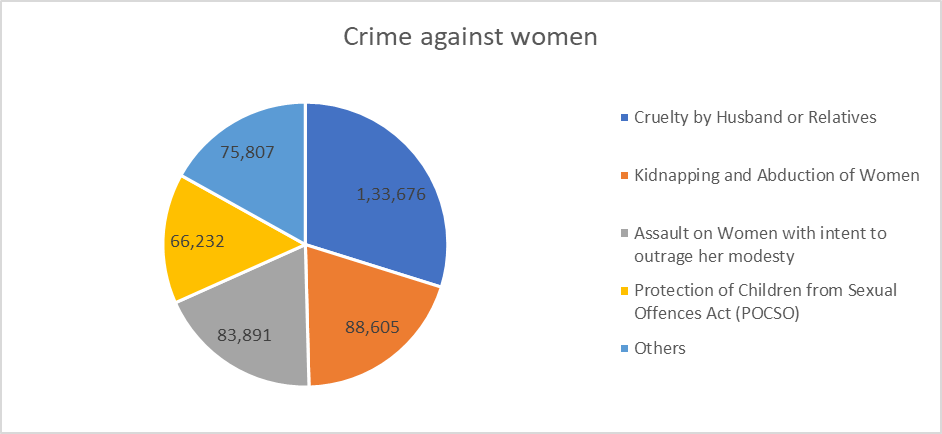
Despite a robust constitutional and statutory framework, including Articles 14, 15, and 21, and provisions under the Nyaya Sanhita, 2023 (such as Section 63 on Rape, Section 85 on Cruelty by husband or relatives, and Section 80 on dowry death), supported by procedural safeguards under BNSS; along with the Protection of Women from Domestic Violence Act, 2005, the Sexual Harassment of Women at Workplace (Prevention, Prohibition and Redressal) Act, 2013 (POSH Act) and the Dowry Prohibition Act, 1961, systemic barriers such as insensitive policing, weak legal aid, prosecutorial delays, and social stigma continue to hinder access to justice.
Over the years, laws to protect women have multiplied, but for many survivors, justice remains an elusive promise. The courts may deliver verdicts, yet societal stigma, institutional gaps, and systemic delays often turn legal victories into hollow triumphs.
Landmark rulings have fundamentally reshaped the gender justice framework. Vishaka v. State of Rajasthan12 recognised workplace sexual harassment and laid down the binding Vishaka Guidelines that imposed preventive and remedial duties on employers. Later, creating foundation for the POSH Act, placing direct responsibility on employers. This judgment reframed workplace harassment from a private grievance to a constitutional wrong, compelling institutional accountability and eventually leading to the POSH Act. On paper, this marked a paradigm shift: Every workplace was bound to have Internal Complaints Committees (ICCs), preventive mechanisms, and procedural safeguards. But practically, many committees remain either non-functional or improperly constituted, awareness among employees remains limited, and complainants often face retaliation or stigma. The normative breakthrough has not always translated into safe working environments. While many organisations have complied formally by constituting ICCs and drafting policies, implementation is often superficial. Committees are sometimes improperly constituted or inactive, awareness among employees remains limited, and complainants may still face stigma or retaliation. In many workplaces, ICCs are perceived as opaque or inaccessible, existing more in form than in function. As a result, the transformative promise of Vishaka case has not always translated into genuinely safe and trusted workplace environments.
The Supreme Court in Laxmi v. Union of India13, issued guidelines that made acid attacks a distinct criminal offence, restricted over-the-counter acid sales with mandatory ID, and ensured minimum compensation and free medical care for survivors./326-B, Penal Code, 1860, were introduced to punish acid attacks and related acts. Even the Ministry of Home Affairs, in its 2024 Guidelines reiterated this.14 Despite this legal framework, the NCRB reported 207 acid attacks in India in 2023,15 showing that the crime persists and may be underreported due to stigma and fear. Acid remains easily accessible in many regions, undermining the Supreme Court’s sales regulation directions. Though the judgment strengthened the law, implementation and outcomes on the ground remain inadequate. The data reveals how wide the gap remains between law on paper and reality on the ground. 326-A/326-B, Penal Code, 1860, were introduced to punish acid attacks and related acts. Even the Ministry of Home Affairs, in its 2024 Guidelines reiterated this.16 Despite this legal framework, the NCRB reported 207 acid attacks in India in 2023,17 showing that the crime persists and may be underreported due to stigma and fear. Acid remains easily accessible in many regions, undermining the Supreme Court’s sales regulation directions. Though the judgment strengthened the law, implementation and outcomes on the ground remain inadequate. The data reveals how wide the gap remains between law on paper and reality on the ground.
These figures do not negate the importance of judicial progress; they underscore its limits. The courts have articulated powerful rights and accountability standards. But without consistent enforcement, survivor-sensitive policing, functional complaint mechanisms, and faster trials, legal reform alone cannot transform lived realities. The promise of these landmark judgments lies not just in precedent, but in sustained institutional commitment to making those rights meaningful in everyday life.
The Supreme Court’s decision in Mukesh v. State (NCT of Delhi) (Nirbhaya case)18, arising out of the 2012 Nirbhaya case, became a watershed moment in India’s criminal justice system. While the judgment itself upheld the death penalty for the convicts under the “rarest of rare” doctrine, its broader impact lay in catalysing sweeping legislative reform. Public outrage following the incident led to the Criminal Law (Amendment) Act, 2013, which expanded the definition of rape, introduced provisions for offences such as stalking, voyeurism and acid attacks, enhanced punishments, and strengthened procedural safeguards for survivors. It also paved way for reforms under the Juvenile Justice (Care and Protection of Children) Act, 2015, permitting 16 to 18-year-olds accused of heinous crimes to be tried as adults after assessment, and accelerated the establishment of fast track courts for sexual offences.
However, despite a stronger statutory framework and stricter penalties, crimes against women continue to be reported in large numbers, and conviction rates remain modest compared to the volume of cases registered.
As per the NCRB Report, 83,891 cases were reported in 2023 on “Assault on Women with Intent to Outrage Her Modesty”19. Further, delays in investigation and trial, inadequate victim support systems, uneven police responsiveness, and persistent societal stigma continue to undermine effective implementation. Thus, while the Nirbhaya case marked a decisive shift in India’s legal response to sexual violence, the promise remains only partially realised in everyday realities.
Structural barriers within justice system
Women’s access to justice in India is often hindered by a web of structural barriers. Deep-rooted patriarchy, social stigma, and fear of backlash often discourage survivors from speaking up, while financial dependence and the high cost of going to court make the journey even harder. Even when the courts deliver landmark judgments, the impact remains minimal due to weak enforcement and low awareness.
In Mohd. Ahmed Khan v. Shah Bano Begum20, the Supreme Court recognised her right to maintenance, but societal and family pressures eventually led her to step back from claiming it. Beyond this, many women face hurdles like not knowing their rights, slow courts, and difficulty accessing legal help. For women from marginalised communities, whether due to caste, class, disability, or religion, these barriers are even greater. And while laws have improved on paper, gaps in enforcement and support mean that justice often remains out of reach.
The Vishaka case21 captured a recurring paradox in Indian constitutional law. The judgment was transformative: It laid down the Vishaka Guidelines, filled out a legislative vacuum, and ultimately paved the way for the POSH Act. Yet, even as constitutional doctrine advanced, the woman at the heart of the case did not see comparable justice, as the accused were acquitted at trial. The case, thus, stands as a powerful reminder that while the courts can articulate progressive principles and catalyse reform, the lived reality of victims often lags behind. In India’s constitutional journey, symbolic victories and structural change do not always translate into timely or lasting relief for the individuals whose suffering first brought the issue before the law.
Another example is Independent Thought v. Union of India22, the judgment that marked a significant step forward for women’s rights, with the Court recognising that even in marriage, a girl’s right to say “NO” and to bodily autonomy cannot be ignored. It made clear that sexual intercourse with a wife aged 15—18 is considered rape, aligning Indian law with child protection rules and sending a strong message that consent matters. But, the ruling did not address the sexual abuse of adult wives by their husbands, and they remain largely unprotected under the law.
The confusion became even more evident in 2022, when the Delhi High Court delivered a split verdict23 on whether the marital rape exception should be removed, one judge favouring criminalisation and the other upholding the exception.
Read more on Delhi HC split verdict on Marital Rape
The divergence highlights the ongoing confusion within the judiciary itself, reflecting the tension between constitutional principles of equality and dignity and the social, cultural, and legislative hesitations surrounding marriage. The result is a half-realised reform: A symbolic but incomplete victory, where the law speaks of rights in principle, yet many women remain without full legal protection.
The road ahead: Making justice real
India has made important legislative and judicial strides; the challenge now is turning laws into a lived reality for women. Recent years have seen targeted efforts to provide faster, easier, and more effective access to justice. Fast track courts under the Nirbhaya Fund are speeding up trials for sexual offences, while women-centric policing, upgraded helplines, and mobile units aim to ensure quicker responses on the ground. Legal aid programs through National Legal Services Authority (NALSA) and awareness campaigns are empowering women to navigate the system, and technology-driven initiatives — e-courts, online filing, and artificial intelligence (AI)-assisted guidance — Nari Adalats24 are also emerging to resolve disputes at the local level, reducing dependence on formal courts.
The road ahead for women’s justice is expanding beyond criminal law to touch every aspect of life, from health and autonomy to property and professional participation. Like recently, the Supreme Court recognised the menstrual health as a fundamental right, in another case it emphasised women’s reservation in Bar Council elections, and also affirmed the rights in live-in relationships, signalling that autonomy and equality extend into personal and public spaces.
Legislative reforms like the 2005 Amendment on daughters’ inheritance, have created formal equality, but awareness, enforcement, with access and introduction to remain key. Workplace protections under the POSH Act are also becoming easier to navigate with the introduction of e-portal like SHe-Box. The challenge now is turning these laws into a practical reality through better implementation, legal support, and awareness.
Continuing importance of Women’s Day in 2026
As United Nation Women celebrates International Women’s Day this year under the theme “Rights. Justice. Action. For ALL Women and Girls”,25 the message could not be clearer that celebration is not enough, action is required to serve justice. Applause without accountability is hollow. Symbolism without structural reform is a disservice to the very women we claim to honour.
International Women’s Day must, therefore, drive a meaningful shift. True empowerment cannot rest on praise alone. It requires systems that respond when rights are violated and consequences when laws are broken. This means ensuring prompt police action, time-bound trials, survivor-centric judicial processes, and strict implementation of workplace and public-safety laws.
Celebrating women while ignoring systemic injustice risks turning empowerment into performance. Asking women to be resilient or inspiring in the face of violence and discrimination subtly shifts responsibility onto them, rather than on the State and society that are obligated to protect their rights.
Women’s day is not merely a reminder of women’s rights; it is a measure of how effectively the law translates those rights into a lived reality.
*Editorial Assistant, EBC Publishing Pvt. Ltd. Author can be reached at: malika.bhola@ebcpublishing.in.
1. UN Documents: Gathering a Body of Global Agreements, Declaration on the Elimination of Violence against Women, A/RES/48/104.
2. Landmark Resolution on Women, Peace and Security (Security Council Resolution 1325).
3. United Nations Security Council, Resolution 1820 (2008), S/RES/1820(2008).
4. UN Women, Women and Peace and Security: Guidelines for National Implementation, 2012.
5. Kriti, India Has 879 Fast Track Courts Operational, 1800 Recommended: Law Ministry. (SCC Times, 30-01-2026).
6. “E-Courts Mission Mode Project”, e-Committee, Supreme Court of India.
7. Press Release, New Labour Codes Empower Women with Greater Safety, Equality, and Workplace Flexibility, Press Information Bureau, 27-11-2025, available at <https://www.pib.gov.in/PressReleasePage.aspx?PRID=2195247®=3&lang=1>.
8. India – Georgetown Institute for Women, Peace and Security < https://giwps.georgetown.edu/>.
9. India’s Maternal Mortality Declines, But Health Inequities Remain a Barrier, 10-4-2025, available at <https://inorder.in/news-fields/indias-maternal-mortality-declines-but-health-inequities-remain-a-barrier>.
10. Ministry of Home Affairs, Crime in India 2023, National Crime Records Bureau, available at <https://www.ncrb.gov.in/uploads/files/1CrimeinIndia2023PartI1.pdf>.
11. Ministry of Home Affairs, Crime in India 2023, National Crime Records Bureau, available at <https://www.ncrb.gov.in/uploads/files/1CrimeinIndia2023PartI1.pdf>.
12. (1997) 6 SCC 241 : 1997 SCC (Cri) 932.
13. (2014) 4 SCC 427 : (2014) 4 SCC (Cri) 802.
14. Ministry of Home Affairs (MHA) in India has strengthened acid attack guidelines under the new criminal laws (BNS, 2023) effective July 1, 2024.
15. NCRB, Crime in India, Vol.1, 2023.
< https://www.ncrb.gov.in/uploads/files/1CrimeinIndia2023PartI1.pdf>
16. Ministry of Home Affairs (MHA) in India has strengthened acid attack guidelines under the new criminal laws (BNS, 2023) effective July 1, 2024. See Also, < https://www.mha.gov.in/en/commoncontent/compensation-acid-attack-victims?utm_source=chatgpt.com>
17. Ministry of Home Affairs, Crime in India 2023, National Crime Records Bureau, available at <https://www.ncrb.gov.in/uploads/files/1CrimeinIndia2023PartI1.pdf>.
18. (2017) 6 SCC 1 : (2017) 2 SCC (Cri) 673.
19. Ministry of Home Affairs, Crime in India 2023, National Crime Records Bureau, available at <https://www.ncrb.gov.in/uploads/files/1CrimeinIndia2023PartI1.pdf>.
20. (1985) 2 SCC 556 : 1985 SCC (Cri) 245.
23. RIT Foundation v. Union of India, (2022) 3 HCC (Del) 572.
24. Sisko Piippo, Marianne Notko, Marita Husso and Janet Carter Anand, “Framing Social Work Discourses of Violence Against Women. Insights From Finland and India” (2022).
25. International Women’s Day 2026: Rights. Justice. Action. For ALL Women and Girls., (UN Women).