
Disclaimer: This has been reported after the availability of the order of the Court and not on media reports so as to give an accurate report to our readers.
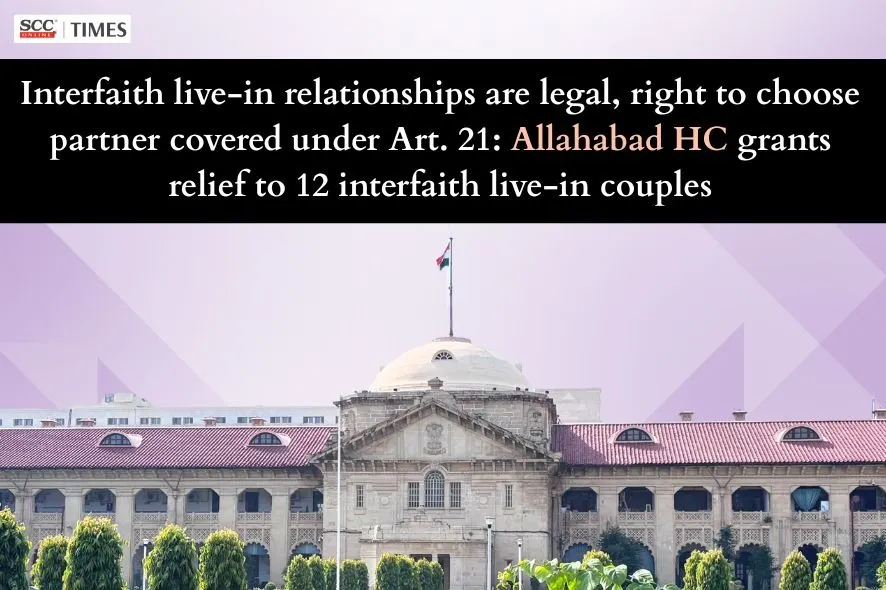
Allahabad High Court: In a batch of writ petitions filed by interfaith live-in couples seeking protection, the Single Judge Bench of Vivek Kumar Singh, J., allowed the petitions, holding that live-in relationship of an interfaith couple is not illegal as live-in relationships are neither prohibited nor punishable. The Court also held that the petitioners did not violate the Unlawful Conversion of Religion Act, 2021 (UCRA), and it is the fundamental right of the petitioners to choose their partners under Article 21 of the Constitution.
Background
The present writ petitions were filed by interfaith live-in couples seeking protection and directions to the respondents not to interfere with their peaceful lives and liberties. Despite approaching the police, no relief was given, and the petitioners continued to face life threats from private respondents and their family members/relatives/associates.
Analysis
At the outset, the Court discussed relationships outside marriage under Muslim law and referred to Kiran Rawat v. State of U.P., 2023 SCC OnLine All 323, wherein it was observed that premarital sex is not permissible in Islam. Noting this, the Court stated that no recognition can be given to sex outside marriage in the Muslim Law. However, there were no provisions in the Penal Code, 1860 (IPC), or any other Act to punish a man or woman with lashes or stoning to death. Therefore, the Court held that a person cannot be punished according to Muslim Law/Islam, as quoted in Kiran Rawat (supra).
The Court opined that for attracting the offence under Sections 3 and 5 UCRA, the conversion needs to be done by practice of misrepresentation, force, undue influence, coercion, allurement, by any fraudulent means, by marriage, or by a relationship like marriage. However, in the present cases, no petitioner claimed that any attempt, in any manner, was made by other petitioners to convert their religion. They only claimed that they are living together in a live-in relationship and following their religion.
The Court also noted that no FIR or complaint was lodged under Section 4 UCRA against any person whose religion was one of the petitioners who was converted or attempted to be converted. Therefore, the Court held that it could not be said under the facts and circumstances of these cases that they committed any punishable offence under the UCRA. Furthermore, the UCRA does not prohibit interfaith marriage, and Sections 8 and 9 provide a procedure if a person wishes to convert.
The Court remarked that it did not view the petitioners herein as Hindu and Muslim, rather as two grown-up individuals who, out of their own free will and choice, were living together peacefully and happily for a considerable time. It was further added that Courts, specifically the constitutional courts, are enjoined to uphold the life and liberty of an individual guaranteed under Article 21 of the Constitution. Right to live with a person of his/her choice, irrespective of the religion professed by them, is intrinsic to the right to life and personal liberty. “Interference in a personal relationship would constitute a serious encroachment into the right to freedom of choice of the two individuals.”
“This Court fails to understand that if the law permits two persons, even of the same sex, to live together peacefully, then neither any individual nor family nor even State can have objection to a heterosexual relationship of two major individuals who, out of their own free will, are living together.”
The Court further stated that the decision of an individual who is of the age of majority, to live with an individual of his/her choice, is strictly a right of an individual. When this right is infringed, it would constitute a breach of his/her fundamental right to life and personal liberty, as it includes the right to freedom of choice, to choose a partner, and the right to live with dignity as enshrined in Article 21 of the Constitution.
In this regard, the Court referred to Shakti Vahini v. Union of India, (2018) 7 SCC 192, wherein the Supreme Court came down heavily on the perpetrators of “honour killings”, which the Court found not only horrific and barbaric, but also an interference with the right to choose a life partner and the dignity of an individual. The Court also referred to K.S. Puttaswamy (Privacy-9J.) v. Union of India, (2017) 10 SCC 1.
“Right to choose a partner irrespective of caste, creed or religion, is inherent under right to life and personal liberty, an integral part of the fundamental right under Article 21 of the Constitution.”
The Court added that an individual on attaining majority is statutorily conferred a right to choose a partner, which if denied, would not only affect his/her human right but also his/her right to life and personal liberty, guaranteed under Article 21 of the Constitution. Additionally, irrespective of the conversion being under clout, the mere fact that the couples were living together, the alleged relationship could very well be classified as a relationship like marriage, distinct from the relationship arising out of marriage as per the Protection of Women from Domestic Violence Act, 2005.
“To disregard the choice of a person who is of the age of majority would not only be antithetical to the freedom of choice of a grown-up individual but would also be a threat to the concept of unity in diversity.”
Regarding interfaith couples, the Court referred to Supriyo v. Union of India, 2023 SCC OnLine SC 1348, wherein the Supreme Court observed that couples in interfaith relationships have historically been forced to contend with and continue to contend with enormous difficulty while solemnizing their unions. It was further observed that the Constitution does not require individuals to first convince others of the legitimacy of the exercise of constitutional rights before they exercise them.
Furthermore, in Shafin Jahan v. Asokan K.M.,(2018) 16 SCC 368, the Supreme Court held that the right to marry a person of one’s choice is integral to Article 21 of the Constitution. It guarantees the right to life and personal liberty. The Constitution protects the ability of each individual to pursue a way of life or faith that they seek.
The Court also referred to judgments where it granted protection to interfaith live-in couples, such as Baby Aaliya v. State of U.P., 2025 SCC OnLine All 2107 and Mohammad Shahnoor Mansoori v. State of Delhi1. In fact, in Suman Ahirwar v. State of U.P.2, the Court had directed the State authorities to evolve an effective mechanism and frame guidelines to address such cases at the district level.
Pursuant to the aforesaid directions, the State Government issued a Government Order dated 31 August 2019, laying down mandatory preventive, remedial, and punitive measures for the protection of couples facing threats on account of marriage or any consensual relationship. The said Government Order mandates that the police authorities shall assess threat perception in each case, extend necessary protection, including safe accommodation, and security shall be provided depending upon the gravity of the situation. It further provides that cases involving Khap Panchayats or honour-based threats are to be treated as serious matters; even in other cases of familial opposition, the authorities are duty-bound to evaluate risk and grant appropriate relief. Failure to comply with these directions has been made punishable by departmental action.
Furthermore, the Court noted that in Mayra v. State of U.P., 2021 SCC OnLine All 805, it had already dealt with interfaith marriage contracted by the petitioners, and a total of 17 petitions about interfaith marriage were allowed. The Court in Mayra (supra) observed that the choice of a partner, whether within or outside marriage, lies within the exclusive domain of each individual, and the UCRA, per se, does not prohibit interfaith marriage.
Noting the aforesaid decisions, the Court stated that it saw no reason to take a different view in this matter since the law is equal for all as per Articles 14 and 15 of the Constitution. “If two persons of the same religion may reside together in a live-in relationship, other persons having a different religion may also live together in a live-in relationship”.
Decision
Reiterating that live-in relationships are neither prohibited nor punishable and considering Articles 14, 15, and 21 of the Constitution and the UCRA, the Court held that it could not be said that a live-in relationship of an interfaith couple is an offence.
The Court reasoned that if any offence had been committed, it would have been reported by any person in terms of Section 4 UCRA, but no FIR or complaint has been registered to date in respect of the live-in relationship of the petitioners. Secondly, the Court stated that it was not a trial court to find out as to whether any offence was committed by the petitioners by putting themselves in a live-in relationship. The Court, at this stage, was only examining the issue of apprehension of the petitioners based on a threat to their life and liberty for the reasons/circumstances as narrated in the petition. If the petitioners have not committed any offence, there was no reason why their prayer for the grant of protection could not be acceded to.
The Court held that a constitutional fundamental right under Article 21 of the Constitution stands on a much higher pedestal and being sacrosanct under the Constitutional Scheme, it must be protected, regardless of the solemnization of an invalid or void marriage or even the absence of any marriage between the parties. Furthermore, it is the bounden duty of the State to protect the life and liberty of every citizen.
“The right to human life is to be treated on a much higher pedestal, regardless of a citizen’s religious belief. The mere fact that the petitioners are living in an interfaith relationship would not deprive them of their fundamental right as envisaged in the Constitution, being citizens of India.”
Accordingly, the Court allowed the writ petitions with the following directions:
-
The petitioners were granted liberty to approach the police authorities for redressal of their grievances, in case the private respondents or their associates cause any harm. Upon receipt of such an application, the police authorities shall examine the matter and age of the petitioners, and if they find any substance in the allegations of the petitioners, they will act in accordance with the law for the protection of life, limb, and liberty of the petitioners.
-
The petitioners may lodge a report/complaint if anybody attempts to convert their religion against their wishes, or by any fraudulent means, force, coercion, allurement, undue influence, or practice of misrepresentation.
-
The directions contained in the Government Order dated 31 August 2019 are binding upon all concerned authorities and shall be strictly complied with.
-
This order would not come in the way of investigation, if any, pending before the Police Authorities.
Lastly, the Court clarified that it had not adjudicated the correct age of the petitioners, and the order has not been passed to protect the petitioners against any action or proceedings instituted in accordance with law.
Also read: Live-in Relationships in India: What Rights Does a Woman Really Have?
[Noori v. State of U.P., 2026 SCC OnLine All 456, decided on 23-2-2026]
Advocates who appeared in this case :
For the petitioners: Akhilesh Kumar Yadav, Shlok Jaiswal, Uday Bhan Singh, Dinkar Lal, Sirajuddin
For the respondent: Additional Chief Standing Counsels Prabhash Kumar Tiwari and Ashwani Kumar Tripathi, Standing Counsels Yogesh Kumar, Pramit Kumar Pal, Suresh Babu, Arvind Kumar Singh, Vijay Kumar Srivastava, Phool Chand
Amicus Curiae: Senior Counsel Shwetashwa Agarwal and Advocate Yashraj Verma
1. W.P. (CRL) No. 2305 of 2025
2. Writ-C No. 24328 of 2019