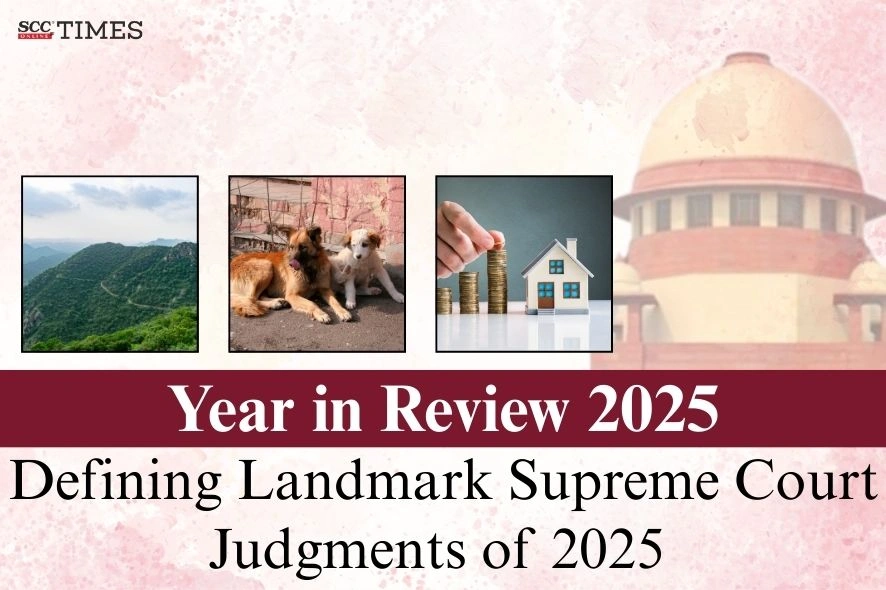
Another year comes to close and with it comes the need to retrospect the year gone by to take lessons. Out of 1,426 judgments delivered by the Supreme Court, several important Supreme Court rulings of 2025 stood out, setting benchmarks across key areas – from environment to proper evidence collection in criminal cases to appointment of judges to cheque dishonour cases and summoning advocates. We have culled out these important verdicts which defined the legal landscape of 2025.
Modification of Arbitral Award: Court’s limited power
In May 2025 a five-judge Bench comprising Sanjiv Khanna*, CJI., B.R. Gavai, Sanjay Kumar, Augustine George Masih, and K.V. Viswanathan**, JJ., with a ratio of 4:1, in Gayatri Balasamy v. ISG Novasoft Technologies Ltd., (2025) 7 SCC 1, held that the Appellate Courts may exercise limited powers to modify arbitral awards under certain specific circumstances:
-
Severability — When the invalid portion of the award can be separated from the valid part.
-
Apparent Errors — To correct clerical, computational, or typographical errors evident on the face of the record.
-
Post-Award Interest — To modify post-award interest where appropriate.
-
Article 142 Powers — The Supreme Court may exercise its special powers under Article 142 of the Constitution to modify awards, but such powers must be used sparingly and with great caution, in accordance with constitutional limits.
Eligibility of Judicial Officers with 7 Years’ Law Experience for Appointment as District Judge
In October 2025, a 5-Judge Constitution Bench comprising of B.R. Gavai, CJI.*, M.M. Sundresh, Aravind Kumar, S.C. Sharma and K. Vinod Chandran, JJ., in Rejanish K.V. v. K. Deepa, 2025 SCC OnLine SC 2196, while deciding a reference on issues related to appointment of Judicial Officers as District Judges, held the following:
-
Judicial Officers who have already completed 7 years in Bar before they were recruited in the subordinate judicial service, would be entitled for being appointed as a District Judge/Additional District Judge in the selection process for the post of District Judges in the direct recruitment process.
-
The eligibility for appointment as a District Judge/Additional District Judge is to be seen at the time of application.
-
Though there is no eligibility prescribed under Article 233(2) of the Constitution for a person already in judicial service of the Union or of the State for being appointed as District Judge; in order to provide a level playing field, the Court directed that a candidate applying as an in-service candidate should have 7 years’ combined experience as a Judicial Officer and an advocate.
-
A person who has been or who is in judicial service and has a combined experience of 7 years or more as an advocate or a Judicial Officer, would be eligible for being considered and appointed as a District Judge/Additional District Judge under Article 233 of the Constitution.
-
In order to ensure level playing field, the Court directed that the minimum age for being considered and appointed as a District Judge/Additional District Judge for both advocates and Judicial Officers would be 35 years of age as on the date of application.
-
The Court held that view taken in Satya Narain Singh v. High Court of Judicature at Allahabad, (1985) 1 SCC 225, till Dheeraj Mor v. High Court of Delhi, (2018) 4 SCC 619, which takes a view contrary to what has been held above, do not lay down the correct proposition of law.
Determination of Seniority in Higher Judicial Services
In November 2025, once again a 5-Judge Bench of B.R. Gavai, CJI, Surya Kant, Vikram Nath, K. Vinod Chandran and Joymalya Bagchi, JJ., in All India Judges Assn. v. Union of India, 2025 SCC OnLine SC 2500, laid down general and mandatory guidelines which shall, henceforth, be incorporated into the respective statutory service rules governing the determination of inter se seniority among officers appointed from different sources to the Higher Judicial Services. The Court thus invoked the powers under Article 142 of the Constitution and issued the following directions vis-a-vis determination and entitlement of seniority:
-
The seniority of officers within the HJS shall be determined through an annual 4-point roster, filled by all officers appointed in the particular year in the repeating sequence of 2 Regular Promotees; 1 Limited Departmental Competitive Examinations, and 1 Direct Recruitment.
-
Only if the recruitment process is completed within the year after which it was initiated and no other appointments, from any of the three sources, have already taken place in respect of the recruitment initiated for that subsequent year, shall the officers belatedly so appointed be entitled to seniority as per the roster of the year in which recruitment was initiated.
-
If the recruitment process is not initiated for vacancies arising in a given year in the same year, the candidate filling such vacancy, in subsequent recruitment, shall be granted seniority within the annual roster of the year in which the recruitment process is finally concluded and appointment is made.
-
That, after the recruitment of DRs and LDCEs is complete for a particular year, the positions falling in their quota that remain unfilled due to lack of suitable candidates shall be filled through RPs, subject to such RPs being placed only on subsequent RP positions in the annual roster; and the vacancies in the subsequent year shall be computed so as to apply the proportion of 50:25:25 to the entire cadre.
-
The statutory rules governing the HJS in the respective States, in consultation with the High Courts, shall prescribe the exact modalities of the Annual Roster and how the directions of this judgement shall be implemented.
The Court clarified that the directions issued herein shall not be construed as an avenue to reopen or unsettle inter se seniorities that have already been determined between officers appointed from the different sources of recruitment.
Presidential Reference on Governor and President’s Powers under Arts. 200/201
While considering this Presidential Reference on Assent, Withholding or Reservation of Bills by the Governor & the President of India, In re, 2025 SCC OnLine SC 2501; the Constitution Bench of B.R. Gavai, CJI, Surya Kant, Vikram Nath, P.S. Narasimha and Atul S. Chandurkar, JJ., opined that, the Governor has 3 constitutional options before him, under Article 200, namely — to assent, reserve the Bill for the consideration of the President, or withhold assent and return the Bill to the Legislature with comments. The first proviso to Article 200 is bound to the substantive part of the provision, and restricts the existing options, rather than offering a fourth option. Pertinently, the third option — to withhold assent and return with comments — is only available to the Governor when it is not a Money Bill.
The Court further opined that the discharge of the Governor’s function under Article 200, is not justiciable. The Court cannot enter into a merits review of the decision so taken. However, in glaring circumstances of inaction that is prolonged, unexplained, and indefinite — the Court can issue a limited mandamus for the Governor to discharge his function under Article 200 within a reasonable time period, without making any observations on the merits of the exercise of his discretion.
Three-year legal practice requirement for eligibility in civil judge exams
In another landmark verdict delivered in May 2025, the three-judge bench of BR Gavai, CJI and AG Masih and K Vinod Chandran, JJ., in All India Judges Assn. v. Union of India, 2025 SCC OnLine SC 1184, restored minimum three-year legal practice requirement for eligibility in civil judge exams.
The Court in November 2025, issued clarification on this verdict stating that, in case of Judicial Officers (JOs), who are appointed prior to the passing of the judgment dated 20-05-2025, the requirement of 3 years practice at the Bar would not be necessary, in case they apply for Judicial Services in any other State. This, however, will be subject to such JOs completing three years’ service in their present State.
Using Urdu as additional language alongside Marathi for official purposes
In Varshatai v. State of Maharashtra, (2025) 7 SCC 293, the appellant had been aggrieved at the use of Urdu on the signboard of the new building of the Municipal Council, Patur (‘Municipal Council’) in district Akola, Maharashtra, the board of the Council displayed “Municipal Council, Patur”, in Marathi at the top, with its translation below in Urdu language. The Division Bench of Sudhanshu Dhulia* and K. Vinod Chandran, JJ., while dismissing the appeal, held that display of an additional language cannot by itself, be said to be in violation of the provisions of the Maharashtra Local Authorities (Official Languages) Act, 2022 (‘2022 Act’) as there is no prohibition on the use of Urdu under the 2022 Act or in any provision of law.
Alleged provocative poem sharing by Imran Pratapgarhi
In Imran Pratapgadhi v. State of Gujarat, 2025 SCC OnLine SC 678, while considering the instant appeal revolving around FIR filed in Jamnagar against Imran Pratapgadhi, Member of the Rajya Sabha for the offences punishable under Sections 196, 197(1), 302, 299, 57 and 3(5) of the Bharatiya Nyaya Sanhita, 2023 (BNS) for allegedly inciting communal disharmony via an allegedly provocative poem he shared from his verified ‘X’ (formerly Twitter) account; the Division Bench of Abhay S. Oka* and Ujjal Bhuyan, JJ., quashed FIR against the Rajya Sabha MP and sternly observed that the instant case shows that even after 75 years of the existence of the Constitution, the law enforcement machinery of the State is either ignorant or does not care for one of the most important fundamental rights conferred on the citizens of India under Article 19 (1)(a) of the Constitution i.e. the fundamental right of freedom of speech and expression.
Expulsion of RJD MLA Sunil Kumar Singh for unparliamentary remarks
In Sunil Kumar Singh v. Bihar Legislative Council, 2025 SCC OnLine SC 439, challenging the Report of the Ethics Committee of the Bihar Legislative Council (‘BLC’) which recommended Rashtriya Janata Dal’s (‘RJD’) Sunil Kumar Singh’s expulsion as a Member of the Legislative Council (‘MLC’), the Division Bench of Surya Kant* and N. Kotiswar Singh, JJ. allowed the petition and set aside the impugned report and notification expelling Singh, considering that the punishment meted out to him was highly excessive and disproportionate to the nature of the misconduct committed by him. The Bench directed him to be reinstated as a member of the BLC with immediate effect. However, he shall not be entitled to claim any remuneration or other monetary benefits for the period of his disbandment. However, the Court clarified that if he indulges further in such misconduct upon his reinstatement, the Ethics Committee or Chairperson of the BLC can take appropriate action, in accordance with law.
Informing Grounds of Arrest; Guidelines to prevent inhuman treatment of accused persons
In considering Vihaan Kumar v. State of Haryana, (2025) 5 SCC 799, concerning violation of appellant’s right under Article 22(1) of the Constitution as he was not informed of the grounds for his arrest; the Division Bench of Abhay S. Oka* and N. Kotiswar Singh**, JJ., taking note of the facts of the case, found that the grounds of arrest were not communicated to the appellant as mandated by Article 22(1), therefore, the appellant’s arrest was rendered illegal. Abhay S. Oka, J., also took stern note of the shocking treatment given to the appellant by the police, whereby he was taken to a hospital while he was handcuffed and was chained to the hospital bed. Which was a violation of the fundamental right of the appellant under Article 21 of the Constitution. Therefore, the Court directed State of Haryana to issue guidelines/departmental instructions to the police (i) to ensure that the act of handcuffing an accused on a hospital bed and tying them to the hospital bed is not committed again; (ii) to ensure that the constitutional safeguards under Article 22 are strictly followed. In his concurring opinion, N. Kotiswar Singh, J., stated that the requirement of communicating the grounds of arrest in writing is not only to the arrested person, but also to the friends, relatives or such other person as may be disclosed or nominated by the arrested person, so as to make the mandate of Article 22(1) of the Constitution meaningful and effective failing which, such arrest may be rendered illegal.
Senior Citizen’s right to cancel a gift deed executed in favour of her son for not fulfilling conditions of gift deed
In Urmila Dixit v. Sunil Sharan Dixit, (2025) 2 SCC 787, the division bench of C.T. Ravikumar and Sanjay Karol, JJ. set the gift deed executed by a mother in favour of her son after conditions for her maintenance were not complied with. Further, directed the possession of the premises to be restored to the appellant by 28-02-2025.
Criminal Trial | Systematic Presentation of Evidence for better appreciation of evidence
While considering Manojbhai Jethabhai Parmar (Rohit) v. State of Gujarat, 2025 SCC OnLine SC 2803,revolving around sexual assault of a 4-year-old-girl (child victim) which was found to be “enveloped in layers of investigative apathy and procedural infirmities”, the Division Bench of Vikram Nath and Sandeep Mehta*, JJ., opined that a more structured and uniform practice must be adopted to enhance the legibility of criminal judgments. Accordingly, to ensure a systematic presentation of evidence that enables efficient appreciation of the record, the Court issued directions to all Trial Courts with the aim to institutionalize a standardized format for cataloguing witnesses, documentary evidence, and material objects, in order to facilitate better comprehension and immediate reference for all stakeholders, including the Appellate Courts.
Pending cases under laws like UAPA that pose reverse burden of proof
In CBI v. Dayamoy Mahato, 2025 SCC OnLine SC 2775, challenging Calcutta High Court’s decision of releasing the 6 Respondents (accused persons) on bail in connection to offences concerning the derailment of Jnaneswari Express on 28-5-2010; the Division Bench of Sanjay Karol* and N. Kotiswar Singh, JJ., emphasised Court’s responsibility in aiding an accused to prove their innocence given that Section 43-E UAPA imposes a reverse burden for proof on the accused and thus issued several directions.
Sexual Harassment at Workplace | ICC’s power to investigate Respondents from Other Departments
In a significant ruling, the bench of JK Maheshwari* and Vijay Bishnoi, JJ., in Sohail Malik (Dr.) v. Union of India, 2025 SCC OnLine SC 2751, has held that an Internal Complaints Committee (ICC) constituted at the workplace of an aggrieved woman can conduct a preliminary inquiry under the Sexual Harassment of Women at Workplace (Prevention, Prohibition and Redressal) Act, 2013 (POSH Act), even if the ‘respondent’ is employed in a different government department.
The Stray Dog Saga – In Re: “City Hounded by Strays, Kids Pay Price”
This year saw the rise of activism related to protection of animals, especially stray dogs. As such the matter reached the Supreme Court, wherein the Court issued several directions trying to harmonise animal welfare and public safety.
On 11-8-2025, the Court directed the authorities concerned to initiate the process of picking up stray dogs from all localities, particularly from vulnerable and peripheral areas. The authorities were granted discretion to determine the mode and structure of implementation, including the creation of a dedicated task force if necessary. This was to be the foremost step toward making the entire NCR region free from stray dogs. However, owing to concerns regarding the proper treatment of the strays, the Supreme Court on 22-8-2025, modified its previous order and directed the authorities to Capture, Vaccinate and Release the stray dogs as ordered in City Hounded by Strays, Kids Pay Price, In re, (2025) 9 SCC 1
Then in November 2025, the Court in In Re: “City Hounded by Strays, Kids Pay Price”, 2025 SCC OnLine SC 2371, perused the compliance affidavits filed by the States and Union Territories pursuant to the Court’s earlier directions; and deemed it fit to modify, the directions issued by the High Court of Judicature for Rajasthan at Jodhpur in Suo Moto v. Union of India, 2025 SCC OnLine Raj 3831 and issued further directions in respect of institutional areas, including educational establishments, hospitals, sports complexes, and other public spaces such as railway stations and bus depots, where incidents of dog-bite attacks continue to be reported with alarming frequency, raising a cause of grave concern and requiring emergent remedial measures.
Jurisdiction to try complaint under S. 138 NI Act in respect of account payee cheque
While considering Jai Balaji Industries Ltd. v. Heg Ltd., 2025 SCC OnLine SC 2581, wherein the issue was whether after the enactment of the Negotiable Instruments (Amendment) Act, 2015 (Amendment Act, 2015), the court within whose local jurisdiction the drawee bank is situated, has the jurisdiction to try a complaint under Section 138; the Division Bench of J.B. Pardiwala* and R. Mahadevan, JJ., held that jurisdiction to try a complaint filed under Section 138 in respect of a cheque delivered for collection through an account, i.e., an account payee cheque, is vested in the court within whose local jurisdiction the branch of the bank in which the payee maintains the account, i.e., the payee’s home branch, is situated.
Private Universities face Scrutiny
The bench of Ahsanuddin Amanullah and NV Anjaria, JJ., in Ayesha Jain v. Amity University, 2025 SCC OnLine SC 2557, directed Union of India, all States and Union Territories, and the University Grants Commission (UGC) to furnish comprehensive details in order to examine the aspects relating to the creation/establishment/setting-up of all private Universities, either under the State Governments/Union Territories or the Central Government, and connected concerns. The direction came while dealing with a dispute related to Amity University, Noida wherein the Court felt the pressing need to examine the establishment and functioning of private Universities across the country in the larger public interest.
Aravali Hills Protection
Protection of Aravali Hills became hot topic of debate and discussion over the penultimate months of 2025. The Supreme Court in November 2025, considered the matter concerning the definition of Aravali Hills and Ranges and the need for its proper conservation in the States of Delhi, Haryana, Gujarat and Rajasthan. The three-judges bench of B.R. Gavai, CJI* and K. Vinod Chandran, and N.V. Anjaria, JJ., in T.N. Godavarman Thirumulpad v. Union of India, 2025 SCC OnLine SC 2512, directed the Ministry of Environment, Forests and Climate Change (‘MoEF&CC’) to prepare an Management Plan for Sustainable Mining (‘MPSM’) for the entire Aravali Range. Regarding the ban on mining is concerned, the Court opined that a complete ban on mining might lead to illegal mining activities, and thus, no such ban is imposed on the present legal mining activities that are already being undertaken in the Aravali Hills and Ranges. Further, the Court directed that till the MPSM is finalized, no new mining leases should be granted, and once finalized, the mining would be permitted as per the MPSM.
However, this direction invited a spate of Interlocutory Applications, Miscellaneous Applications, and petitions before the Court challenging the findings of the Committee and the subsequent approval accorded by the Court, while also seeking clarification on certain directions stipulated in the judgment dated 20-11-2025. Hence, the Court in December 2025, the 3- Judge Bench of Surya Kant, CJ., and J.K. Maheshwari and Augustine George, JJ., to uphold complete justice and serve the broader public interest, stayed the Committee’s recommendations, together with the findings and directions in the judgment dated 20-11-2025. The Court in In Re: Definition of Aravalli Hills and Ranges and Ancillary Issues1 stated that this stay shall remain in force until the proceedings reach finality, ensuring that no irreversible administrative or ecological measures are undertaken under the current framework. The Court further directed the formation of a High-Powered Expert Committee to reassess the earlier Committee’s Report and to clarify the definition of the Aravalli Hills and Ranges, identifying exclusions, evaluating ecological risks of mining, and analysing environmental impacts to ensure ecological integrity.
Rights of Disabled Prisoners
The Supreme Court rendered a decision in July 2025 the division bench of JB Pardiwala and R. Mahadevan*, JJ., in L. Muruganantham v. State of T.N., (2025) 10 SCC 401, in furtherance of Articles 14 and 21 of the Constitution, the Rights of Persons with Disabilities Act, 2016 (‘RPwD Act’), and India’s obligations under the United Nations Convention on the Rights of Persons with Disabilities, 2006 (‘UNCPRD’), held that ‘State bears constitutional and moral obligation to uphold rights of disabled prisoners’ and issued directions for improved accessibility and care.
Furthermore, while considering a petition seeking exhaustive directions for providing appropriate legal framework and facilities to persons with Disabilities (PwD) who are undergoing incarceration in the prisons either as undertrials or convicts, the Division Bench of Vikram Nath and Sandeep Mehta*, JJ., in Sathyan Naravoor v. Union of India, 2025 SCC OnLine SC 2738, issued another set of directions in addition to salutary directions issued in L. Muruganantham (supra), which shall also be read in conjunction with the mandate of L. Muruganantham judgment.
The Court while considering Mission Accessibility v. Union of India, 2025 SCC OnLine SC 2635, filed by Mission Accessibility seeking inter alia, the modification of the timeline for scribe registration in the Civil Services Examination conducted by Union Public Service Commission and for permitting the use of laptops equipped with Screen Reader Software along with accessible digital question papers for eligible candidates; the Division Bench of Vikram Nath and Sandeep Mehta*, JJ., issued necessary directions to ensure that decisions taken by the UPSC are effectively translated into action and the rights of candidates belonging to the Persons with Benchmark Disability/Persons with Disability (PwBD/PwD) category are fully safeguarded.
Digital KYC for Acid-Attack Victims
In a significant ruling, the Division Bench of J.B. Pardiwala and R. Mahadevan*, JJ., in Pragya Prasun v. Union of India, (2025) 7 SCC 191 laid down 20 Directions in order to make the process of digital KYC accessible to persons with disabilities, especially facial/ eye disfigurements due to acid attacks and visual impairments. The Court further held that inaccessibility of digital KYC for persons with disabilities due to digital platforms not being compatible to with screen readers; crucial information being presented in visual formats without alternative text etc., such significantly hinder the ability of persons with disabilities to work, learn, and engage with society, thereby violating their right to equal opportunity and full participation as guaranteed under the United Nations Convention on the Rights of Persons with Disabilities (UNCRPD) and national disability laws. These barriers collectively amount to a denial of equal access and violate the accessibility mandates under the Rights of Persons with Disabilities Act, 2016 (RPwD Act) and results in economic and social marginalization. The Court pointed out that bridging the digital divide is no longer merely a matter of policy discretion but has become a constitutional imperative to secure a life of dignity, autonomy and equal participation in public life. The right to digital access, therefore, emerges as an intrinsic component of the right to life and liberty, necessitating that the State proactively design and implement inclusive digital ecosystems that serve not only the privileged but also the marginalized, those who have been historically excluded.
Rights of divorced Muslim women
In a significant judgment reinforcing the rights of divorced Muslim women, the bench of Sanjay Karol and N. Kotiswar Singh, JJ., in Rousanara Begum v. S.K. Salahuddin, 2025 SCC OnLine SC 2602, has held that the interpretation of the Muslim Women (Protection of Rights on Divorce) Act, 1986 must be done, keeping at the forefront equality, dignity, autonomy and the lived experiences of women where particularly in smaller towns and rural areas, inherent patriarchal discrimination is still the order of the day. The Court observed that the object of the Muslim Women (Protection of Rights on Divorce) Act is to secure the dignity and financial protection of a Muslim women post her divorce which aligns with the rights of a women under Article 21 of the Constitution.
Quashment of Tribunal Reforms Act, 2021
In a case wherein the validity of the key provisions of the Tribunals Reforms Act, 2021 (‘Impugned Act’) has been challenged, the Division Bench of B.R. Gavai, CJ.* and K. Vinod Chandran, J., in Madras Bar Assn. v. Union of India, 2025 SCC OnLine SC 2498, stated that the Impugned Act directly contradicts binding judicial pronouncements that have repeatedly clarified the standards governing the appointment, tenure, and functioning of tribunal members. The Court stated that merely reproducing the very provisions which were earlier struck down, amounts to a legislative override, which is an attempt to nullify binding judicial directions without addressing the underlying constitutional infirmities. Accordingly, the Court struck down the impugned provisions as unconstitutional. The Court further granted the Union of India a period of four months to establish a National Tribunals Commission, which must adhere to the principles concerning independence from executive control, professional expertise, transparent processes, and oversight mechanisms that reinforce public confidence in the system.
Ex-Post Environmental Clearances
In Confederation of Real Estate Developers of India v. Vanashakti, 2025 SCC OnLine SC 2474, seeking review of the earlier judgment in Vanashakti v. Union of India, 2025 SCC OnLine SC 1139 (Vanashakti judgment) which had barred post-facto (ex-post) environmental clearances (ECs), the 3-judge bench of BR Gavai, CJI and K. Vinod Chandran, and Ujjal Bhuyan, JJ, in a 2:1 verdict recalled the Vanashakti judgment and has held that retrospective ECs may be granted, but only for “permissible activities” as defined in the relevant regulatory framework. Further, these ECs will typically require payment of penalties/fines. BR Gavai, CJI, and K. Vinod Chandran, JJ formed the majority, while Ujjal Bhuyan, J dissented.
Jim Corbett Tiger Safari
While considering T.N. Godavarman Thirumulpad v. Union of India, 2025 SCC OnLine SC 2463, pertaining to conservation of tigers and their habitat, restoration of Jim Corbett Tiger Reserve and permitting tiger safaris, the 3-Judge Bench of B.R. Gavai, CJI*, Augustine George Masih and A.S. Chandurkar, JJ., directed that Tiger Safari shall not be permitted in the core or a critical tiger habitat area.
Nithari Killings: Surendra Koli’s Acquittal
While considering the petition filed by Surendra Koli, whose conviction in Rimpa Haldar case was affirmed by the Supreme Court whilst his acquittal in 12 companion prosecutions connected to Nithari Killings was upheld; the 3-Judge Bench of B.R. Gavai, CJI, Surya Kant and Vikram Nath*, JJ., allowed the curative petition and acquitted Surendra Koli of the charges under Sections 302, 364, 376 and 201 of the Penal Code, 1860 (IPC), thereby allowing him to go free in the 13th criminal case related to the horrific Nithari Killings. The Court in Surendra Koli v. State of U.P., 2025 SCC OnLine SC 2384, stated that to allow a conviction to stand on evidentiary basis that Supreme Court itself has since rejected as involuntary or inadmissible in the very same factual matrix, offends Article 21 of the Constitution. It also violates Article 14 of the Constitution, since like cases must be treated alike. Arbitrary disparity in outcomes on an identical record is inimical to equality before the law. “The curative jurisdiction exists to prevent precisely such anomalies from hardening into precedent”.
Communicating grounds of arrest
While considering Mihir Rajesh Shah v. State of Maharashtra, 2025 SCC OnLine SC 2356, wherein the appellants raised concerns over violation of their rights Article 22(1) of the Constitution and Section 50 of the CrPC (Section 47 of Bharatiya Nagarik Suraksha Sanhita, 2023 [“BNSS”]) asserting that they were not informed of grounds of their arrest in writing, the Division Bench of B.R. Gavai, CJI., and Augustine George Masih*, J., held the following vis-a-vis communicating the grounds of arrest to the arrested person:
-
The constitutional mandate of informing the arrestee the grounds of arrest is mandatory in all offences under all statutes including offences under Penal Code, 1860 (now BNS, 2023)
-
The grounds of arrest must be communicated in writing to the arrestee in the language he/she understands;
-
In cases where the arresting officer/person is unable to communicate the grounds of arrest in writing on or soon after arrest, it be so done orally. The said grounds be communicated in writing within a reasonable time and in any case at least two hours prior to production of the arrestee for remand proceedings before the magistrate.
-
In case of non-compliance of the above, the arrest and subsequent remand would be rendered illegal and the person will be at liberty to be set free. “The ends of fairness and legal discipline therefore demand that this procedure as affirmed above shall govern arrests henceforth”.
Private buses operating on inter-state routes
In U.P. SRTC v. Kashmiri Lal Batra, 2025 SCC OnLine SC 2335, filed against the judgment and order of the Madhya Pradesh High Court , as well as in a writ petition filed under Article 32 of the Constitution seeking enforcement of the rights guaranteed under Article 19(1)(g) of the Constitution, the Court was concerned with the grant of permits on certain inter-State routes that overlapped portions of certain intra-State notified routes. Accordingly, Chapter V of the Motor Vehicles Act, 1988, titled Control of Transport Vehicles, and Chapter VI, titled Special Provisions Relating to State Transport Undertakings, along with the relevant forms, constituted the focal point of the Court’s consideration. The Division Bench of Dipankar Datta* and A.G. Masih, JJ. emphasised that, given India’s substantial progress in the road transport sector, the interests of passengers and commuters must remain of paramount concern for transport authorities, in this case, for both the States of Uttar Pradesh and Madhya Pradesh. Consequently, the Court held that no permission could be granted at this stage to any private operator holding a permit issued by the State Transport Authority (STA), MP, to operate a stage carriage on an inter-State route overlapping a notified intra-State route in Uttar Pradesh.
Summoning Advocates in Criminal Cases
While considering this reference titled Summoning Advocates who give legal opinion or represent parties during investigation of cases & related issues, In re, 2025 SCC OnLine SC 2320, made by a Division Bench of the Court in a Special Leave Petition filed against notice issued against an Advocate under Section 179 of the Bharatiya Nagarik Suraksha Sanhita, 2023 (BNSS), the 3-Judge Bench of B.R. Gavai, CJI., K. Vinod Chandran* and N.V. Anjaria, JJ., issued important directions to ensure that the Client-Advocate privilege is not impinged upon by valiant investigators or overzealous parties to a litigation, purely on the basis of the interpretation of the evidentiary rules codified.
Protection of Transgender Persons
While considering Jane Kaushik v. Union of India, 2025 SCC OnLine SC 2257, highlighting discrimination faced by the petitioner due to gender identity as a transgender person in employment, which allegedly resulted in the petitioner’s termination from two different schools situated in two different States in the span of a year; the Division Bench of J.B Pardiwala and R. Mahadevan, JJ*., dishearteningly noted the there are several provisions in the Transgender Persons (Protection of Rights Act), 2019 (2019 Act) which remain as mere aspirations on paper despite the same being couched in a mandatory language, and issued important directions.
The Court identified that that persons who are in the workforce and wish to undergo Sex Reassignment Surgery (SRS) or change their documents in line with their self-perceived identity are forced to not undergo the same. They are put in fear of their employment being terminated, or they are asked to seek permission from superior authorities. The Court said that no transgender or gender diverse person is bound to take permission from their employer to undergo surgical intervention, unless the nature of their work is such that it is based on one’s gender identity. Of course, the employers must be given a reasonable notice, but that should purely be to make the requisite changes and modifications in documents, etc.
Relaxing Firecracker ban in Delhi-NCR region
In a significant decision right before the festival of lights, the Division Bench of B.R. Gavai, CJI., and K. Vinod Chandran, JJ., in M.C. Mehta v. Union of India, 2025 SCC OnLine SC 2244, issued the following directions as a temporary measure on use of firecrackers during Diwali. The sale of Green Crackers as uploaded on the website of NEERI, was permitted commencing from 18-10-2025 till 20-10-2025.
Age limit under Surrogacy Act
In Vijaya Kumari S. v. Union of India, 2025 SCC OnLine SC 2195, common grievance of the petitioners and applicants was regarding upper age limit for the ‘intending couple’, since the female could not be over and above 50 years of age and the male could not be over and above 55 years of age. The Division Bench of B.V. Nagarathna* and K.V. Viswanathan, JJ., opined that the Surrogacy (Regulation) Act, 2021 (‘the Surrogacy Act’) was enforced when the intending couples in the present case, were in the midst a crucial phase i.e., at the stage of creation of embryos and freezing the same. The Court stated that the provision could not apply retrospectively because there was no age restriction when the intending couples commenced the surrogacy procedure. The Court stated that age restriction under Section 4(iii)(c)(I) of the Surrogacy Act would not be applicable to couples who froze embryos prior to commencement of law i.e., 25-01-2022. Thus, the Court held that Section 4(iii)(c)(I) of the Surrogacy Act did not have retrospective operation and would not apply in the present case.
Pedestrian Safety
While considering S. Rajaseekaran v. Union of India, 2025 SCC OnLine SC 2191, filed by a leading orthopaedic surgeon and a public-spirited citizen raising issues concerning road safety, the Division Bench of J.B. Pardiwala and K.V. Viswanathan, JJ., issued Guidelines as an interim measure on the following 5 important aspects, expressing hope that if complied with, the Guidelines would help in reduction of road accidents and fatalities.
Bhushan Power and Steel Insolvency Case
In Kalyani Transco v. Bhushan Power & Steel Ltd., (2025) 260 Comp Cas 1, filed under Section 62 of the Insolvency and Bankruptcy Code, 2016, (‘IBC’) erstwhile promoters and various operational creditors of the corporate debtor challenged the impugned judgment and order dated 17-02-2020, which had been passed by the National Company Law Appellate Tribunal (‘NCLAT’) in relation to the Corporate Insolvency Resolution Proceedings of Bhushan Power and Steel Limited (‘BPSL’). The three-judge bench of B.R. Gavai, CJI, and Justices Satish Chandra Sharma and K. Vinod Chandran, JJ. dismissed the appeals filed by the erstwhile promoters-cum-directors of BPSL and upheld the NCLAT’s judgment dated 17-02-2020. The Court strongly rejected the arguments raised by the appellants and the CoC regarding post-approval claims, particularly concerning Earnings Before Interest, Taxes, Depreciation and Amortization (‘EBITDA’).
Massive Backlog of Cheque Bounce Cases under NI Act in District Courts
In an important decision rendered by the Court in Sanjabij Tari v. Kishore S. Borcar, (2025) 259 Comp Cas 685, the Division Bench of Manmohan* and N.V. Anjaria, JJ., took judicial notice of the fact that despite repeated directions by the Court in various judgments, pendency of cheque bouncing cases under the NI Act in District Courts in major metropolitan cities of India continues to be staggeringly high. Thus, in view the massive backlog and the fact that service of summons on the accused in a complaint filed under Section 138 of the NI Act continues to be one of the main reasons for the delay in disposal of the complaints as well as the fact that punishment under the NI Act is not a means of seeking retribution but is more a means to ensure payment of money and to promote credibility of cheques as a trustworthy substitute for cash payment, the Court issued extensive Guidelines.
Draft Constitution of All India Football Federation (AIFF) approved
In All India Football Federation v. Rahul Mehra, 2025 SCC OnLine SC 2020, while considering this appeal concerning Constitution of the All India Football Federation (AIFF), the Division Bench of P.S. Narasimha and Joymalya Bagchi, JJ., approved the provisions of the Draft Constitution and directed the AIFF administration to call for a special general body meeting and adopt the draft Constitution with the modifications made in the judgment. This shall be done at the earliest, preferably within 4 weeks. “We are of the firm opinion that the Constitution, once adopted in terms of Article 84, will mark a new beginning for Indian football and take the sport to greater heights”.
Timeframe for Disposal of Pending Bail Applications
While considering Anna Waman Bhalerao v. State of Maharashtra, 2025 SCC OnLine SC 1974, which was an appeal against common judgment of Bombay High Court dismissing appellants’ bail applications, the Division Bench of J.B. Pardiwala and R. Mahadevan*, JJ., opined that applications concerning personal liberty cannot be kept pending for years while the applicants remain under a cloud of uncertainty. “The consistent line of authority of this Court makes it abundantly clear that bail and anticipatory applications must be decided expeditiously on their own merits, without relegating the parties to a state of indefinite pendency”. The Court explained that prolonged delay in disposal not only frustrates the object of CrPC, but also amounts to a denial of justice, contrary to the constitutional ethos reflected in Articles 14 and 21. Therefore, the Court issued directions.
Registration of Marriages solemnised by Anand Karaj
In Amanjot Singh Chadha v. Union of India, 2025 SCC OnLine SC 2017, the Division Bench of Vikram Nath and Sandeep Mehta, JJ., while considering this petition seeking directions for the States and Union Territories (Respondents) to frame and notify rules under Section 6 of the Anand Marriage Act, 1909 (as amended in 2012) to facilitate registration of marriages solemnised by the Sikh rite commonly known as Anand Karaj, laid down general directions for the States and Union Territories.
Conditions in Beggar Homes of the country
While deliberating over M.S. Patter v. State (NCT of Delhi), 2025 SCC OnLine SC 1970, revolving around a PIL that was instituted in Delhi High Court highlighting a news report over beggars suffering from Cholera and Gastroenteritis, the Division Bench of J.B. Pardiwala and R. Mahadevan*, JJ., deemed it appropriate to issue directions on diverse aspects, in respect of all Beggars’ Homes across the country, to ensure that the improved conditions are continuously maintained.
Vantara Clean chit
While considering C.R. Jaya Sukin v. Union of India, 2025 SCC OnLine SC 2007, pertaining to allegations about Greens Zoological Rescue and Rehabilitation Centre and Radhe Krishna Temple Elephant Trust (‘Vantara’); the Division Bench of Pankaj Mithal and Prasanna B. Varale, JJ., upon perusing the report prepared by the Special Investigation Team (SIT) constituted in pursuance of order dated 25-8-2025, took note of the Report’s conclusion that Vantara did not violate any of the relevant laws such as the Wildlife (Protection) Act, 1972, Recognition of Zoo Rules, 2009, CZA guidelines, Customs Act, 1962, Foreign Trade (Regulation and development) Act, 1992, Foreign Exchange Management Act, 1999, Prevention of Money Laundering Act, 2002, Bharatiya Nyaya Sanhita, 2023 or the Convention of International Trade in Endangered Species of wild Fauna and Flora.
The Court accepted the conclusion so drawn in the Report. Since, no contravention of law was reported by the SIT, therefore, the complaints particularly those listed in Schedule A in the summary of the SIT Report, were closed.
Disability Rights: Project Ability Empowerment
While considering Reena Banerjee v. State (NCT of Delhi), 2025 SCC OnLine SC 1966 urging the Court to uphold and advance the constitutional vision of an inclusive society that recognizes every individual, regardless of their disability, as an equal participant in the nation’s framework, the Division Bench of Vikram Nath and Sandeep Mehta*, JJ., directed a nationwide monitoring of all State-run care institutions housing persons with cognitive disabilities to be distributed across different regions of the country for greater reach and oversight so as to be effective. The monitoring shall also extend to examining the implementation of the RPwD Act. To undertake this task, the Court directed that the monitoring be undertaken under the name and style of the “Project Ability Empowerment” and which shall be undertaken by eight National Law Universities each covering specific States and/or Union Territories.
Waqf Amendment Act 2025 Landmark Ruling
In Waqf Amendment Act, 2025 (1), In re, (2025) 10 SCC 1, challenging the validity of several provisions of the Waqf (Amendment) Act, 2025 (‘Impugned Act’), the division bench of BR Gavai*, CJI and AG Masih, J. concluded that, in the totality of the circumstances, no case had been made out to stay the provisions of the entire statute. Therefore, the prayer for a stay of the impugned Act was rejected. However, to protect the interests of all parties and balance the equities during the pendency of this batch of matters, the court issued several directions in relation to the stay on certain provisions of the Amended Waqf Act.
Determining veracity of quashment prayer raised by an accused under S. 482 CrPC
The Division Bench of J.B. Pardiwala and Sandeep Mehta, JJ., in Pradeep Kumar Kesarwani v. State of U.P., 2025 SCC OnLine SC 1947 laid down certain steps which must be followed to determine the veracity of a prayer for quashing, raised by an accused by invoking the power vested in the High Court under Section 482 of the CrPC– Whether the material relied upon by the accused is sound, reasonable, and indubitable, i.e., the materials is of sterling and impeccable quality? Whether the material relied upon by the accused, would rule out the assertions contained in the charges levelled against the accused, i.e., the material is sufficient to reject and overrule the factual assertions contained in the complaint, i.e., the material is such, as would persuade a reasonable person to dismiss and condemn the factual basis of the accusations as false. Whether the material relied upon by the accused, has not been refuted by the prosecution/complainant; and/or the material is such, that it cannot be justifiably refuted by the prosecution/complainant? Whether proceeding with the trial would result in an abuse of process of the court, and would not serve the ends of justice?
POSH Act Compliance
While considering Aureliano Fernandes v. State of Goa, 2025 SCC OnLine SC 1749 pertaining to proper implementation of the Sexual Harassment of Women at Workplace (Prevention, Prohibition and Redressal) Act, 2013 (POSH Act), the Division Bench of B.V. Nagarathna and K.V. Viswanathan, JJ., in pursuance of the Court’s earlier order dated 3-12-2024, wherein the District Authorities concerned were to survey the number of organisations, (both public sector as well as private), which have already constituted the Internal Complaints Committee (ICC); directed the respondents have this survey conducted now with the assistance of the District Labour Commissioners and the Chief Labour Commissioner of the State. The Court emphasised that the survey shall be conducted within a period of 6 weeks from 12-8-2025 if not already completed. Referring to Sections 2(o) and 2(p) of the POSH Act, the Court pointed out that it is the duty of an employer to ensure that in a workplace an Internal Complaints Committee is constituted in terms of Section 4 of the POSH Act. It is, hence, the responsibility of the Labour Department to ensure that the Internal Complaints Committee is constituted by every employer of a workplace and if no such Committee has been constituted then to take steps under the provisions of the POSH Act.
Judge Advocate General (JAG) Recruitment
In Arshnoor Kaur v. Union of India, 2025 SCC OnLine SC 1668 the primary issue was whether Union of India after having issued a Notification under Section 12 of the Army Act, 1950 allowing induction of women in the Judge Advocate General (‘JAG’) branch, could have denied admission to the Petitioners who secured 4th and 5th rank in the merit list of women candidates in preference to Respondent 3 who secured 3rd rank in the merit list of men candidates, but obtained lesser marks than the female candidate placed at 10th in the Females Merit List. The Division Bench of Dipankar Datta and Manmohan*, JJ., opined that Executive cannot restrict number of women candidates and/or make a reservation for male officers under the guise of ‘extent of induction’ by way of a policy or administrative instruction. The Court further held that notification dated 18-1-2023 for the JAG Scheme 31st Course, qua Short Service Commission (‘SSC’) Course for Law Graduates (impugned notification) to the extent that it provides for only 3 vacancies for female candidates as against 6 vacancies for male candidates is against the concept of equality as enshrined in the Constitution as it makes a reservation for male officers under the guise of ‘extent of induction’. The Court directed that Union of India to conduct JAG recruitment where it shall allocate not less than 50% of the vacancies to women candidates, as well as publish a common merit list for all JAG candidates (i.e. for all male and female candidates) and make the merit list public as well as the marks obtained by all candidates participating in the selection process.
Banke Bihari Temple Management
While considering the petitions and applications pertaining to the management and development of the Thakur Shree Bankey Bihari Ji Maharaj Temple at Vrindavan, Mathura in Uttar Pradesh, the Division Bench of Surya Kant and Joymalya Bagchi, JJ., in Management Committee of Thakur Shree Bankey Bihari Ji Maharaj Temple v. State of U.P., 2025 SCC OnLine SC 1666, directed the establishment of a High-Powered Temple Management Committee (“the Committee”) under the Chairmanship of Justice Ashok Kumar, Former Judge, Allahabad High Court, to oversee and supervise the day-to-day functioning inside and outside of the Bankey Bihari Temple, subject to the ultimate outcome of the proceedings before the Allahabad High Court. The Court further modified the order passed by the coordinate Bench of the Court in Ishwar Chanda Sharma v. Devendra Kumar Sharma, 2025 SCC OnLine SC 1135, vis-a-vis directions issued for Bankey Bihari Temple, thereby restoring the legal position to status quo ante.
Justice Yashwant Varma Cash in House row
X4 v. Union of India, 2025 SCC OnLine SC 1646, was filed by a sitting Judge of Allahabad High Court seeking declaration of Paragraphs 5(b) and 7 of In-House Procedure dated 15-12-1999 to the extent that it enables the In-House Committee to inquire and comment on the existence of ‘serious misconduct warranting removal’ and the CJI to intimate the same to the President and the Prime Minister for initiating proceedings for removal and other consequential action, as unconstitutional and ultra vires; and set aside the Final Report dated 03-05-2025 submitted by the Committee, and all consequential actions taken pursuant to the same. The Division Bench of Dipankar Datta* and A.G. Masih, JJ., dismissed the writ petition and opined that if indeed any fault were found in the Procedure and questions were to be raised, the Petitioner ought not to have waited for completion of the fact-finding inquiry set in motion by the CJI. The Court further held that the in-house inquiry or its report forming part of the Procedure in itself does not lead to removal of a Judge, unlike the constitutionally ordained procedure. Thus, the in-house inquiry is not a removal mechanism in the first place, much less an extra-constitutional mechanism.
Undertakings as basis for Regular or Anticipatory Bail
In Gajanan Dattatray Gore v. State of Maharashtra, 2025 SCC OnLine SC 1571, the Division Bench of JB Pardiwala* and R. Mahadevan, JJ. made it unequivocally clear through explicit directions that henceforth, no Trial Court or High Court shall grant regular bail or anticipatory bail based on any undertaking furnished by the accused solely for the purpose of obtaining such relief. The Court directed that all applications for regular bail or anticipatory bail must be decided strictly on the merits of the case. It further emphasised that neither the High Courts nor the Trial Courts shall exercise their discretion in such matters based on any undertaking or statement made by the accused, indicating a willingness to deposit any amount or fulfill any condition that is unrelated to the merits of the case.
Disqualification of defected BRS MLAs
Padi Kaushik Reddy v. State of Telangana, 2025 SCC OnLine SC 1576 was filed by MLAs belonging to Bharat Rashtra Samithi (BRS) who had been seeking disqualification of former BRS MLAs from Telangana Legislative Assembly on grounds of defection and had been aggrieved by the delay/inaction shown by the Speaker of the Legislative Assembly. While considering these appeals, the Division Bench of B.R. Gavai, CJ* and A.G. Masih, J., declined to accede to the appellants’ request of deciding the question of disqualification of the defected MLAs stating that, judicial precedents have consistently held that the Speaker is the authority who should decide the issue regarding disqualification at the first instance. However, in view of specific findings in Kihoto Hollohan v. Zachillhu, 1992 Supp (2) SCC 651, and Subhash Desai v. State of Maharashtra, (2024) 2 SCC 719, the Court deemed it fit to direct the Speaker of Telangana Legislative Assembly to conclude the disqualification proceedings pending against the 10 MLAs pertaining to the present appeals/petition as expeditiously as possible and in any case, within a period of three months from the date of this judgment. The Court further directed that the Speaker would not permit any of the MLAs who are sought to be disqualified, to protract the proceedings. In the event, any of such MLAs attempt to protract the proceedings, the Speaker would draw an adverse inference against such of the MLAs.
Serving S. 35 BNSS notice over WhatsApp
In Satender Kumar Antil v. CBI, 2025 SCC OnLine SC 1578 filed by the State of Haryana seeking modification of the order dated 21-01-2025, passed by the Supreme Court, the Court had directed all States and Union Territories to issue Standing Orders to their respective police departments mandating that notices under Section 41-A of the Criminal Procedure Code, 1973 (‘CrPC’), or Section 35 of the Bharatiya Nagarik Suraksha Sanhita, 2023 (‘BNSS’), be issued only through modes of service prescribed by law. The division bench comprising MM Sundresh and NK Singh, JJ., dismissed the application and confirmed the impugned order. The Court held that it was not persuaded that electronic communication constituted a valid mode of service of notice under Section 35 of the BNSS, 2023. The deliberate omission of such a provision by the Legislature was construed as a clear indication of its intent. The Court observed that incorporating a procedure into Section 35 of the BNSS, 2023, which had not been expressly provided by the Legislature, would have been contrary to legislative intent.
Hyatt International and India-UAE DTAA
The principle that arose for determination in Hyatt International Southwest Asia Ltd. v. CIT, 2025 SCC OnLine SC 1506, was whether Hyatt International Southwest Asia Ltd. (‘Hyatt International’), a tax resident of the UAE, had a Permanent Establishment (‘PE’) in India under Article 5(1) of the Indo-UAE Double Taxation Avoidance Agreement (‘DTAA’), and whether its income derived under the Strategic Oversight Services Agreement (‘SOSA’) was taxable in India. The Division Bench of J.B. Pardiwala and R. Mahadevan*, JJ., stated that a detailed review of the SOSA executed between Hyatt International and Asian Hotels Limited, India (‘AHL’), demonstrated that the Hyatt International exercised pervasive and enforceable control over the hotel’s strategic, operational, and financial dimensions. The Court stated that Hyatt International’s ability to enforce compliance, oversee operations, and derive profit-linked fees from the hotel’s earnings demonstrated a clear and continuous commercial nexus and control with the hotel’s core functions. Thus, the Court affirmed the findings of the Delhi High Court (‘High Court’), that Hyatt International had a fixed place PE in India within the meaning of Article 5(1) of the DTAA, and the income received under the SOSA was attributable to such PE, therefore taxable in India.
Protecting mental health of young students in coaching centres and colleges
While considering the appeal in Sukdeb Saha v. State of A.P., 2025 SCC OnLine SC 1515, challenging Andhra Pradesh High Court’s decision to not transfer the investigation on the appellant’s 17-year-old daughter’s tragic death to the CBI; the Division Bench of Vikram Nath and Sandeep Mehta*, JJ., reflecting upon the underlying societal issue of growing crisis of student suicides in the context of contemporary education, issued Guidelines for preventive, remedial, and supportive framework for mental health protection and prevention of suicides by students across all educational institutions.
Tribal Woman’s share in Ancestral Property
While considering an appeal wherein the Court had to deliberate that whether a tribal woman (or her legal heirs) would be entitled to an equal share in her ancestral property or not; the Division Bench of Sanjay Karol* and Joymalya Bagchi, JJ., in Ram Charan v. Sukhram, 2025 SCC OnLine SC 1465, opined that, unless otherwise prescribed in law, denying the female heir a right in the property only exacerbates gender discrimination, which the law should ensure to weed out. Therefore, in keeping with the principles of justice, equity and good conscience, read along with the overarching effect of Article 14 of the Constitution, the Court held that in the instant case, since the Plaintiffs were D’s (Tribal woman heir) legal heirs, they are entitled to their equal share in the property of their maternal grandfather.
Guidelines on Handling of DNA Evidence
While considering Kattavellai v. State of T.N., 2025 SCC OnLine SC 1439 challenging conviction and sentence of death penalty to the appellant (convict) which was affirmed by Madras High Court via the impugned judgment; the 3 Judge Bench of Vikram Nath, Sanjay Karol* and Sandeep Mehta, JJ., emphasised need of a legislative framework to compensate accused persons who have been suffering long incarcerations only for them to be cleanly acquitted. The Court further took strict note of the faulty investigation and especially the treatment of the DNA evidence in ways that rendered the samples useless for the purposes of the case. Hence, the Court issued important guidelines which must be followed in all cases where DNA Evidence is involved.
Privacy vs. Evidence: Secretly recorded spousal conversations as admissible evidence
The Court in Vibhor Garg v. Neha, (2025) 10 SCC 128, was considering the appeal against the judgment passed by the Punjab and Haryana High Court, where the High Court had ruled that recorded conversations between a husband and wife could not be the basis for deciding a petition under Section 13 of the Hindu Marriage Act, 1955 the Division Bench of BV Nagarathna* and Satish Chandra Sharma, JJ. held that the founding rationale for Section 122 of the Evidence Act, 1872 as acknowledged by the Law Commission and various High Courts, was to protect the sanctity of marriage rather than focusing on the right to privacy of the individuals involved. Consequently, the Court stated that the right to privacy is not a relevant consideration in situations where the privilege under Section 122 is not granted, such as in proceedings between spouses (an exception recognized in Section 122 itself). The Court emphasised that spousal communications were deemed privileged under Section 122 for the purpose of protecting the sanctity of the marital relationship, and not for safeguarding individual privacy rights.
Involuntary or forced narco-analysis test
In Amlesh Kumar v. State of Bihar, 2025 SCC OnLine SC 1326, a criminal appeal was against Patna High Court’s decision, which had allowed narco-analysis testing of accused persons during an ongoing criminal investigation; the Division Bench of Sanjay Karol and Prasanna B. Varale, JJ. held that compelling an accused to undergo such a test without free consent violates their fundamental rights under Articles 20(3) and 21 of the Constitution. Reaffirming its decision in Selvi v. State of Karnataka, (2010) 7 SCC 263, the Court reiterated that involuntary administration of narco-analysis tests is unconstitutional and any information obtained therefrom cannot be used as evidence.
One Rank One Pension’ for all retired High Court Judges
In High Court Judges Pension Refixation Considering Service Period in District Judiciary & High Court, In re, (2025) 7 SCC 674 concerning the pension payable to retired Judges of the High Courts, including the payment of gratuity and other terminal benefits, a Three- Judge Bench of BR Gavai*, CJI., Augustine George Masih, and K. Vinod Chandran, JJ. issued the following directions: The Union of India was directed to pay the full pension of Rs. 15,00,000/- per annum to a retired Chief Justice of the High Court. The Union of India was directed to pay the full pension of Rs. 13,50,000/- per annum to a retired Judge of the High Court, other than a retired Chief Justice of the High Court. A retired Judge of the High Court was deemed to include retired Judges who had served as Additional Judges of the High Court. The Union of India was instructed to follow the principle of One Rank One Pension for all retired High Court Judges, regardless of their entry source (whether from the District Judiciary or the Bar) and irrespective of the number of years served either as a District Judge or a High Court Judge. All retired Judges were to be paid full pension as stipulated.
POCSO Courts
In Alarming Rise in the Number of Reported Child Rape Incidents: In re, 2025 SCC OnLine SC 1130 concerning the alarming rise in the number of reported child rape incidents, the Division Bench consisting of Bela M. Trivedi* and Prasanna B. Varale, JJ., urged both the Central Government and the State Governments to take appropriate steps to sensitize officials involved in the investigation of POCSO cases. The Bench also emphasised the need to prioritize the creation of additional courts dedicated to hearing cases under the Protection of Children from Sexual Offences Act, 2012 (‘POCSO Act’) and to ensure that chargesheets were filed within the mandatory period stipulated in the Act. Furthermore, the Court directed that the trials be completed within the time frame envisaged by the Act.
Senior Advocate Designation Process
In Jitender v. State (NCT of Delhi), (2025) 10 SCC 651 seeking reconsideration of the guidelines laid down for conferment of Senior Advocate designation in 2017 and 2023 in Indira Jaising v. Supreme Court of India, (2017) 9 SCC 766 (Indira Jaising — 1) and Indira Jaising v. Supreme Court of India, (2023) 8 SCC 1 (Indira Jaising — 2), the three-Judge Bench of Abhay S Oka*, Ujjal Bhuyan, and SVN Bhatti, JJ. directed that: the directions of Indira Jaising-1 as amended by Indira Jaising-2 shall not be implemented; the High Courts to frame Rules in terms of what is held in this decision within a period of 4 months from today by amending or substituting the existing Rules.
Road Accidents: Compensation Amount Lying with MACT and Labour Courts
In Compensation Amounts Deposited with Motor Accident Claims Tribunals & Labour Courts, In re, (2025) 10 SCC 167, wherein the Court took note of large amounts payable by way of compensation under the Motor Vehicles Act, 1988 (MV Act) and the Workmen’s Compensation Act, 1923 (the 1923 Act’) which are lying deposited with the Motor Accident Claims Tribunals (MACT) and Labour Courts; the Division Bench of Abhay S. Oka* and Ujjal Bhuyan, JJ., pointed out that it is not clear how many States have exercised the rulemaking power under Section 176(a) of the MV Act for prescribing the form of the application under Section 166(1) of the MV Act. Applications for compensation can be made by the persons who have sustained injuries or by the owners of the damaged property and in case of fatal accidents, by all or any of the legal representatives of the deceased. Even an agent duly authorised by the person injured or the legal representatives of the deceased can also file a claim petition.
‘Manufacturing Process’ under Factories Act
In State of Goa v. Namita Tripathi, 2025 SCC OnLine SC 480, concerning the question that whether the process of ‘Dry cleaning of clothes’ constitutes ‘manufacturing process’ as defined under the Factories Act, 1948 (‘Act of 1948’), the division bench of BR Gavai and KV Viswanathan*, JJ. held that washing, cleaning, and dry-cleaning activities fall within the definition of ‘manufacturing process’ under the Factories Act, 1948, even if these processes do not result in the creation of a new tangible product. The Court further clarified that the laundry business qualifies as a ‘factory’ under Section 2(m) of the Act, 1948, provided that it employs 10 or more workers, and the laundry work is carried out with the aid of power-operated machines.
Evidence Act: Principles on Minimum Age for Witness
While considering State of M.P. v. Balveer Singh, (2025) 8 SCC 545 challenging the accused husband’s acquittal in the case concerning his wife’s death under mysterious circumstances 22 years ago (2003); the Division Bench of J.B. Pardiwala* and Manoj Misra, JJ., upon perusing the facts of the case, found that the circumstances in the case constitute more than a prima facie case to enable the prosecution to invoke Section 106 of the Evidence Act and shift the burden on the accused husband to explain what had happened on the day & date his wife died. The Court opined that the prosecution duly established the foundational facts, thereby justifying the invocation of Section 106, Evidence Act. The Court while determining the matter, reiterated the foundational principles regarding testimony of a child witness and convictions based on circumstantial evidence. Hence, the accused husband’s acquittal was set aside and his conviction and sentence by the Trial Court was restored.
Legal Framework for Domestic Workers’ Rights
In Ajay Malik v. State of Uttarakhand, 2025 SCC OnLine SC 185, which were a set of two criminal appeals preferred by the accused and the State against Uttarakhand High Court’s decisions for compounding and quashing the criminal proceedings against the accused/ appellant, and allowing the co-accused’s application for discharge from allegations of wrongfully confining and trafficking of a female domestic worker—the complainant, the Division Bench of Surya Kant* and Ujjal Bhuyan, JJ. allowed the accused’s appeal and set aside the High Court’s decision considering that no prima facie offence under Section 370 and Section 343 of the IPC was made out, as there was no evidence of neglect or exploitation of the complainant. The Bench also dismissed the State’s appeal and upheld the High Court’s decision discharging the co-accused.
Availability of toilet facilities for males/females/PwD/transpersons in Court premises
While considering the instant petition seeking Writ of Mandamus directing all the States and Union Territories to ensure that basic toilet facilities are made available in all Courts/ Tribunals in the Country for men, women and handicapped persons including transgenders, and to provide and maintain urinals and similar conveniences at appropriate locations in every Court premises and to construct public toilets and public conveniences in all the Courts/ Tribunals and the same should be identifiable and accessible by the advocates/ litigants/ court staff etc. for men and women, transgender persons and to provide amenities for persons with disabilities and maintain the same; the Division Bench of J.B. Pardiwala and R. Mahadevan*, JJ., in Rajeeb Kalita v. Union of India, 2025 SCC OnLine SC 81 issued directions. The Court directed that High Courts and the State Governments / UTs shall ensure the construction and availability of separate toilet facilities for males, females, PwD, and transgender persons in all Court premises and Tribunals across the Country. The High Courts shall oversee and ensure that these facilities are clearly identifiable and accessible to Judges, advocates, litigants, and court staff.
Frequently Asked Questions (FAQs)
Has the Supreme Court changed the definition of Aravalli Hils?
The Supreme Court in November 2025, considered the matter concerning the definition of Aravali Hills and Ranges and the need for its proper conservation in the States of Delhi, Haryana, Gujarat and Rajasthan. The three-judges bench of B.R. Gavai, CJI* and K. Vinod Chandran, and N.V. Anjaria, JJ., in T.N. Godavarman Thirumulpad v. Union of India, 2025 SCC OnLine SC 2512, directed the Ministry of Environment, Forests and Climate Change (‘MoEF&CC’) to prepare an Management Plan for Sustainable Mining (‘MPSM’) for the entire Aravali Range. Regarding the ban on mining is concerned, the Court opined that a complete ban on mining might lead to illegal mining activities, and thus, no such ban is imposed on the present legal mining activities that are already being undertaken in the Aravali Hills and Ranges. However, the Court in December 2025, in In Re: Definition of Aravalli Hills and Ranges and Ancillary Issues stayed the Committee’s recommendations, together with the findings and directions in the judgment dated 20-11-2025.
Has Supreme Court addressed the pendency of cheque bounce cases in the courts?
In an important decision rendered by the Court in Sanjabij Tari v. Kishore S. Borcar, (2025) 259 Comp Cas 685, the Division Bench of Manmohan* and N.V. Anjaria, JJ., took judicial notice of the fact that despite repeated directions by the Court in various judgments, pendency of cheque bouncing cases under the NI Act in District Courts in major metropolitan cities of India continues to be staggeringly high. Thus, in view the massive backlog and the fact that service of summons on the accused in a complaint filed under Section 138 of the NI Act continues to be one of the main reasons for the delay in disposal of the complaints as well as the fact that punishment under the NI Act is not a means of seeking retribution but is more a means to ensure payment of money and to promote credibility of cheques as a trustworthy substitute for cash payment, the Court issued extensive Guidelines.
What is Supreme Court’s approach on 3-year law practice requirement for Civil Judges?
In All India Judges Assn. v. Union of India, 2025 SCC OnLine SC 1184, restored minimum three-year legal practice requirement for eligibility in civil judge exams. The Court in November 2025, issued clarification on this verdict stating that, in case of Judicial Officers (JOs), who are appointed prior to the passing of the judgment dated 20-05-2025, the requirement of 3 years practice at the Bar would not be necessary.
Does a Court have wide power to modify an arbitral award?
No, in May 2025 a five-judge Bench comprising Sanjiv Khanna*, CJI., B.R. Gavai, Sanjay Kumar, Augustine George Masih, and K.V. Viswanathan**, JJ., with a ratio of 4:1, in Gayatri Balasamy v. ISG Novasoft Technologies Ltd., (2025) 7 SCC 1, held that the Appellate Courts may exercise limited powers to modify arbitral awards under certain specific circumstances.
Does Supreme Court have extensive power to interfere with the functions of Governor?
The Court in Assent, Withholding or Reservation of Bills by the Governor & the President of India, In re, 2025 SCC OnLine SC 2501 opined that the discharge of the Governor’s function under Article 200, is not justiciable. The Court cannot enter into a merits review of the decision so taken. However, in glaring circumstances of inaction that is prolonged, unexplained, and indefinite — the Court can issue a limited mandamus for the Governor to discharge his function under Article 200 within a reasonable time period, without making any observations on the merits of the exercise of his discretion.
Can Advocates be summoned in criminal cases?
While considering this reference titled Summoning Advocates who give legal opinion or represent parties during investigation of cases & related issues, In re, 2025 SCC OnLine SC 2320, the Court held that The Investigating Officers in a criminal case or a Station House Officer conducting a preliminary inquiry in a cognizable offence shall not issue a summons to an Advocate who represents the accused to know the details of the case, unless it is covered under any of the exceptions under Section 132 BSA.
Does Supreme Court’s decision on Summoning Advocates, protect In-House Counsels?
In-house counsel will not be entitled to the privilege under Section 132 since they are not Advocates practicing in Courts as spoken of in the BSA. The In-house counsel, however, would be entitled to the protection under Section 134 insofar as any communication made to the legal advisor of his employer, which however, cannot be claimed for the communications between the employer and the In-house counsel.
Does a Senior Citizen’s right to cancel a gift deed executed in favour of her son for not fulfilling conditions of gift deed?
Yes, in Urmila Dixit v. Sunil Sharan Dixit, (2025) 2 SCC 787, the division bench of C.T. Ravikumar and Sanjay Karol, JJ. set the gift deed executed by a mother in favour of her son after conditions for her maintenance were not complied with. Further, the Court directed the possession of the premises to be restored to the appellant by 28-02-2025.
What direction did Supreme Court give for Stray Dogs in August 2025?
Modifying its earlier direction, the Court on 22-8-2025, directed the authorities to Capture, Vaccinate and Release the stray dogs as ordered in City Hounded by Strays, Kids Pay Price, In re, (2025) 9 SCC 1.
Whether ICC under POSH Act investigate Respondents from Other Departments?
In a significant ruling, the bench of JK Maheshwari* and Vijay Bishnoi, JJ., in Sohail Malik (Dr.) v. Union of India, 2025 SCC OnLine SC 2751, has held that an Internal Complaints Committee (ICC) constituted at the workplace of an aggrieved woman can conduct a preliminary inquiry under the Sexual Harassment of Women at Workplace (Prevention, Prohibition and Redressal) Act, 2013 (POSH Act), even if the ‘respondent’ is employed in a different government department.
Whether a tribal woman would be entitled to an equal share in her ancestral property or not?
The Division Bench of Sanjay Karol* and Joymalya Bagchi, JJ., in Ram Charan v. Sukhram, 2025 SCC OnLine SC 1465, opined that, unless otherwise prescribed in law, denying the female heir a right in the property only exacerbates gender discrimination, which the law should ensure to weed out. Therefore, in keeping with the principles of justice, equity and good conscience, read along with the overarching effect of Article 14 of the Constitution, the Court held that in the instant case, since the Plaintiffs were D’s (Tribal woman heir) legal heirs, they are entitled to their equal share in the property of their maternal grandfather.
1. Suo Moto Writ Petition (Civil) No. 10 of 2025