








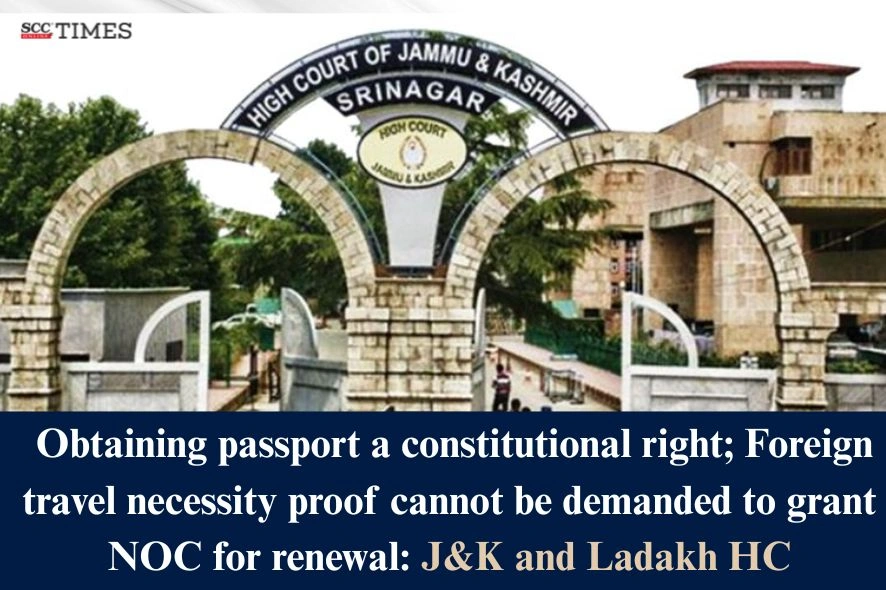
Jammu & Kashmir and Ladakh High Court: In a case revolving around the question whether an accused facing trial could be denied a No Objection Certificate (‘NOC’) for renewal of a passport on the grounds of prematurity or absence of documentary proof of foreign travel necessity, a Single Judge Bench of Sanjay Dhar, J., set aside the Trial Court’s order and remanded the matter for fresh consideration, holding that the right to hold a passport is a constitutional right and cannot be curtailed except in accordance with law.
The petitioner was facing trial for offences under Sections 409, 418, 465, 467, 468, 471 and 120-B of the Penal Code, 1860 (‘IPC’) and Sections 7-A, 8, 12 and 13(1) of the Prevention of Corruption Act, 1988 (‘PCA’). During the pendency of the challan, he sought an NOC before the Trial Court to obtain a passport for undertaking Hajj Pilgrimage. However, the Trial Court vide order dated 24-02-2025, issued an NOC valid for one year, pursuant to which the petitioner obtained a limited passport and undertook Hajj Pilgrimage.
The petitioner reapplied for the grant of NOC to obtain a passport for five years, but the Trial Court dismissed his request, citing two grounds: first, that the application was premature since the earlier NOC remained valid up to 23-02-2026; and second, that no documentary proof was produced to show that he was required to travel abroad for business purposes.
The Court observed that both the grounds adopted by the Trial Court were specious. It is a settled law that every citizen has a legal right to hold a passport and that the said right can be taken away only in accordance with the law. The Court relied on Maneka Gandhi v. Union of India, (1978) 1 SCC 248, where the Supreme Court held that no person can be deprived of the right to go abroad unless there exists a law enabling the State to do so. The right to personal liberty includes the right to travel abroad, and for that purpose, holding a passport is mandatory. Therefore, it is not necessary for a citizen to demonstrate the pressing need to travel abroad before the Court or the Passport Authority. Consequently, the Court observed that the Trial Court’s reasoning that absence of documentary proof of necessity could justify denial of NOC is contrary to the legal position.
The Court noted that while it was true that the existing NOC remained valid until February 2026, the approaching expiry of the passport entitled the petitioner to seek renewal. The Court clarified that issuance of the passport must be in accordance with the rules governing the field, and it can even be refused if the NOC is not issued by the Court before which the accused is facing trial. However, a criminal court, while considering an application for a grant of NOC, should only advert itself to the question as to whether the accused, if allowed to travel abroad, would be available to face the trial and no other factor should influence the decision while considering an application for grant of NOC in favour of an accused.
Accordingly, the Court, while allowing the petition, set aside the Trial Court’s order and remanded the matter for fresh consideration.
[Zahoor Ahmad Pahalwan v. State (UT of J&K), 2025 SCC OnLine J&K 1189, decided on 26-11-2025]
Advocates who appeared in this case:
For the Petitioner: Saqib Shabir, Advocate.
For the Respondent: Ilyas Laway, GA.
Buy Penal Code, 1860 HERE

Buy Prevention of Corruption Act, 1988 HERE










0 replies