








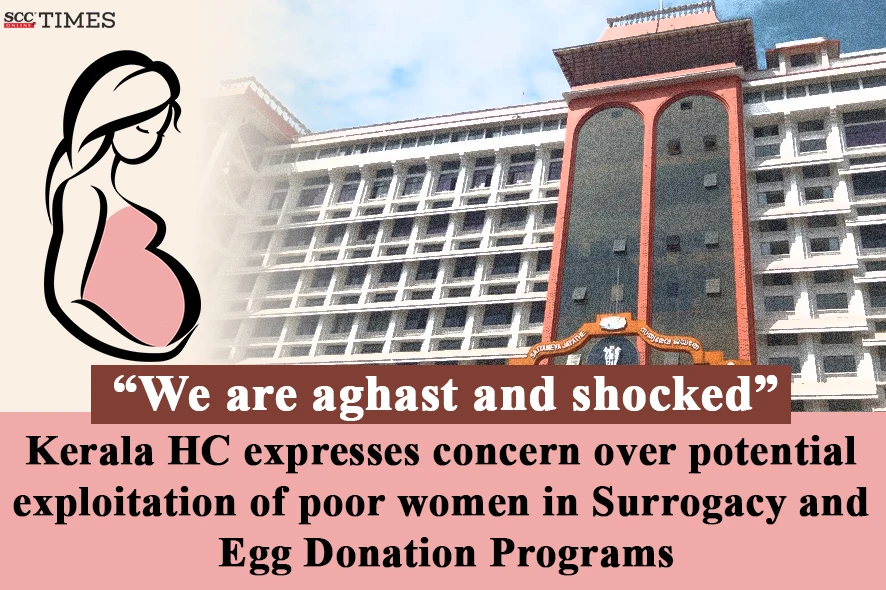
Kerala High Court: In a case concerning alleged illegal practices surrounding Assisted Reproductive Technology (‘ART’) and the exploitation of women under the guise of egg donation, the division bench of Devan Ramachandran* and M.B. Snehalatha, JJ. expressed concern and shock over the alleged exploitation of women who were reportedly brought into the State under the guise of ART programs, purportedly as egg donors or prospective surrogate mothers.
The Court observed:
“Innovation is always key in medicine; and Assisted Reproductive Technology (ART) has been a global game changer. Unfortunately, ART has brought into its fold, because of its huge demand, various deleterious tendencies, particularly in the growing markets in low and middle-income countries. We fear if this has percolated into our small State of Kerala also.”
The Court expressed serious concern over potential human rights violations, ethical breaches, and lack of transparency in the ART ecosystem within the State.
The petitioner claimed that the women taken into custody by the Police and Health Department were voluntary egg donors seeking medical assistance. However, the authorities suspected that the petitioner was operating in contravention of the law, with possible elements of human trafficking and financial exploitation involved.
The Bench stated:
“A prefatory word of agony needs to be placed, that if the ladies in question, and several others, are being subjected to exploitation or financial abuse…”
The Court emphasised that ART is a complex and emotionally driven procedure, often involving vulnerable individuals, both intending parents and egg donors who are drawn in by advertisements and social media promotions, especially in developing regions.
The Court noted with grave concern the power imbalance in such arrangements, where uneducated or financially insecure women from outside Kerala are allegedly being induced into such practices purely by promises of money, without adequate agency, awareness, or legal protection.
The Bench described the alleged practices as “a complex web of deceit”, facilitated by middlemen and aggravated by the emotional and physical toll such procedures extract from the women involved. The lack of ethical standards, the Court observed, was “shocking to any human mind guided by even the faintest of humanism.”
Taking note of the Government Pleader’s submission that investigations are ongoing and raids have taken place across the State, the Court adjourned the matter to 10-10-2025 and directed the respondents to submit:
-
A comprehensive report of all actions taken so far;
-
Proposed further actions; and
-
Concrete steps to prevent such exploitation in the future.
The Court concluded:
“We are aghast and shocked—assuming the facts stated before us to be true—that such tendencies are allowed in a State like ours, where literacy is highest… Exploitation cuts at the root of everything constitutionally guaranteed…”
The authorities under the Health Department and Police were reminded of their constitutional obligations and were tasked with ensuring such exploitative practices are eradicated, guided by the “acme constitutional imperatives and principles.”
[Art Bank v. State Police Chief of Kerala, 2025 SCC OnLine Ker 9786, decided on 29-09-2025]
*Order by: Justice Devan Ramachandran









0 replies