








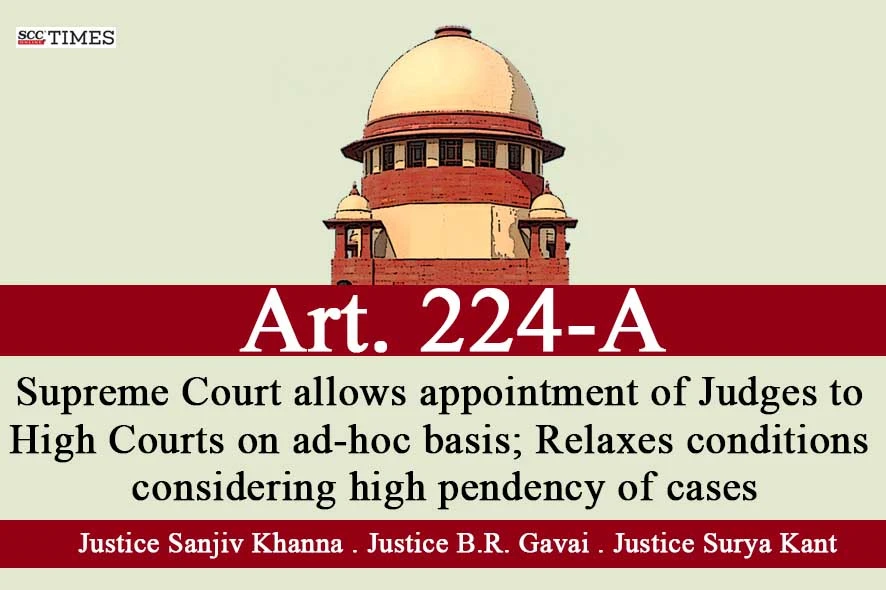
Supreme Court: The three-Judge Bench comprising Sanjiv Khanna, CJI and BR Gavai, and Surya Kant, JJ. relaxed the conditions for appointments of ad-hoc Judges in High Courts and directed that the High Courts can recommend the appointment of retired Judges on an ad-hoc basis to tackle pendency and clear the backlog of pending cases, which is mostly high in criminal matters.
Further, the Bench also laid down that each High Court can appoint two to five Judges and in any case, the number should not exceed 10 percent of the sanctioned strength.
Earlier in 2021, the Court in Lok Prahari v. Union of India, (2021) 15 SCC 80, activated the “dormant” Article 224-A of the Constitution of India and issued some general guidelines for the appointment of ad- hoc Judges to deal with the unprecedented situation arising from the backlog of cases pending in the High Courts. The Court stated that certain checks and balances must be provided so that Article 224-A of the Constitution of India can be resorted to only on the process having being initiated for filling up of the regular vacancies and awaiting their appointments.
The Court therein, held that though the discretion of the Chief Justice of the High Court under Article 224-A was not constrained, it can be exercised under following circumstances:
-
If the vacancies are more than 20% of the sanctioned strength.
-
The cases in a particular category are pending for over five years.
-
More than 10% of the backlog of pending cases are over five years old.
-
The percentage of the rate of disposal is lower than the institution of the cases either in a particular subject matter or generally in the Court.
[Lok Prahari v. Union of India, decided on: 30-01-2025]







0 replies