








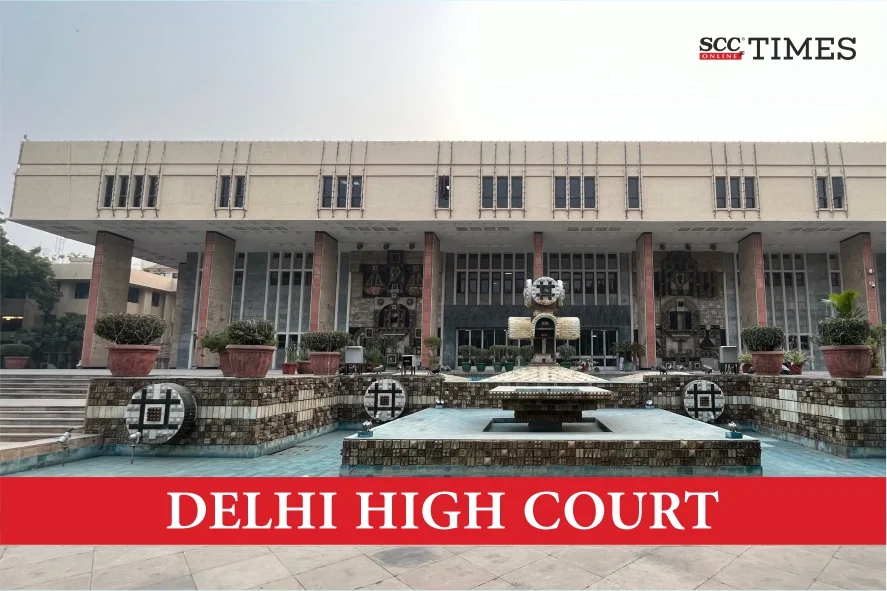
Delhi High Court: In a couple of suits filed by an Indian Foreign Service officer (plaintiff) seeking damages for a sum of Rs. 5 crores each for loss of his reputation due to alleged damaging conversations about him contained in tapes being published or disseminated by Hindustan Times (defendants) in its English and Hindi daily being in gross violation of the norms of journalistic conduct issued by Press Council of India, a Single Judge Bench of Neena Bansal Krishna, J. held that the articles which were the subject matter of the two suits were not per se defamatory and directed the plaintiff to make good the deficit Court fee within six weeks as the alleged articles and tapes in question did not meet the legal standard for defamation.
Background
The plaintiff was a well-known figure in Rajasthan in his student life, so, various newspapers continuously highlighted his scholastic achievements. The conduct and performance of the plaintiff was appreciated during his training period at Lal Bahadur Shastri National Academy of Administration and after he joined the Foreign Service Institute, New Delhi, his work was again appreciated.
The plaintiff claimed that Hindustan Times (Defendant) published an article under the heading “IFS Probationer Sacked After Tapes ‘Prove’ Misconduct” and similar news was published in the Hindi edition of the newspaper under the caption “shadi se inkar karne par adhkari ne yuvti ka jeena haram kiya”.
It was claimed that these articles were in gross violation of the norms of journalistic conduct issued by the Press Council of India and that there was no truth in the facts mentioned regarding the obnoxious conversation with a woman on tape and abusive and expletive language used by the plaintiff. It was also asserted that the article had definitive defamatory meaning.
Hindustan Times published another article on 30-08-2002 to cover up the wrong done by them with the heading “Foreign Office in a quandary over probationer’s sacking”. This article was contrary to the one published earlier which made it clear that the previous article was baseless and was published in bad faith.
The petitioner was aggrieved by the newspaper reports which resulted in immense damage to his reputation and severe adverse socio-economic consequences. He claimed that his mother could not bear the shock and passed away due to continuing mental trauma, defamation, and harassment caused by the defamatory article.
The plaintiff sought Rs. 2.5 crores for damages due to his mental health and lowering of his reputation respectively in both suits.
Analysis and Decision
Whether the news article dated 21-07-2002 published in “Hindustan” had defamed the plaintiff, if so, to what effect?
The Court referred to various definitions of defamation to state that the intrinsic facet of defamation is harm to reputation or lowering the estimation of a person in the public domain. The Court stated that to ascertain whether any statement has caused a loss of reputation, the existence of malice, an essential ingredient to establish defamation, must be considered.
Further, the Court stated that evidence of loss of reputation is necessary as without evidence, it would not be clear that the reputation had been injured. The Court also stated that no action lies for mere vulgar abuse or for words that had not inflicted any substantial injury.
Further, the Court stated that the public’s right to information and the duty of the Press to make the information available to the public is circumscribed by a limitation of not disseminating wrong information or presenting the news in a manner causing harm to the reputation of the individuals.
The Court further stated that the defences available to newspaper publications are — truthful statement, fair comment for public good, and privileged statements.
The Court referred to the article that was published and stated that it was quite evident that it was a neutral reporting of an incident and that it was merely a statement of facts that had been reported. The Court also stated that it was balanced reporting without imputing any misconduct on the part of the plaintiff.
The Court further stated that from the entire article, it could not be inferred that there were any malicious false allegations or conduct attributed to the plaintiff and that it was evident that the reporting was a fair comment and was not defamatory.
With regard to the second article dated 29-08-2002, the Court stated that the tone and tenure of the reporting reflected statements of facts and certain insertions based on the inside information obtained by the reporter and that none of the statements could be said to malign the image of the plaintiff.
The Court also referred to the article published in the Hindi edition of Hindustan Times and concluded that the articles had in a neutral/truthful manner simply reported the news based on the information collected from various sources, and that the reply that was subsequently filed by Union of India corroborated with the truthfulness of the reported news.
The Court, while balancing the public’s right to information with the duty of the Media to do truthful reporting and the individual protection of the plaintiff’s reputation, held that the articles that were the subject matter of the two suits were not per se defamatory.
On the aspect of entitlement of damages, the Court stated that based on the findings these issues were decided against the plaintiff.
Thus, the Court stated that even though the plaintiff was allowed to file the suit as an indigent person due to lack of sufficient means to pay the Court fee, no such situation continued to exist and directed the plaintiff to make good the deficit Court fee within six weeks.
[Mahaveer Singhvi v. Hindustan Times Ltd., 2024 SCC OnLine Del 4409, Decided on 31-05-2024]
Advocates who appeared in this case :
For Plaintiff — Advocate Aadil Singh Boparai, Advocate Sumer Singh Boparai, Advocate Sadiq Noor
For Defendants — Advocate M. Dutta, Advocate Aditya Guha






0 replies