









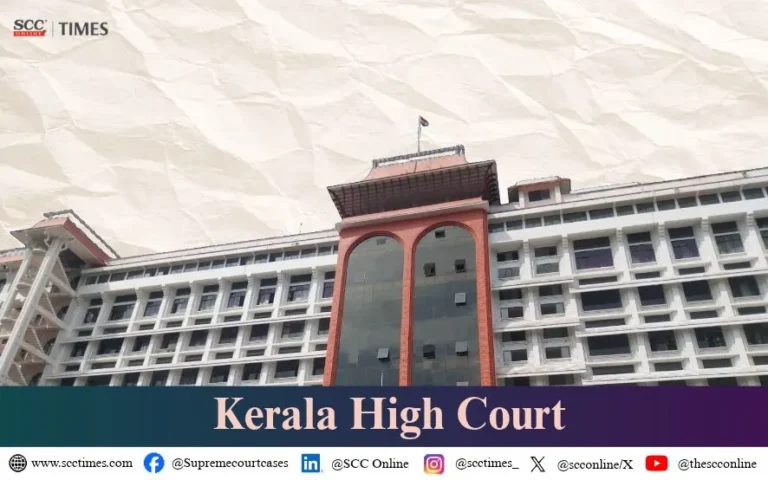
Kerala High Court: In a matter concerning the legal status and identity of an adopted child in official records, a Single Judge Bench of P.V. Kunhikrishnan, J. held that an adopted child must be recognised simply as the “son” or “daughter” of their adoptive parents, without the prefix “adopted”. The Court observed that Section 12, Hindu Adoptions and Maintenance Act, 1956, recognises an adopted child as the child of the adoptive parents for all purposes and directed the State Government to remove the option for separately identifying adopted children from the e-District portal and amend the relevant guidelines.
The Court directed the State Government to remove the corresponding option from the e-District portal and modify its guidelines to ensure that adopted children are not placed in a separate category while recording their relationship with their adoptive parents.
Background
The petitioner was adopted by her parents on 30 June 1990, when she was less than a month old. Her adoptive parents had been married since 29 June 1974 and had remained childless for more than 16 years.
Following her adoption, the petitioner was accepted and treated as the daughter of her adoptive parents in all respects. Her relationship with them was reflected in various official records, including her Aadhaar, passport, ration card, electoral identity card, driving licence, PAN card and Secondary School Leaving Certificate (SSLC) certificate.
After her adoptive mother passed away on 3 January 2023, the Tahsildar issued a legal heirship certificate dated 16 March 2023, recognising Anmol as her sole legal heir and describing her relationship as “daughter”. Similarly, the family membership certificate issued following her father’s death also described her as “daughter”.
However, when the petitioner subsequently applied for a legal heirship certificate concerning her deceased father, the Tahsildar issued a certificate describing her as “adopted daughter” instead of simply “daughter”.
Aggrieved by this distinction in the official record, the petitioner approached the High Court seeking to set aside the certificate to the extent that it described her as an “adopted daughter” and for a fresh certificate recognising her as the “daughter” of her deceased father.
Contentions of the parties
Petitioner’s contentions
The petitioner contended that describing her as an “adopted daughter” in the legal heirship certificate was unnecessary and adversely affected her legal status and dignity. She pointed out that the authorities had previously recognised her simply as “daughter” in the legal heirship certificate of her mother and the family membership certificate of her father.
State’s contentions
The Government Pleader submitted that an enquiry had established that the petitioner was an adopted child. The State further contended that the Government guidelines governing the issuance of legal heirship certificates provided a specific option in the e-District portal to record whether a legal heir was an adopted son or daughter.
According to the State, the Tahsildar had merely followed the prescribed guidelines and used the available option to ensure uniformity and accuracy in official records. Therefore, the issuance of the certificate was neither illegal nor arbitrary.
Analysis and Decision
The Court examined Section 12, Hindu Adoptions and Maintenance Act, which provides that an adopted child shall be deemed to be the child of the adoptive father or mother for all purposes from the date of adoption. The provision states:
“An adopted child shall be deemed to be the child of his or her adoptive father or mother for all purposes with effect from the date of the adoption.”
From that date, the child’s ties with the family of birth are deemed to be severed and replaced by those created in the adoptive family, subject to the statutory exceptions.
The Court also referred to its earlier decision in Vysakh K.G. v. Union of India, 2022 SCC OnLine Ker 7337 , wherein it had observed that, in matters relating to child custody and adoption, details identifying the parties should not be published. Applying this principle, the Court directed that the petitioner’s identity be masked in the judgment and that she be referred to as “Anmol” meaning “priceless” or “invaluable”, instead of using an alphabet.
The Court emphasised that the law recognises an adopted child as the child of the adoptive parents for all purposes and that society accepts such a child as their son or daughter. Consequently, there was no necessity to distinguish an adopted child through a separate description in official documents. Stating that some relationships begin at birth, and some others are formed through adoption and that the paths may differ, but the word “daughter” need not carry that difference wherever it appears, the Court observed:
“When society treats the child as the son or daughter of the adoptive parents, there is no need to describe the child as an ‘adopted girl’ or ‘adopted boy’ in official documents.” The Court further clarified that although describing a child as an adopted son or daughter is statutorily recognised and does not, by itself, amount to an insult, such a qualification should be avoided in official records.
Rejecting the State’s justification based on the e-District portal and existing guidelines, the Court held that the facility to separately identify an adopted son or daughter in official records should be removed.
It observed that adopted children should be described simply as “son” or “daughter”, without any prefix, and that the Government must modify its guidelines and make the necessary changes to the e-District portal.
Applying these principles to the case, the Court noted that the petitioner’s mother’s legal heirship certificate and her father’s family membership certificate had both described her as “daughter” without any qualification. Therefore, the description “adopted daughter” in the legal heirship certificate issued in respect of her father was required to be removed.
Allowing the writ petition, the Court issued the following directions:
1. Set aside the legal heirship certificate issued in respect of the petitioner’s deceased father.
2. The Tahsildar was directed to issue a fresh legal heirship certificate describing the petitioner’s relationship with her deceased father as “daughter” instead of “adopted daughter”, within 2 weeks from the date of receipt of a certified copy of the judgment.
3. The State Government was directed to modify the e-District portal and delete the option requiring an adopted child to be separately identified in a legal heirship certificate. The necessary changes were to be completed within 1 month from the receipt of a certified copy of the judgment.
4. The Registry was directed to mask the petitioner’s name in the cause title and use the name “Anmol” for the purposes of the judgment. It was also directed to provide certified copies containing her actual name and details in a separate sealed cover, if required by her.
The Court accordingly held that adopted children must be recognised simply as sons or daughters of their adoptive parents in official records, without a separate prefix identifying their adopted status.
[[Anmol v. State of Kerala, W.P.(C) No. 9697 of 2026, decided on 10-11-2026]
Advocates who appeared in this case :
For the Petitioner: Arun Ashok, Neena James, Celia Isaac, Antony M. George and Joel C. Jexon, Advocates.
For the Respondents: Smt. Rukhiyabi Mohammed Kunhi, Government Pleader.






0 replies