Question
An arbitrator is statutory prohibited from deciding cases on the basis of justice and equity. Yet, can an arbitrator decline to grant specific relief on the basis of established equitable defences such as “unclean hands” and “laches”? It is this problem to which we turn our attention in this article.
Preamble
The Specific Relief Act, 1963 had its first avatar in the Specific Relief Act, 1877. The Act was originally drafted upon the lines of the draft New York Civil Code, 18621, and its main provisions embody the doctrines evolved by the English Equity Courts, which had previous to the Act been applied in India as principles of equity, justice and good conscience.
Pollock and Mulla, in their seminal work on Specific Relief2 had opined that there was no need for a separate law for specific relief, since it was merely a branch of the law of procedure, which was rooted in equity. In other words, it was merely the codification of the principles evolved by the Chancery Courts in England, and was brought about as a separate law, albeit to be applied by the common law courts.
The fact that the Specific Relief Act was a codification of the principles of equity remained unchanged even when the 1963 Act was promulgated. The Law Commission expressly admits this:
“The Act, as revised by us, deals only with certain kinds of equitable remedies. These are (1) Recovery of possession of property, (2) Specific performance of contracts. (3) Rectification of instruments, (4) Rescission of contracts. (5) Cancellation of instruments, (6) Declaratory decrees and (7) Injunctions.”3
But this is not all. The Law Commission also recognises that there are very many equitable principles that are not codified in the Act, but are still very much in existence. The Report specifically quotes Lord Evershed MR, as saying the following:
“As an equity lawyer, let me acknowledge that I have a natural inclination to favour the undefined and undefinable in the form of principles which have never lost, by unnecessary and constricting definition, their capacity for useful growth. And I would like, here, to make the important point that these undefined principles of equity could never, as far as I can see (save to a very limited extent) be effectively or usefully comprehended, by codification, in the enacted law.”
For many years thereafter, the courts of India were applying this brilliant fusion of equity and common law, and our entire jurisprudence of specific relief evolved.
Then came the Arbitration Act. The problem arose when the courts held that arbitrators were fully empowered to grant specific performance4, and other reliefs under the Specific Relief Act5.
The Eclipse of Equity in Arbitration
Section 28(2), Arbitration and Conciliation Act, 1996 (hereinafter, “Arbitration Act”) provides for the Arbitral Tribunal to decide ex aequo et bono but only if the parties have expressly authorised it to do so.
Ex aequo et bono means “according to what is equitable (just) and good”6. The Arbitration Act leaves room for equitable decision making. This of course, is subject to specific authorisation by the parties. The power given to the Arbitral Tribunal to act as an amicable compositeur again springs from the ultimate base of arbitration which is party autonomy.
Therefore, Section 28, Arbitration Act expressly prohibits the application of equitable principles in deciding arbitrations (unless parties agree otherwise).
For so long as an arbitrator has the provisions of the Specific Relief Act to look into, all is well. The problem arises when they seek to apply principles of equity which are as yet, uncodified, such as, “unclean hands” or “laches”. This is the problem created by Section 28 which eclipses the bright sunlight of equity and leaves us in the dark.
There are three well-established defences in actions for specific performance which are now left in the dark. The first is that a party who comes to court with unclean hands will not receive equitable relief. The second is that a person who approaches court belatedly or lackadaisically (though within the law of limitation) will not get specific relief. The third is where the grant of specific relief is inequitable for reasons such as lack of mutuality.
Will an arbitrator be justified in dismissing a claim for specific performance on any of these grounds? In the light of Section 28, it is likely that such an award will be swiftly set aside.
The rationale behind the equitable defences
Equity tempers the rigidity of the letter of the law. Equity is said to spring from the conscience of the court, and hence the criticism that it varies with the length of the Chancellors Foot7! However, such criticisms apart, it must be noted that equity is discretionary, and hence, the courts will not apply equitable principles unless a rightful cause comes before them, in a rightful manner.
This is why it is said that the refusal of the court to extend equity to someone who approaches it with unclean hands, is not a principle of action, but a principle of inaction. Nothing will rouse the court into action, but good conduct and prompt action8.
Thus, even if both parties consent to it, a court will not grant specific relief where the parties’ hands are tainted.
This is the heart of the problem. If the parties to an arbitration consent to a course of action, there is very little room for the arbitrator to differ, but the exact opposite is the case with equity.
Do the equitable principles survive in the darkness of the eclipse?
In 1963, the Specific Relief Act, 1963, replaced the Specific Relief Act, 1877. As seen above, the draftsmen did not codify all of the equitable principles engrafted by the courts into the Act. They were content to leave the Act as it was, with the mechanics of specific relief contained in the Act, and the uncodified equitable principles being supplied by the courts.
The equitable defences of “unclean hands”9, “laches”10 and “mutuality”11 were all well known when the Specific Relief Act, 1963 was drafted.
Yet, the legislature left those principles uncodified. It left the law untouched. This is significant. The effect of such legislative passivity has been explained by James LJ in Ex Parte Cambell12:
“Where once certain words in an Act of Parliament have received a judicial construction in one of the superior courts, and the legislature has repeated them without alteration in a subsequent Statute, I conceive that the legislature must have been taken to have used them according to the meaning which a court of competent jurisdiction has given to them.”
Hence, we may take it that the legislature intended that these equitable defences continue to remain in play post the promulgation of the Specific Relief Act, 1963. In fact, one learned author has opined that the principles of equity are to be taken as “embedded” in the statute law of our country13.
The conundrum
We, therefore, reach the conundrum that actions for specific relief may be laid before arbitrators, but the defences available to ordinary suitors at the common law, may not be available before the arbitrator.
The answer to this question may be found in another provision of the Arbitration Act.
The grounds for challenge of an award are contained under Section 34, Arbitration Act. An award can be set aside if it is against the public policy of India. What is this public policy? The explanation brought about to Section 34 offers some solutions such as when an award which violates the fundamental policy of Indian law, or if it is in conflict with the most basic notions of morality and justice.
What are these basic notions of “morality” and “justice”? Does it include equity? Is an award passed in favour of a person who comes with unclean hands, contrary to “basic notions of morality”?
The provision of the Explanation to Section 34, without touching Section 28 deepens the conundrum.
In a Section 34 petition challenging an award, the Delhi High Court set aside an award that granted Rs 60 crores on reasonable and conscience-based estimation rather than evidence/contract based. The High Court in Jaiprakash Associates Ltd. v. NHPC Ltd.14, held that without express authorisation under Section 28(2), a tribunal cannot make an award on principles of equity. Similarly, in Board of Control for Cricket in India v. Deccan Chronicle Holdings Ltd.15, while relying on Associate Builders v. DDA16, the Bombay High Court held that a contravention of Section 28 would be a ground to set aside an award as it would be considered patently illegal. Hence, any exercise of equitable principles by an arbitrator in contravention with what has been agreed by the parties would amount to patent illegality and liable to be set aside.
And yet, there is hope. The Supreme Court17 has, in interpreting this term of “basic notions of morality” held as under:
64. The other ground is of morality. On the question of morality, in Associate Builders18, this court, after referring to the provisions of Section 23, Contract Act, 1872; earlier decision of this court in Gherulal19; and Indian Contract Act by Pollock and Mulla, held that judicial precedents have confined morality to sexual morality. And if ‘morality’ were to go beyond sexual morality, it would cover such agreements as are not illegal but would not be enforced given the prevailing mores of the day. The Court also clarified that interference on this ground would be only if something shocks the Court’s conscience [See, Associate Builders case20].
63. As we have already noticed, the object of inserting Explanations 1 and 2 in place of earlier Explanation to Section 34(2)(b)(ii) was to limit the scope of interference with an arbitral award, therefore the amendment consciously qualified the term “justice” with “most basic notions” of it. In such circumstances, giving a broad dimension to this category [In conflict with most basic notions of morality or justice.] would be deviating from the legislative intent. In our view, therefore, considering that the concept of justice is open-textured, and notions of justice could evolve with changing needs of the society, it would not be prudent to cull out “the most basic notions of justice”. Suffice it to observe, they [Most basic notions of justice.] ought to be such elementary principles of justice that their violation could be figured out by a prudent member of the public who may, or may not, be judicially trained, which means, that their violation would shock the conscience of a legally trained mind. In other words, this ground would be available to set aside an arbitral award, if the award conflicts with such elementary/fundamental principles of justice that it shocks the conscience of the court.
And there we have it, the re-entry of “conscience”; and what else is equity, if not conscience? It is in these subtle ways that the courts are forced to apply equitable principles.
The Supreme Court in Olympus Superstructures (P) Ltd. v. Meena Vijay Khetan21, held that merely because the provisions of the Specific Relief Act confer discretion on the courts to grant specific performance or damages in lieu of performance, that discretion in itself does not preclude the Arbitral Tribunal’s jurisdiction. Has the Supreme Court impliedly approved the application of equitable principles? It is difficult to say so. The legislature has amended the Arbitration Act many times after Olympus22, and yet Section 28 remains untouched, in its solitary glory.
For now, the courts are forced to work around Section 28. The time has come to deal with the problem directly.
Conclusion
Section 28, Arbitration Act expressly prevents the arbitrator from using the “golden met-wand” of equity, and to act contrary to the express wishes of the parties. However, the employment of equitable principles in adjudication of disputes wherein remedies under the Specific Relief Act, 1963 are sought appears to be inevitable. We have seen a shadow of this in Section 34, where, as we have noted above, the courts apply veiled equitable principles, hiding under the mask of “public policy”. Perhaps the legislature must consider amending Section 28.
Until such time, the position appears to be that Section 28 may have buried the equitable principles through Section 28, but the courts will continue to invoke their ghosts, when we seek arbitration of specific reliefs.
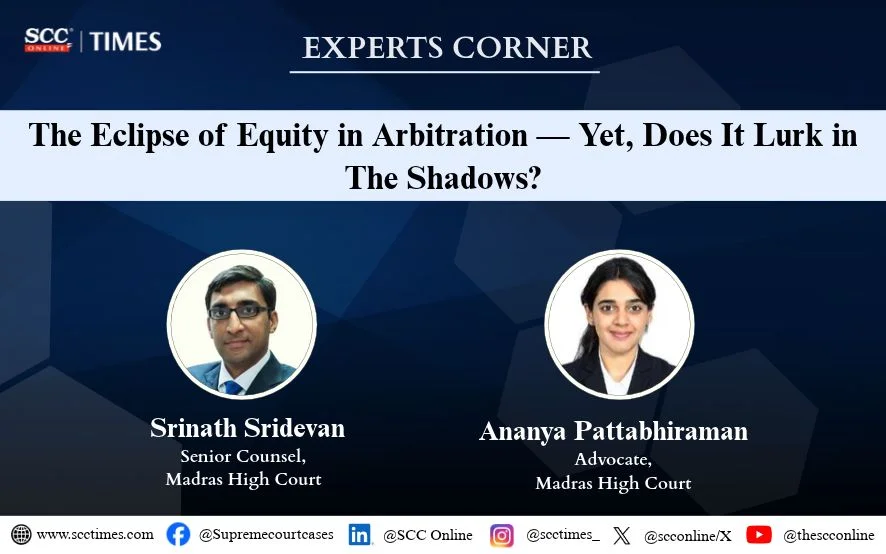
*Senior Counsel, Madras High Court
**Advocate, Madras High Court
1. The Commissioners of the Code, Draft of a Civil Code for the State of New York (1862)
2. Sir Frederick Pollock and Dinshah Fardunji Mulla, The Specific Relief Act, 1963 (8th Ed.) p. 735.
3. Law Commission of India, Specific Relief Act, 1877, Report No. 9 (1958) p. 3.
4. Olympus Superstructures v. Meena Vijay Khetan, (1999) 5 SCC 651.
5. Vidya Drolia v. Durga Trading Corpn., (2021) 2 SCC 1.
6. See, BCCI v. Deccan Chronicle Holdings Ltd., 2021 SCC OnLine Bom 834 para 232. See also, Article 28 of the UNCITRAL Model Law and the UNCITRAL 2010 Rules which remains the basis for Section 28 of Arbitration Act.
7. John Selden, Lectures, 1654.
8. Ex Parte Cooke, (1876) 4 Ch.D. 123
9. A.C. Arulappan v. Ahalya Naik, (2001) 6 SCC 600
10. P. Daivasigamani v. S. Sambandan, (2022) 14 SCC 793
11. Sahadeva Gramani v. Perumal Gramani, (2005) 11 SCC 454
12. L.R. Vol. 5 Chancery Appeals p. 703, and approved by the House of Lords in Barras v. Aberdeen Trawling, 1933 A.C. 402 (HL), and applied in India in numerous cases such as Banarsi Debi v. ITO, (1964) 53 ITR 100 : 1964 SCC OnLine SC 48 and Kaliannan v. Sangeetha, 2020 SCC OnLine Mad 28522.
13. Sricharan Rangarajan, Treatise on Arbitration Law, p. 28.32.
17. OPG Power Generation (P) Ltd. v. Enexio Power Cooling Solutions (India) (P) Ltd., (2025) 2 SCC 417
18. Associate Builders v. DDA, (2015) 3 SCC 49 : (2015) 2 SCC (Civ) 204.
19. Gherulal Parakh v. Mahadeodas Maiya, 1959 SCC OnLine SC 4.
20. (2015) 3 SCC 49, para 39 : (2015) 2 SCC (Civ) 204.