As part of Dubai Arbitration Week 2026, the Dubai International Arbitration Centre (DIAC) hosted its Annual Conference on 10 November 2026 at the Waldorf Astoria DIFC, Dubai. The conference brought together members of the judiciary, arbitrators, in-house counsel and practitioners from the international arbitration community to discuss contemporary developments and challenges in international dispute resolution.
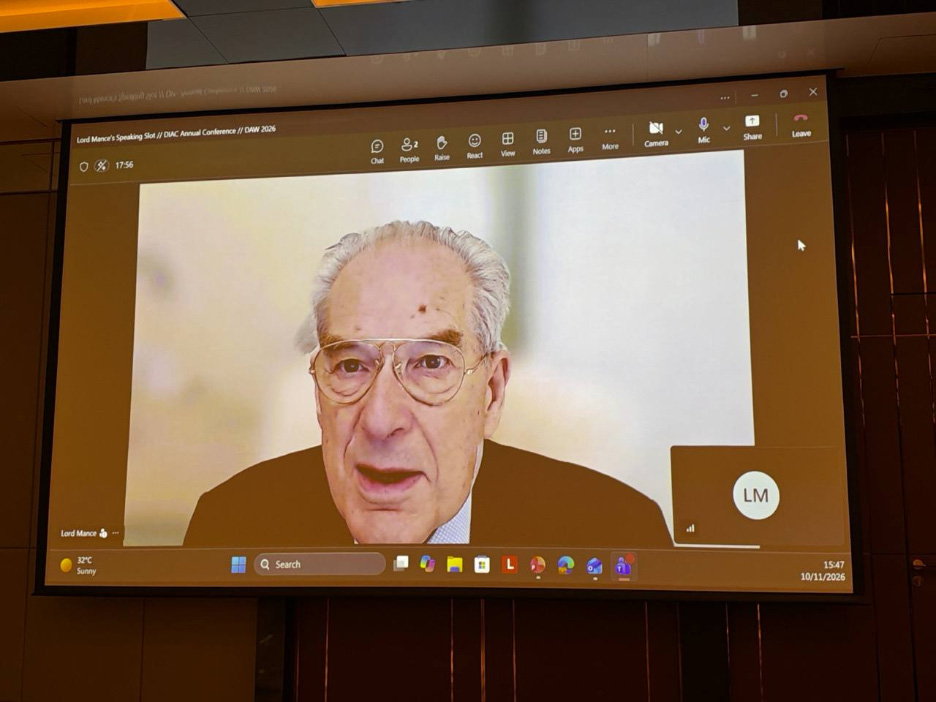
At the conference, Lord Mance, Independent Arbitrator and Mediator, former Deputy President of the UK Supreme Court and member of 7 King’s Bench Walk, delivered a keynote address examining concerns surrounding ‘due process paranoia’ and its implications for the effective case management of arbitral proceedings.
Drawing on his experience as a former judge and an arbitrator, Lord Mance considered whether concerns over procedural fairness were affecting the confidence with which tribunals conduct proceedings, the factors contributing to this development, and the role of legislative reforms in promoting efficient arbitration while safeguarding parties’ rights.
Due process objections and the changing culture of arbitration
Opening his address, Lord Mance cautioned against drawing broad conclusions merely from personal experience, particularly where recollections of past practices may be coloured by nostalgia. Recalling his experience of domestic arbitrations before joining the judiciary, he described proceedings that were often conducted in a spirit of cooperation and courtesy, without frequent threats of due process objections.
He observed that the contemporary arbitration landscape was markedly different. While acknowledging that genuine instances of denial of due process and bias do occur and must be addressed, he expressed the view that such instances were not as frequent as advocates sometimes alleged.
In this regard, Lord Mance observed:
“No doubt of course there are cases where there is actually want of due process or worse still bias and they should certainly be called out. But such cases are not occurring I think actually as often as advocates allege and human nature being what it is, allegations of that sort may have an effect even if only subconscious on a tribunal’s conduct.”
He explained that allegations of procedural unfairness may influence a tribunal’s conduct, even at a subconscious level, irrespective of whether such concerns are ultimately justified. He also observed that modern arbitration advocacy had become more aggressive, often appearing to be directed at impressing clients or the opposing party rather than necessarily influencing the tribunal.
“I think dispute resolution today is of a very different nature. It’s a major fear for those involved and this has I think contributed to make advocacy more aggressive, often more apparently aimed at impressing the client or aimed at the opposition rather than necessarily influencing the tribunal.”
Against this backdrop, he identified the increasing tendency to invoke due process in relation to ordinary procedural decisions as a particular concern. Questions concerning amendments to pleadings, the manner in which cases should be presented, or the allocation of hearing time, he suggested, were often practical case-management issues rather than matters that necessarily warranted allegations of procedural unfairness.
Emphasising the extent to which the terminology itself had become overused, he remarked:
“The words due process have in short become degraded and tarnished.”
He added that procedural questions should be approached on the basis that the tribunal was capable of behaving fairly and identifying the material considerations. As he stated:
“Issues should be argued on the basis that the tribunal is capable of behaving fairly and it will identify the material considerations.”
He cautioned that indiscriminate references to due process should not carry unjustified weight in a tribunal’s thinking or behaviour.
Why arbitration is structurally different from court proceedings
Lord Mance then examined the structural differences between courts and arbitral tribunals, explaining why the latter may be more susceptible to pressure arising from procedural objections.
Courts operate within an established judicial system, exercise jurisdiction conferred by law, and have judges appointed independently of the parties. They also possess coercive powers and mechanisms to regulate advocates’ conduct. Arbitration, by contrast, derives significant advantages from party autonomy and the consensual nature of the process.
However, he cautioned that party autonomy also has a corresponding downside. Parties retain considerable influence over how proceedings are conducted, while tribunals may have limited ability to impose a different procedural approach where both parties insist on a particular course.
Explaining this distinction, Lord Mance observed:
“Arbitration has huge advantages of party autonomy but the flip side of party autonomy can involve some disadvantages.”
According to Lord Mance, this structural distinction could subtly affect the way tribunals conduct proceedings. Although party autonomy remains one of arbitration’s principal strengths, it could also create circumstances in which tribunals become more cautious in responding to procedural disputes.
Reflecting on the effect of this dynamic, he stated:
“The underlying principle of party autonomy can have a subtle continuing impact.”
Legislative reforms to strengthen arbitral case management
Turning to legislative developments, Lord Mance discussed the changes introduced by the Arbitration Act 2025 in the United Kingdom, which amended the Arbitration Act 1996. He observed that the amendments had removed several limitations on the formal powers of arbitral tribunals, bringing their powers closer, in many respects, to those exercised by courts when resolving disputes.
He also discussed the proposed amendments to the DIFC Arbitration Law1, noting that they would take on board certain changes introduced under English law and further strengthen the powers available to arbitral tribunals.
Among the measures he highlighted were the replacement of the requirement to provide parties with a “full opportunity” to present their cases with a “reasonable opportunity”, provisions concerning summary proceedings, peremptory orders, binding emergency awards and provisional awards, as well as stronger cost sanctions for poor procedural conduct and the pursuit of irrelevant or hopeless points.
He also welcomed the proposed reaffirmation of the parties’ duty to cooperate in and promote the efficient conduct of arbitration proceedings.
Assessing these proposed changes, Lord Mance observed:
“All that seems to me admirable and very appropriate and I wish the Act every success in ensuring parties that their disputes will be heard sensibly.”
He considered these measures appropriate for strengthening the ability of tribunals to ensure the speedy and sensible resolution of disputes.
Legislative reform must be accompanied by cultural change
However, Lord Mance cautioned that expanding the formal powers of tribunals would not, by itself, resolve the problem of due process paranoia. While legislative reform could provide tribunals with the necessary tools, it could not automatically change the culture surrounding arbitral proceedings or eliminate the possibility that repeated procedural objections might inhibit confident decision-making.
He emphasised that a broader cultural shift was necessary, explaining:
“The most complete powers will not by themselves alter either a culture of proliferation of due process complaints or remove the risk that such complaints may inhibit the robust and confident conduct of cases by tribunals.”
He then underlined the importance of changing the prevailing approach to procedural objections, stating:
“There has to be a degree of cultural change.”
In this regard, Lord Mance suggested that a better understanding of the actual success rates of due process challenges would be valuable. He proposed that statistics demonstrating how rarely such challenges succeed in responsible jurisdictions should be disseminated more widely.
Such information, he explained, could help reassure arbitrators that successful challenges on grounds of procedural unfairness were limited in number, while reinforcing the importance of addressing genuine instances of injustice.
Concluding his address, Lord Mance emphasised that arbitrators should remain attentive to genuine procedural injustice but should not be unduly influenced by allegations of due process violations where such concerns were not justified.
SCC Times is the Official Information & Documentation Partner for Dubai Arbitration Week 2026. Stay tuned for comprehensive coverage, key insights and highlights from the event!
1. Consultation Paper No. 2 of 2026, published on 11 June 2026