Calcutta High Court: In an application filed under Section 482, Criminal Procedure Code, 1973 (CrPC) seeking to quash the proceedings under Sections 419, 420, 498-A, 323, 313, 416, 120-B, 506 and 34, Penal Code, 1860 (IPC) pending before Additional Chief Judicial Magistrate, Barrackpore, against a police constable accused of posing as an unmarried Hindu man named “Rajib Sarkar” to enter into a relationship and a marriage ceremony with the complainant, and then subjecting her to assault, the single judge bench of Ajay Kumar Gupta, J., dismissed the application being devoid of merits and holding that the allegations, prima facie, disclosed cognizable offences warranting a trial. The Court also observed that the characterisation of the case as ‘love jihad’ was unsupported by the materials on record at this stage, as the case was confined to the alleged suppression of the petitioner’s name, religion and marital status.
Background
The complainant alleged that Petitioner 1, a police constable posted at Labpur Police Station, fraudulently concealed his identity, religion and existing marriage, introducing himself as a Hindu bachelor named “Rajib Sarkar” and inducing her into a relationship and physical intimacy on the promise of marriage. She further alleged that he married her in May 2021 at a temple in Digha according to Hindu rites, continued to cohabit with her at a rented accommodation in Bardhaman, and subsequently subjected her to physical and sexual abuse after she discovered that his real name was “Rafikul Islam”, that he was Muslim and that he was already married with 2 daughters.
The complainant further alleged that on 9 July 2021, when Petitioner 1 took her to his residence in Murshidabad, his family members (Accused 2—11), along with him, assaulted her, attempted to strangulate her with a saree and caused injuries resulting in her alleged miscarriage. Upon her recovery, she alleged that Labpur Police Station refused to register her complaint owing to Petitioner 1’s association with the police station and that she subsequently received threats from him. Thereafter, pursuant to her application under Section 156(3) CrPC, the Additional Chief Judicial Magistrate, Barrackpore, directed investigation, resulting in registration of a case dated 27 November 2021 under Sections 419, 420, 498-A, 323, 313, 416, 120-B, 506 and 34 IPC, which the petitioners challenged through the present revisional application
Issue
The issue under consideration was whether Petitioner 1 induced the relationship and her consent by deliberately misrepresenting his name, religion and marital status, and whether the alleged acts of assault, forcible intercourse and intimidation were committed.
Analysis
The Court noted, prima facie, that Petitioner 1 and the complainant shared a romantic relationship, married at a temple in Digha in or about May 2021 and lived together at Bardhaman. It further noted that the petitioners had raised several defences, including that the relationship was consensual, that the complainant had herself suppressed her marital status, that she had falsely implicated the petitioners to extort money and that the medical evidence did not substantiate her allegations. However, the Court held that these contentions raised questions of fact requiring appreciation of evidence and could not be adjudicated in proceedings under Section 482 CrPC.
With respect to Sections 416, 419 and 420 IPC, the Court observed that the allegation was that Petitioner 1 had assumed a false identity and represented himself as an unmarried Hindu named “Rajib Sarkar”, thereby obtaining the complainant’s consent to the relationship and marriage ceremony on that footing. Whether her consent was vitiated by a misconception of fact under Section 90 IPC, and whether she knew his true identity and marital status, could not be determined without evidence. Distinguishing Rajnish Singh v. State of U.P., (2025) 4 SCC 197, that the petitioner had relied on for the view that consensual intercourse between adults is not an offence, the Court held that the said case concerns the distinction between a consensual relationship and one induced by a false promise, whereas in the case at hand the allegation extended to identity and status and it could not be applied to quash the proceedings without a finding that consent was free and informed.
On the applicability of Section 498-A IPC, the Court noted the petitioners’ contention that the provision would not apply where the marriage itself was void. However, it observed that the allegations of assault, wrongful confinement, sexual intercourse without consent, intimidation and deception were distinct and independently disclosed cognizable offences. Whether Section 498-A was attracted on the facts was left for determination by the trial court.
The Court also considered the allegations against Petitioners 2—11, who were accused of assaulting the complainant. Referring to the injury report dated 10 July 2021 issued by Khargram Rural Hospital, Murshidabad, which suggested injuries on the complainant’s body, the Court held that the allegations could not be dismissed as omnibus or inherently improbable at this stage.
On the petitioners’ contention that the allegations of impersonation and assault had not been proved in the departmental proceedings initiated against Petitioner 1, the Court rejected the argument, observing that departmental enquiries and criminal prosecutions differ in their object, standard of proof and forum. A finding in the former does not bind the criminal court. It further noted that the departmental enquiry was directed against Petitioner 1 alone and did not adjudicate the allegations dated 9 July 2021 against Petitioners 2—11. The outcome of the disciplinary proceedings was a matter for consideration by the trial court and did not, by itself, establish that the criminal proceedings amounted to an abuse of the process of law.
Placing reliance on the principles laid down by the Supreme Court in Neeharika Infrastructure (P) Ltd. v. State of Maharashtra, 2021 SCC OnLine SC 315, concerning the exercise of inherent powers under Section 482 CrPC and Article 226 of the Constitution, the Court reiterated that quashing powers must be exercised sparingly and that courts should not undertake an enquiry into the reliability or genuineness of allegations at the initial stage.
On the characterisation of the case as “love jihad”, the Court observed that the counsel appearing for the complainant and the State had described the case as such. However, upon considering the statements recorded under Sections 161 and 164 CrPC and the allegations made by the complainant, the Court found that there was no material disclosing any attempt by Petitioner 1 or the other petitioners to convert her to Islam, or any inducement, coercion or pressure towards that end. The case, as presented, was confined to the alleged suppression of Petitioner 1’s name, religion and marital status.
The Court categorically observed:
“The characterisation of the case as ‘love jihad’ is therefore unsupported by the materials on record at this stage and has no bearing on this Court’s assessment.”
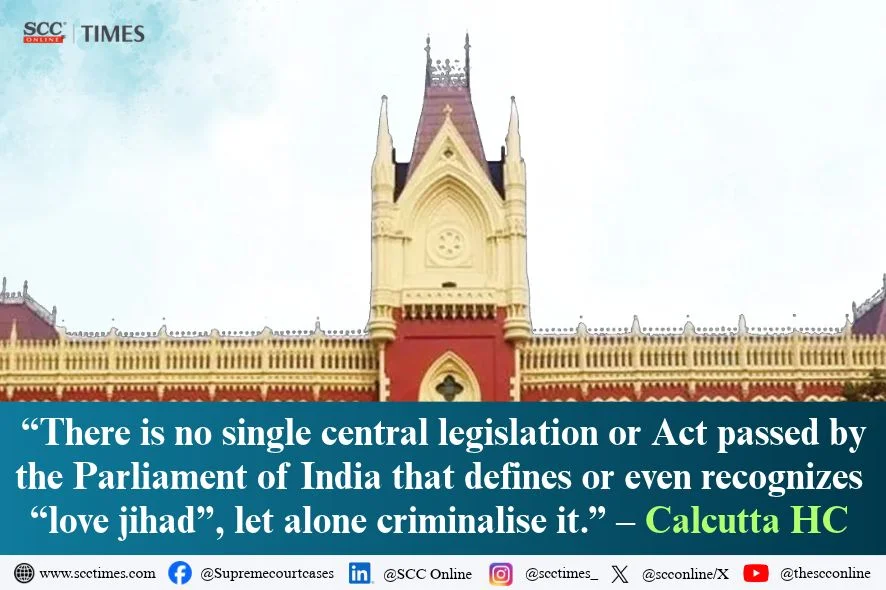
It further observed that there was no single central legislation or Act passed by the Parliament of India that defined or even recognised “love jihad”, let alone criminalised it. The Court also noted that West Bengal did not have an active law specifically against the same or anti-conversion legislation in effect.
The Court clarified that the alleged suppression of identity and marital status nevertheless remained relevant to the offences under Sections 416, 419 and 420 IPC, particularly whether Petitioner 1 had represented himself as an unmarried Hindu named “Rajib Sarkar” and whether the complainant’s consent had been obtained on that basis. These were questions of fact to be determined by the trial court on the basis of evidence.
Decision
Accordingly, holding that the allegations, read with the case diary and charge-sheet, prima facie disclosed the commission of cognizable offences, the Court concluded that the petitioners’ defences required appreciation of evidence at trial, and thus, interference at this stage would amount to conducting a mini-trial.
[Mohd. Rafikul Islam v. State of W.B., 2026 SCC OnLine Cal 16795, decided on 15-10-2026]
Advocates who appeared in this case:
For the Petitioners: Mr. Ayan Bhattacharya, Ld. Sr. Adv. Mr. Pratip Mukherjee, Adv. Mr. Sk. Md. Ismail, Adv. Mr. Sk. Md. Jayed, Adv.
For the Opposite Party No. 2: Mr. Moyukh Mukherjee, Adv. Mr. Abhijit Singh, Adv. Ms. Sagnika Banerjee, Adv. Ms. Sarmistha Basak, Adv.
For the State: Mr. Kallol Mondal, Ld. P.P. Mr. Anamitra Banerjee, Adv.