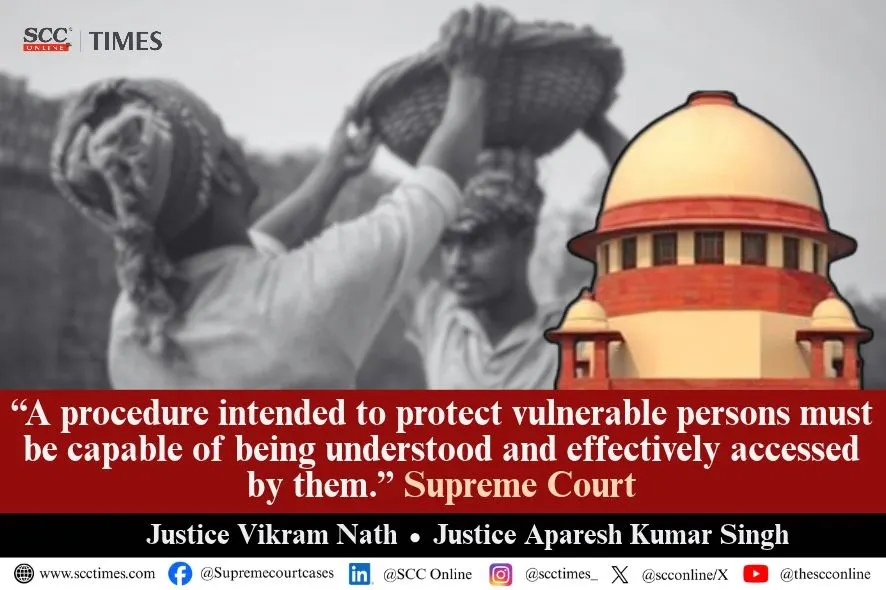
Supreme Court: In a case concerning the identification, rescue, release and rehabilitation of bonded labourers across the country, a Division Bench of Vikram Nath* and Aparesh Kumar Singh, JJ., emphasised that the State’s constitutional obligation does not conclude with the physical release of bonded labourers but extends to ensuring timely financial assistance, meaningful rehabilitation and protection against re-exploitation. Observing that identification, release and rehabilitation are interconnected stages of a continuing constitutional responsibility under Articles 21 and 23 of the Constitution, the Court held that rehabilitation delayed may, in substance, amount to rehabilitation denied.
The Court further observed that the principal concern was not the absence of a statutory framework under the Bonded Labour System (Abolition) Act, 1976, but the difficulties encountered in its effective implementation, particularly in cases involving inter-State rescue and repatriation. Emphasising the need for uniformity, accountability and timely disbursement of rehabilitation assistance, the Court directed the Union of India and all States and Union Territories to implement a uniform Standard Operating Procedure (SOP), ensure disbursement of immediate financial assistance ordinarily within 7 days of issuance of release certificates, and initiate individual rehabilitation measures within 90 days of rescue. The Court also directed the States of Uttar Pradesh and Bihar to verify and disburse outstanding assistance to 17 rescued bonded labourers, besides establishing effective monitoring and grievance redressal mechanisms. The Court further directed the filing of compliance affidavits and retained the writ petitions for continued monitoring of implementation.
Background
The present proceedings arose out of 2 writ petitions instituted under Article 32 of the Constitution, raising concerns regarding the identification, rescue, release and rehabilitation of bonded labourers across the country. The first petition, filed by SM, a survivor of bonded labour, arose from his rescue along with several other labourers from a brick kiln in District Shahjahanpur, Uttar Pradesh, on 28 February 2019, where they were allegedly subjected to exploitative working conditions on the pretext of repayment of bonded debt.
Although the rescued labourers were repatriated to Bihar and issued release certificates, several of them were not provided immediate financial assistance under the Central Sector Scheme for Rehabilitation of Bonded Labourers. Out of 42 labourers issued release certificates, only 25 received immediate financial assistance of ₹20,000 each, while the remaining 17 continued to await payment. The proceedings also highlighted difficulties arising from inter-State coordination and non-compliance with the prescribed format for release certificates, resulting in delays in disbursement of rehabilitation assistance. The second connected petition, instituted by the National Campaign Committee for the Eradication of Bonded Labour and others, raised broader concerns regarding the continued prevalence of bonded labour and ineffective implementation of the statutory framework under the Bonded Labour System (Abolition) Act, 1976.
“The prohibition of bonded labour is among the most fundamental assurances of human dignity embodied in our Constitution. Freedom from bondage, however, cannot be secured by the act of rescue alone. Unless such freedom is accompanied by timely financial assistance and meaningful rehabilitation, those released from exploitation may find themselves compelled by economic necessity to return to the very conditions from which the law sought to protect them. The obligation of the State, therefore, extends beyond securing their physical liberty to ensuring that such liberty is meaningful, enduring and accompanied by the means to lead a life of dignity.”
The Court, from time to time, issued directions to the Ministry of Labour and Employment, Government of India, and other authorities concerned to formulate a simplified and uniform procedure for identification, rescue, issuance of release certificates and timely disbursement of immediate financial assistance to rescued bonded labourers. The connected petition was subsequently tagged with the first petition on 18 August 2026.
Analysis
The Court observed that the principal concern arising in the present proceedings was not the absence of a statutory framework for the eradication of bonded labour, but the difficulties encountered in its effective implementation. Referring to Articles 21 and 23 of the Constitution and the Bonded Labour System (Abolition) Act, 1976, the Court emphasised that identification, release and rehabilitation of bonded labourers must be understood as interconnected stages of a continuing constitutional responsibility. It reiterated that the State’s obligation does not conclude with the physical release of bonded labourers, but extends to ensuring timely financial assistance, meaningful rehabilitation and protection against re-exploitation.
The Court observed that delayed disbursement of financial assistance substantially defeats the purpose of rehabilitation, particularly when rescued labourers are left without an independent source of livelihood and remain vulnerable to further exploitation. Referring to the circumstances of the first petitioner, who received financial assistance nearly three years after his rescue, and the 17 other labourers who were still awaiting assistance, the Court observed that rehabilitation delayed may, in substance, amount to rehabilitation denied.
The Court further observed that difficulties become more pronounced in cases involving inter-State rescue and repatriation, owing to delays in issuing release certificates, transmitting records and processing rehabilitation benefits. It held that the entitlement of a rescued labourer cannot be made dependent upon differences in administrative practices or jurisdictional arrangements between States. Accordingly, a uniform procedural framework prescribing definite timelines and clearly identifying the responsibilities of the authorities concerned was considered necessary.
The Court emphasised that uniformity must extend beyond prescribed forms and administrative procedures. The process must be accessible to rescued labourers, who may be unfamiliar with the language spoken in the State where they are identified or with the procedures undertaken by the authorities. Their statements must be recorded with appropriate safeguards, and information concerning their release and rehabilitation entitlements must be communicated in a language they understand. Particular sensitivity was directed to be exercised in cases involving children.
The Court also distinguished between rehabilitation of bonded labourers and prosecution of persons responsible for their exploitation. It observed that criminal proceedings are necessary to secure accountability, whereas immediate financial assistance is intended to address the urgent needs of released labourers. Therefore, such assistance ought not to be withheld merely because investigation or criminal proceedings remain pending, provided the requirements of the applicable scheme are satisfied. The Court further emphasised the need for effective monitoring, regular reporting and mechanisms to address administrative delays.
Recognising the constructive engagement between the petitioners, the Union of India, the States concerned and other stakeholders, the Court observed that the present proceedings illustrated the purpose underlying Article 32 of the Constitution. It clarified that judicial intervention was not intended to supplant the executive in discharging its statutory functions, but to ensure that the existing framework operated effectively and in conformity with constitutional guarantees.
Decision
Having considered the compliance affidavit filed by the Union of India, the suggestions submitted by the National Campaign Committee for the Eradication of Bonded Labour, Bachpan Bachao Andolan and the submissions advanced by the parties, the Supreme Court issued the following directions:
-
Uniform Implementation of SOP: The Union of India shall ensure uniform implementation throughout the country of the revised SOP dated 14 May 2026. All States and Union Territories shall implement the SOP within 6 months. The Union of India shall issue supplementary guidelines, in consultation with the National Human Rights Commission (NHRC), within 3 months.
-
Identification and Release: Complaints concerning bonded labour shall ordinarily be verified within 24 hours, followed by expeditious rescue wherever warranted. Upon identification of bonded labour, the competent authority shall ordinarily issue the release certificate within 24 hours of such determination. A uniform format for release certificates shall be prescribed and recognised by all States and Union Territories. Statements shall be recorded with appropriate safeguards, and relevant information shall be provided in a language understood by the rescued persons.
-
Financial Assistance and Rehabilitation: Immediate financial assistance admissible under the Rehabilitation Scheme shall ordinarily be disbursed within 7 days of issuance of the release certificate, subject to necessary verification. Individual rehabilitation plans shall be prepared and applicable rehabilitation measures initiated within 90 days of rescue. Financial assistance shall not be withheld merely because investigation or criminal proceedings remain pending, where the requirements of the scheme are otherwise satisfied.
-
Revision of Rehabilitation Scheme: The Union of India shall take an appropriate decision within 3 months regarding proposed revisions to the Rehabilitation Scheme, including:
-
Enhancement of immediate financial assistance.
-
Simplification of rehabilitation procedures.
-
Clarification of responsibilities in inter-State cases.
-
Provision for interim subsistence assistance where rehabilitation benefits are delayed.
-
-
Inter-State Coordination: The rescuing State shall ensure timely issuance and transmission of release certificates and relevant records, while the receiving State shall facilitate verification and rehabilitation. Every State and Union Territory shall designate a nodal officer and establish an effective inter-State coordination mechanism within 6 months. No eligible bonded labourer shall be deprived of assistance due to administrative differences between States or disputes concerning responsibility for disbursement.
-
Outstanding Assistance to 17 Labourers: Uttar Pradesh and Bihar shall jointly verify the status of financial assistance payable to the 17 bonded labourers rescued alongside the first petitioner, Surendra Manjhi, within 1 month. Any outstanding assistance found payable shall be disbursed as expeditiously as possible, preferably within 3 months and, in any event, within 6 months from the date of the order.
-
Vigilance Committees and Rehabilitation Funds: All States and Union Territories shall ensure that Vigilance Committees are duly constituted and functioning at district and sub-divisional levels. The Committees shall periodically review identification, release and rehabilitation of bonded labourers. District-level rehabilitation funds shall also be made available and effectively utilised.
-
Digital Monitoring and Accountability: The Union of India shall ensure effective operation of the NAVJIVAN Portal for recording and monitoring identification, rescue, release and rehabilitation of bonded labourers. States and Union Territories shall regularly update relevant information and establish State-level Monitoring Committees under the concerned Principal Secretary or Secretary to review implementation every month. Particular attention shall be given to cases pending for more than one year and delayed financial assistance. Every district shall designate a grievance redressal officer, and grievances shall ordinarily be resolved within 30 days. Confidentiality of rescued persons shall be protected.
-
Protection and Rehabilitation of Children: In cases involving children, authorities shall ensure compliance with applicable child protection laws and facilitate access to education, medical care, counselling and other rehabilitative measures, with procedures sensitive to their age and circumstances.
-
Training and Enforcement: States and Union Territories shall undertake regular training and sensitisation programmes for officers responsible for implementing the Act and the Rehabilitation Scheme, including police officers and members of Vigilance Committees. They shall also ensure prompt recovery of unpaid wages and other amounts recoverable under law. Unjustified failure to discharge statutory obligations or comply with prescribed timelines shall be examined by the appropriate supervisory authority for necessary action in accordance with law.
-
Continuing Rehabilitation: District Magistrates shall facilitate access to livelihood opportunities and benefits under existing Central and State welfare schemes. District Vigilance Committees shall periodically review the rehabilitation of released bonded labourers for at least one year following their release, with particular emphasis on preventing re-exploitation and ensuring effective reintegration into society.
Compliance and Further Directions
The Supreme Court further issued the following directions to ensure accountability and continued monitoring:
-
The Union of India shall file a compliance affidavit within 4 months from the date of the order, indicating the steps taken towards implementation, including decisions concerning proposed revisions to the Rehabilitation Scheme and uniform implementation of the SOP.
-
All States and Union Territories shall ensure compliance with the directions within 6 months and file their respective compliance affidavits within 2 weeks thereafter, indicating the measures undertaken, implementation status and reasons for outstanding deficiencies.
-
The Union of India shall place on record a consolidated status report concerning compliance by all States and Union Territories.
-
Having regard to the gravity of the issues and the need for continued monitoring, the Court declined to dispose of the writ petitions and directed that both matters shall remain pending for monitoring compliance and issuing further directions, as may be necessary.
-
The matters were directed to be listed after 7 months for consideration of compliance reports and further directions.
[Surendra Manjhi v. Union of India, 2026 SCC OnLine SC 2306, decided on 2-11-2026]
*Judgment authored by: Justice Vikram Nath