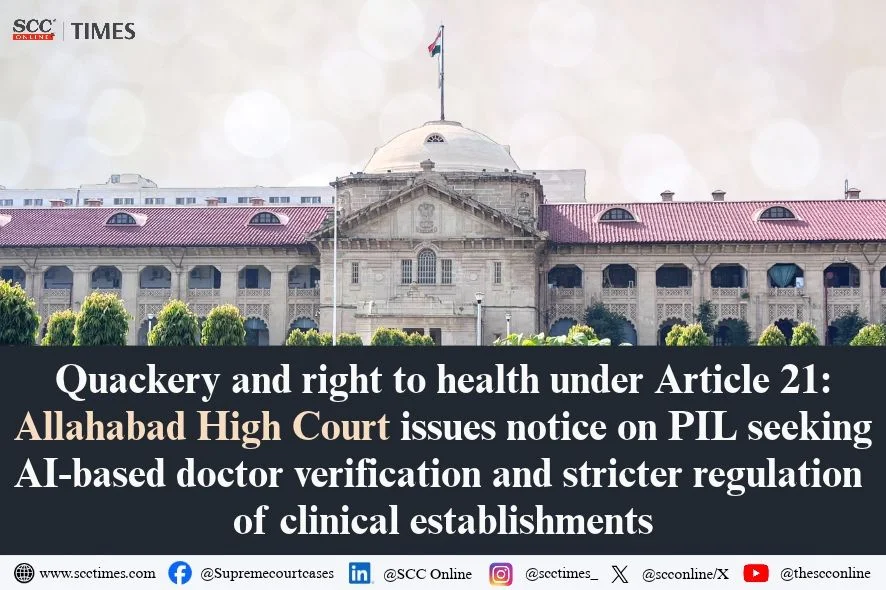
Allahabad High Court: While considering a Public Interest Litigation (PIL) on quackery and right to life and health under Article 21 of the Constitution, seeking recognition of the right to protection from quacks and unqualified medical practitioners, and prohibition on the operation of unlicensed clinical establishments, as an integral component of the Right to Life and Health under Article 21 of the Constitution, the Division Bench of Rajan Roy and Manjive Shukla, JJ., issued notice to the respondents and directed that the matter be connected with a pending PIL raising overlapping issues.
The PIL, filed by Tulsa Devi Sewa Sansthan against the Union of India, State of Uttar Pradesh and other authorities, also seeks a systematic and effective roadmap to eliminate quackery, unauthorised medical practice and cross-disciplinary practice by practitioners lacking requisite qualifications.
The Court directed that the petition be connected with We the People v. State of U.P., PIL No. 8294 of 2016, and other connected matters, observing that some of the issues raised in the present petition were also canvassed therein. The opposite parties were permitted to file their responses.
Recognition of protection against quackery under Article
The petition seeks recognition of protection against quacks, unqualified medical practitioners and unlicensed clinical establishments as part of the Right to Health, protected as an aspect of the Right to Life under Article 21 of the Constitution.
It also seeks effective implementation of the Clinical Establishments (Registration and Regulation) Act, 2010, including proper constitution and functioning of the State Council of Clinical Establishments, Uttar Pradesh, under Section
Integration of medical registers and AI-based verification of doctors
The petition highlights the need to update and integrate statutory registers of doctors and clinical establishments maintained under the Clinical Establishments Act, 2010, the National Medical Commission Act, 2019 and the National Commission for Indian System of Medicine Act, 2020.
It seeks to make these registers publicly accessible and digitally available so that individuals can verify the credentials of doctors, clinics, and hospitals. It also proposes the adoption of technology and Artificial Intelligence (AI) to verify the genuineness of medical practitioners, citing the QR-code-based verification system implemented in Telangana, which enables prospective patients to verify a doctor’s authenticity through their mobile phones.
The petition further seeks directions that registrations and permissions be granted only to practitioners and establishments whose names appear in the statutory registers, and only for the system of medicine in which the practitioners are qualified.
Uniform guidelines to prevent unauthorised medical practice
The petition also seeks effective handling of complaints relating to quackery and unqualified medical practice through the IGRS/Jansunwai grievance portal in accordance with prescribed norms.
It further seeks uniform guidelines throughout Uttar Pradesh to ensure that government doctors do not indulge in private practice, rather than leaving the issue to sporadic disciplinary action.
Additionally, it proposes that the constitution of an expert committee to recommend a ceiling on the number of establishments with which a doctor may be associated simultaneously.
Inter-departmental task force to eliminate quackery
The petition also seeks the constitution of an inter-departmental task force for implementation of penal and regulatory provisions aimed at outlawing quackery.
The Court issued notice to Respondent No. 8, directed the opposite parties to file their responses and connected the petition with PIL No. 8294 of 2016 and other connected matters.
The matter is next listed on 10 December 2026.
[Tulsa Devi Sewa Sansthan v. UOI, (PIL) No. – 1058 of 2026, decided on 29-10-2026]
Advocates who appeared in this case:
For the petitioner: Ishan Khanna, Aakash Prasad, Himanshu Singh
For the respondent: A.S.G.I., C.S.C., Kumar Ayush